

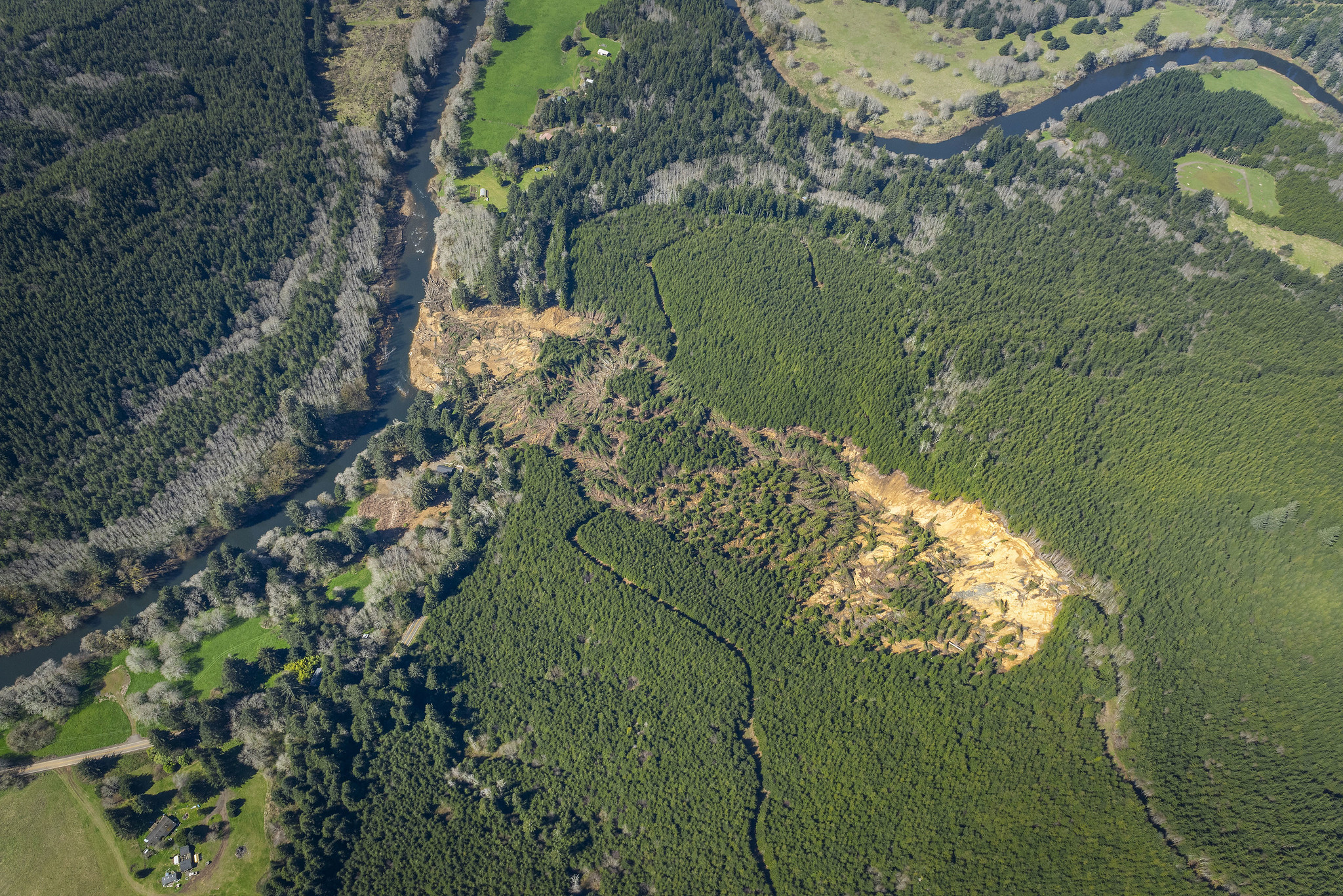
 An Oregon Department of Transportation aerial photo shows the massive landslide on Highway 229 between mileposts 14 and 15 on April 3, nearly four months after it demolished a one mile section of the highway. (ODOT photo)
By DANA TIMS/Lincoln Chronicle
A technical report is expected soon that will present key findings on when, and even if, a section of Oregon 229 between Siletz and Kernville buried by a massive landslide last December might be reopened.
The slide, which occurred between mileposts 14 and 15, remains active and is still considered extremely dangerous, Mindy McCartt, an Oregon Transportation Department spokeswoman, told the Lincoln Chronicle.
But, behind the scenes, engineers and consultants are busily working on everything from a temporary road for local residents cut off by the slide to long-term plans to completely rebuild the highway.
“At this point, we really need for the ground to dry out so we can safely get into that area to assess what we’re actually looking at,” McCartt said. “But, above all, we are really committed to get something done for this small community to use.”
First up is a report due in early June by Cornforth Consultants, a geologic engineering company based in Portland. The report will identify the mechanics still driving the landslide, pinpoint locations for the deep sub-surface monitors needed to better understand the slide and outline potential risks to any future roads in the area.
In addition to addressing on-the-ground realities of the slide, McCartt said the plan is also part of a larger effort to obtain repair money made available by Gov. Tina Kotek’s emergency declaration in December and approved in February by the Federal Highway Administration.
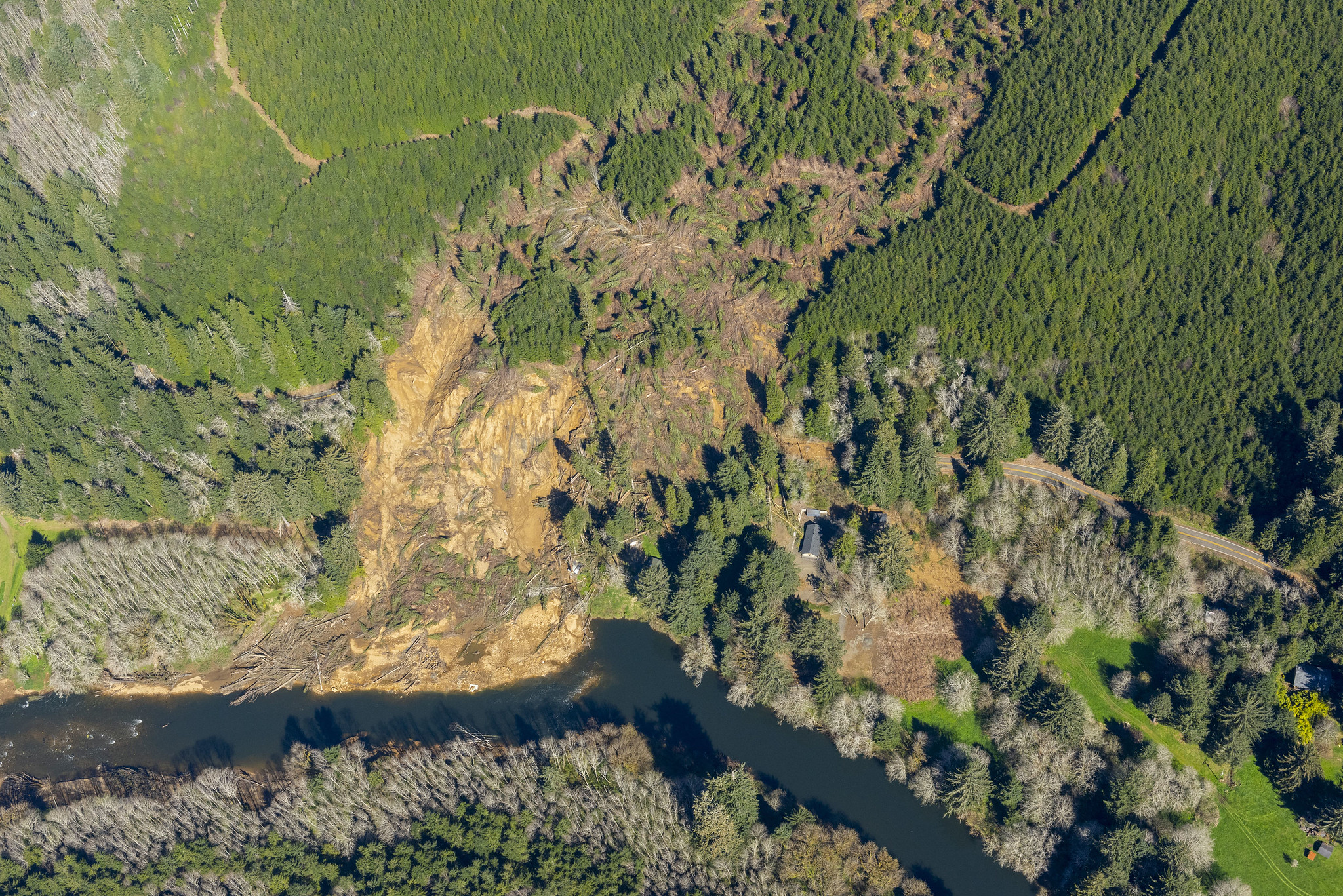 The Oregon Department of Transportation is working on an idea to create a temporary, two-lane gravel road for local traffic only below the original Highway 229 washed out by a slide in December. (ODOT photo)
Temporary road
Part of that larger effort involves planning by state highway engineers to explore what it will take to build a temporary road near the existing highway. Current thinking calls for a gravel, two-lane road wide enough for cars, school buses and garbage trucks.
“Commercial trucking is not envisioned for the road,” McCartt said. “We are talking about a temporary local road only for commuting.”
As many as 400 vehicles a day used the highway prior to the Dec. 12 landslide, according to state traffic data. Now, drivers who used to need only about 20 minutes to travel from U.S. Highway 101 through Kernville south to Siletz must take a detour that more than triples that time.
 The Oregon Department of Transportation hopes a geotechnical study due in June will help it determine when, how or if to repair Highway 229 between Siletz and Kernville. (ODOT photo)
Any longer-term repair would be dependent on knowing both that the slopes above the slide area are stable enough to accommodate a rebuilt highway, and that money can be found to move forward with the job.
The myriad details of those two tasks are just beginning to become clearer, McCartt said, but one new action can’t be taken until previous ones have been addressed.
“It’s one step at a time,” she said. “You don’t go to the bank until you have the building plans in place for your house. Same thing here.”
The massive slide was likely triggered by back-to-back atmospheric rivers of rain. The result sent untold tons of rocks, trees and mud from Weyerhaeuser property across the highway and into the Siletz River. In the process, three homes and their contents were also knocked into the river and some debris from those floated down the Siletz and landed on the beach at the river’s mouth.
Engineers are now hoping that rain continues to hold off so that they can do more exacting work around the slide area. Once things have stabilized one of the first tasks will be to drill holes for the sub-surface monitors.
“But even that is highly problematic,” McCartt said. “They need big enough cranes to do the work, but those cranes require platforms to stabilize them and some type of road just to get up and into the area. And all of that just takes time.”
- Dana Tims is an Oregon freelance writer who contributes regularly to Lincoln Chronicle and can be reached at [email protected]





















Thanks for the update, hadn’t heard anything about this and I live at the 12 mile.