

 Erica Thompson runs Blueberry Meadows in Corvallis and relies on a farm stand to help diversify her income. “In order for farmers to keep farming, in order for farmland to remain farmland, the model has to be sustainable,” Thompson told Reinventing Rural.
By ALEJANDRO FIGUEROA/Oregon Public Broadcasting
Oregon is pumping the brakes on changes to farm stand rules, after owners of small farms across Oregon stormed to social media.
At issue is a set of proposed rule changes Oregon’s Department of Land Conservation and Development published in early July. The goal was to clarify what’s allowed with so-called farm stands — usually the farms families go to buy local, fresh produce, pick berries or run through a corn maze.
“If [the rules are] adopted later this year it will make it virtually impossible for agritourism to survive,” said Jim Abels, who along with his wife, Kat Topaz, run Topaz Farm on Sauvie Island just north of Portland. “Who benefits if small to medium sized farms go under? Who benefits if you can’t go to u-pick or pumpkin patches or enjoy those fall harvest activities.”
Land and farm conservation groups, however, say those changes are meant to preserve farmland, and that there needs to be a balance so that farms don’t lose their primary function, to grow crops and raise livestock.
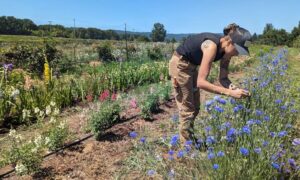 Thousands of visitors head out to Topaz Farms on Sauvie Island north of Portland each summer for their u-pick flowers and other agri-tourism activities.
Land use is often a contentious and complicated issue among Oregonians, with competing visions of how land should be preserved or used. The latest effort to update how farm land can be used, possibly requiring other permits for events and tourism, has become especially contentious.
The rules were in the drafting phase. On Friday, the state agency released a statement saying it will pause the rulemaking process at the governor’s direction.
“I want to reassure farmers who have been anxious and frustrated about how proposed changes to existing rules regarding farm stand operations may affect their businesses that I hear from you and am paying attention,” Gov. Tina Kotek said in a statement.
A spokesperson at the governors told OPB they had received over 2,300 emails and calls from farmers and people concerned about the changes.
While the proposed changes were meant to clarify what some county planners and farmers say are unclear or vague definitions in the current rules, some farm owners took to social media on Monday to voice their frustration. They say the proposed rules do the opposite of helping and would further complicate a system farmers say is already hard enough to navigate.
“Much of the alarm being raised isn’t rooted in fact. Both the current and proposed rules allow farm stands, u-pick set-ups, pumpkin patches, and farm-to-table dinners,” 1000 Friends of Oregon board member Nellie McAdam, said in a statement. “The proposed farm stand rules would actually make it easier for farmers to establish farm stands and U-pick operations for all of us to enjoy and support.”
1000 Friends is an Oregon land use policy watchdog. That group argues the proposed changes would streamline permitting by clarifying when a farm owner needs a farm stand permit, when they don’t or when they need some other commercial agritourism permit altogether.
“The issue we’re dealing with has to do with agritourism things happening at farm stands that should actually be going through the agritourism process,” said Jim Johnson the working lands policy director at 1000 Friends. He is also a retired land use and planning coordinator at the Oregon Department of Agriculture.
Johnson said that’s because farm stands, which can range from a simple wooden stand on the side of a road to a brick and mortar store front on a farm, are not subject to what’s called a good neighbor test, which would require a farm owner to demonstrate their visitors won’t disrupt surrounding working farms with added traffic, trespassing or noise from musical events.
“Agritourism is great as far as it goes, and as long as it’s complementary to agriculture,” Johnson said. “Bottom line, the more that you bring non-farm development out onto farmland, the more that the speculative value of that land changes and it makes it more difficult for people to farm long term.”
But some farm owners that engage in agritourism activity disagree with that view.
They argue traditional farming models alone don’t work as well as they used to, and allowing more uses of farm land would help them diversify their income.
Those farm owners say the rules DCLD put out were too narrow and overly complicated, such as proposed limits on musical events, cow trains or pony rides, which would require operators to directly feature a “farm product” or have an educational component with that activity, said Samantha Bayer, the general counsel at the Oregon Property Owners Association.
The disagreements
The Oregon Property Owners Association is affiliated with a campaign lobbying for more relaxed farm stand regulations.
“A cow train has nothing to do with the products, the corn, the tomatoes, the lettuce that’s being sold in the farm stand, like how do you market that on social media?” Bayer said. “And if you wanna do a cow train under this rule, now you have to go get a whole separate permit.”
Bayer said that would force farm owners to have to seek another more burdensome commercial use permit, which would require the good neighbor test, meeting with county planners, hiring an attorney, and there’s a chance their permit request might be denied.
“I feel like DLCD to kind of shield themselves from the kind of public outcry that’s happening is missing the forest through the trees,” Bayer said. “Yeah, maybe you didn’t outright prohibit it, but you basically did.”
There are several other proposed changes that the Oregon Property Owners Association and farmers disagree with, including a current 25% limit on annual sales of non-agricultural goods — like t-shirts or mugs — on farm stands, and other fees farmers charge for activities like hay rides or farm-to-table dinners. Farmers wanted DLCD to increase the cap. That change is not up to the state agency, though, it has to go through the Oregon Legislature.
Bayer said she and other farmers will be calling on Land Conservation department to go back to the drawing board.
“Yes, this rule is not going to affect every single farmer in Oregon, but it’s going to affect a subset of farmers that have the most interface with the public and serve such a valuable role,” she said.
A 2024 Oregon State University report estimates as many as 4,000 farms in the Willamette Valley alone might be engaged in some agri-tourism activity.
With rule changes paused, the state agency and the governor’s office say they will reassess next steps.
“We can support local farm businesses while also preserving Oregon’s historic land use system. This is not an either/or conversation,” Kotek said. “We need to acknowledge that some of our small and midsize farms need to maintain or consider different business models to continue to deliver the agricultural products and working farms we all value in Oregon.”
- This story originally appeared July 25, 2025 on Oregon Public Broadcasting.













Maybe I’m feeling my age today but these questions come up in my mind whenever new regulations are proposed: Who is requesting these regulations, members of the public, special interest groups, or the agencies themselves? Will the new regulations improve health and safety or some other public value or need? What will happen to the public if the new regulations are not adopted? I realize, living in my little corner of the universe, that I know very little about the reasons for many things. But given our current government’s proclivity for putting acquisition of money and power over supporting people’s basic needs, it behooves us to think carefully before taking any legal action that does not provide a benefit or value to the people.
I’d like to be able to shop at more good-neighbor farm stands. Thank you, Governor Kotek, for doing the right thing.