

 This colorful group of cottages in a commercial zone on West Second Street was originally a “motor court” built in the 1940s. Today the five units, which sit on a 100 by 100 foot lot, operate as long-term rentals. They were grandfathered into the city’s current housing code as a non-conforming housing type. It is an example of so-called “cottage clusters” the city believes fits into the community. (Garret Jaros/Lincoln Chronicle)
By GARRET JAROS/Lincoln Chronicle
YACHATS – After years of analysis and work by consultants, Yachats’ planning commission and city council are working to finish proposals to amend rules that could allow for more types of housing across the city.
The effort stems from the city’s goal to create more affordable housing options for working class people in a city of 1,000 predominately populated by well-to-do retirees. Yachats is also a popular tourist destination with 125 houses operating as vacation rentals and an estimated 60 percent of all houses set aside as second homes.
City officials say amending the outdated housing code could allow accessory dwelling units, duplexes, townhomes, cottage clusters and multiple-unit housing in residential areas currently dominated by single-family homes.
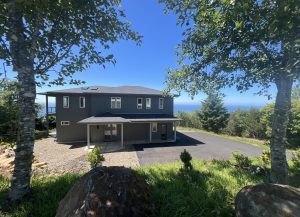 Three-fourths of all housing built in Yachats in the last 25 years have been detached, single-family homes, including this new home on Horizon Hill Road. (Quinton Smith/Lincoln Chronicle)
The proposals, the city argues, could open an avenue for local workers and their families to weave into the fabric of the community. It is also hoped some proposed but “optional” code amendments will allow for older homeowners to better age in place by allowing in-house or accessory dwellings.
Yachats’ 100-page housing code, which was adopted in 1992, must be updated to align with Oregon law — a mandate specific to cities with an urban growth boundary. State law requires every incorporated city to maintain a 20-year supply of buildable land to accommodate projected housing and employment.
But what has raised the ire of some community members are the city’s suggested optional amendments. Critics contend those will negatively change the face of the community and lead to unintended consequences that will not create more affordable housing.
The draft to amend the code is now under review by the planning commission, which is going through it line-by-line with another work session scheduled July 21. Public hearings by the city council will not likely occur until the fall.
While some critics claim they are just now hearing about the proposed housing code amendments, there have been public meetings in various forms over the past year to inform and get feedback following two years of housing studies by the consultant. The city also conducted an online survey, which had an arguably low number of responses.
There has also been public testimony at planning commission and city council meetings over the past several months. But because of continued questions about the proposals, the city is hosting a public “listening session” from 4:30-7 p.m. Tuesday, July 14 in the multipurpose room of the Commons.
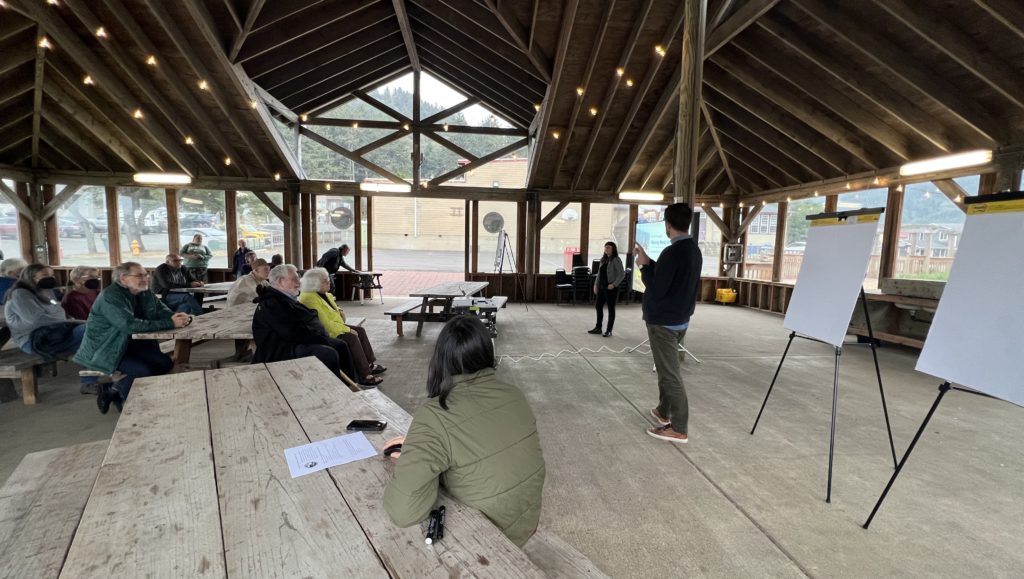 Jamin Kimmell and Rachel Cotton of Cascadia Partners began consulting work for the city of Yachats in 2022 with a series of housing presentations and after four years are wrapping up their work advising the city. (Quinton Smith/Lincoln Chronicle)
A little history
The initiative to update zoning codes has been in development for several years “representing an incredible amount of heavy lifting and community vision,” city manager Bobbi Price told the planning commission in May.
The city hired Portland-based Cascadia Partners, an urban planning and land-use firm to develop a housing needs analysis in 2022. The analysis noted a lack of land for townhomes, duplexes and multi-unit housing and emphasized the need for more housing types and affordability.
From the analysis came the realization that for years basically nothing but single-family homes had been built and that residential areas zoned for higher density had been filled with single-family homes, according to city planner Katherine Guenther.
The analysis led to a housing implementation plan in 2023 that identified strategies to meet housing needs and recommended specific code changes to meet those needs. That then dovetailed into 2025 and 2026 with the current effort to update codes.
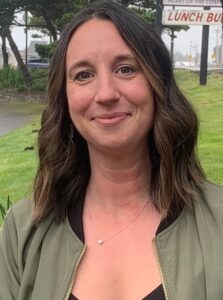 Price
“ … it’s important to remind everyone this project is not a sudden or singular pursuit to build affordable, middle-housing or attainable housing overnight,” Price told the planning commission in May. “Rather, it is the essential municipal function to update outdated, and in some cases, non-compliant local municipal codes.”
According to the housing needs analysis, Yachats has sufficient raw, buildable land within its urban growth boundary to accommodate projected population growth over the next 20 years. The city’s total estimated building capacity is 326 housing units, which exceeds the baseline projected need of 271 units.
But while there is a surplus of land for single-family homes, there is a mismatch between capacity and actual need for alternative housing types, according to the analysis. If historic development patterns continue – 75 percent of all housing built in Yachats since 2000 have been detached, single-family homes – the city faces a projected deficit over the next 20 years of 23 townhomes or duplexes and four multi-unit (five or more) and a surplus of 61 single-family homes.
Yachats currently has what are called “non-conforming” housing types — accessory dwelling units, cottage clusters and duplexes — that were grandfathered in prior to the city adopting its comprehensive land-use plan in 2019.
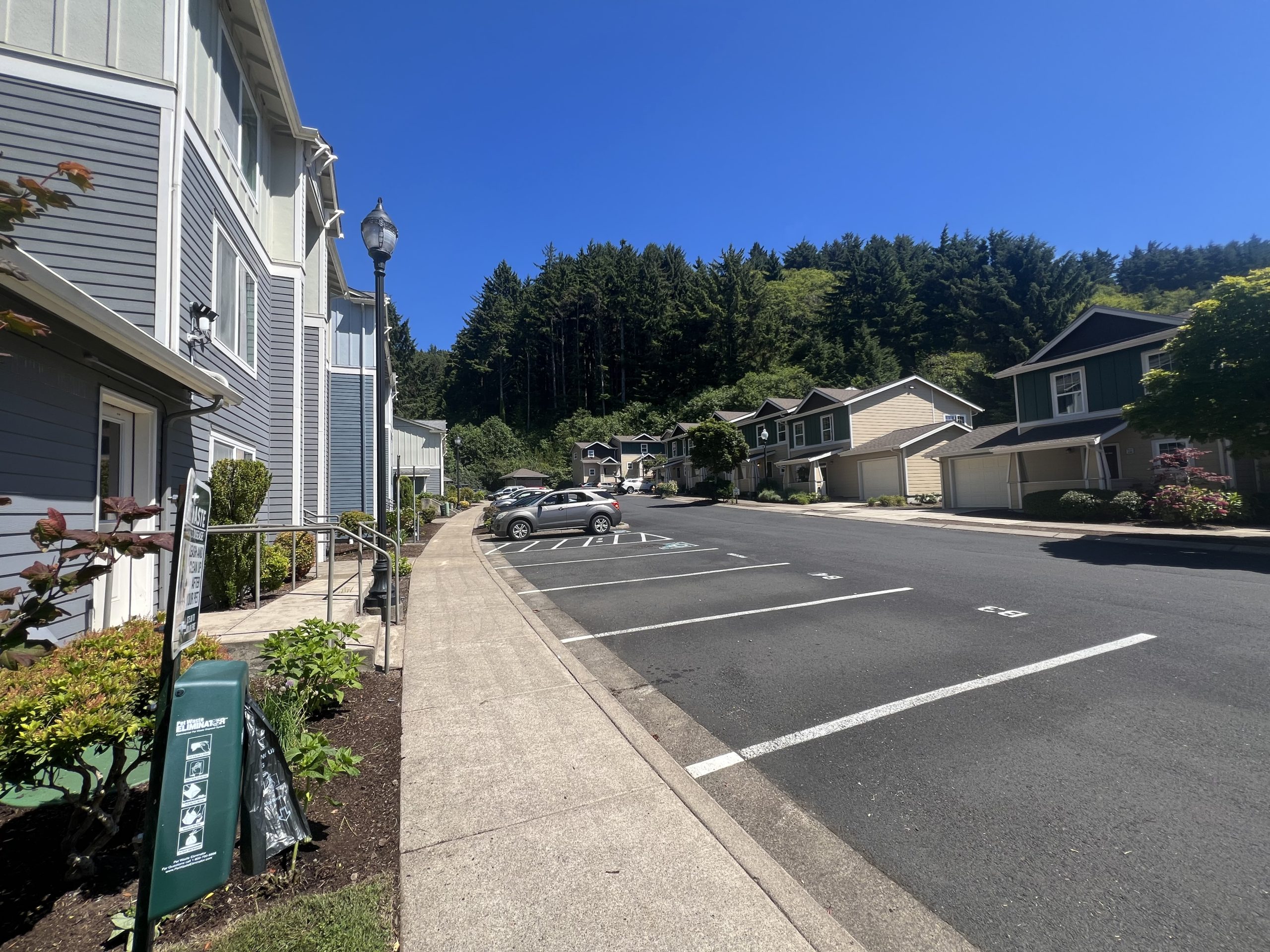 The 25-unit Fisterra Garden Apartments and the 21-unit Fisterra Garden Townhomes were built using state and local subsidies and loans, are restricted to renters who meet low-income requirements but do not have to come from the Yachats area. Both have waiting lists for vacancies. (Quinton Smith/Lincoln Chronicle)
Required vs. optional
There has been some confusion expressed by planning commission members around which of the proposed code amendments are required by the state and which are optional.
The state’s required changes include:
- Allowing single-room occupancy housing in all locations where housing is allowed, at densities and with parking standards dictated by state requirements. The state has also removed occupancy limits that may discriminate based on family relationships. “We can no longer say who lives under that one roof,” Guenther said. “You could have multiple unrelated people, each with a private room with a door that locks and either a shared kitchen or bathroom.”
- Allowances for siting affordable housing. “Basically, what that is saying is that the city cannot require a zone change or conditional use permit if certain criteria are met for proposed affordable housing projects … ,” Guenther said. “The one that may impact us here … (are) places of assembly for religious institutions. So, if the Baptist or the Presbyterian church wanted to use some property for an affordable housing project. They would get certain considerations a developer might not get.”
- Density and height bonuses for affordable housing on land zoned for residential uses. “But again, we don’t have any of this stuff, we don’t offer bonuses,” Guenther said.
- Administrative approval of subdivisions, partitions and non-conforming uses;
- Removing design and development standards for manufactured homes that do not apply to detached single-unit dwellings;
- Allowing siting of prefabricated structures such as tiny homes that do not meet definition of manufactured home parks, and not applying a minimum lot size greater than one acre to manufactured home parks; and
- Allowing RVs to be used as a residential dwelling in RV parks and manufactured home parks, if connected to water, electrical and sewage systems.
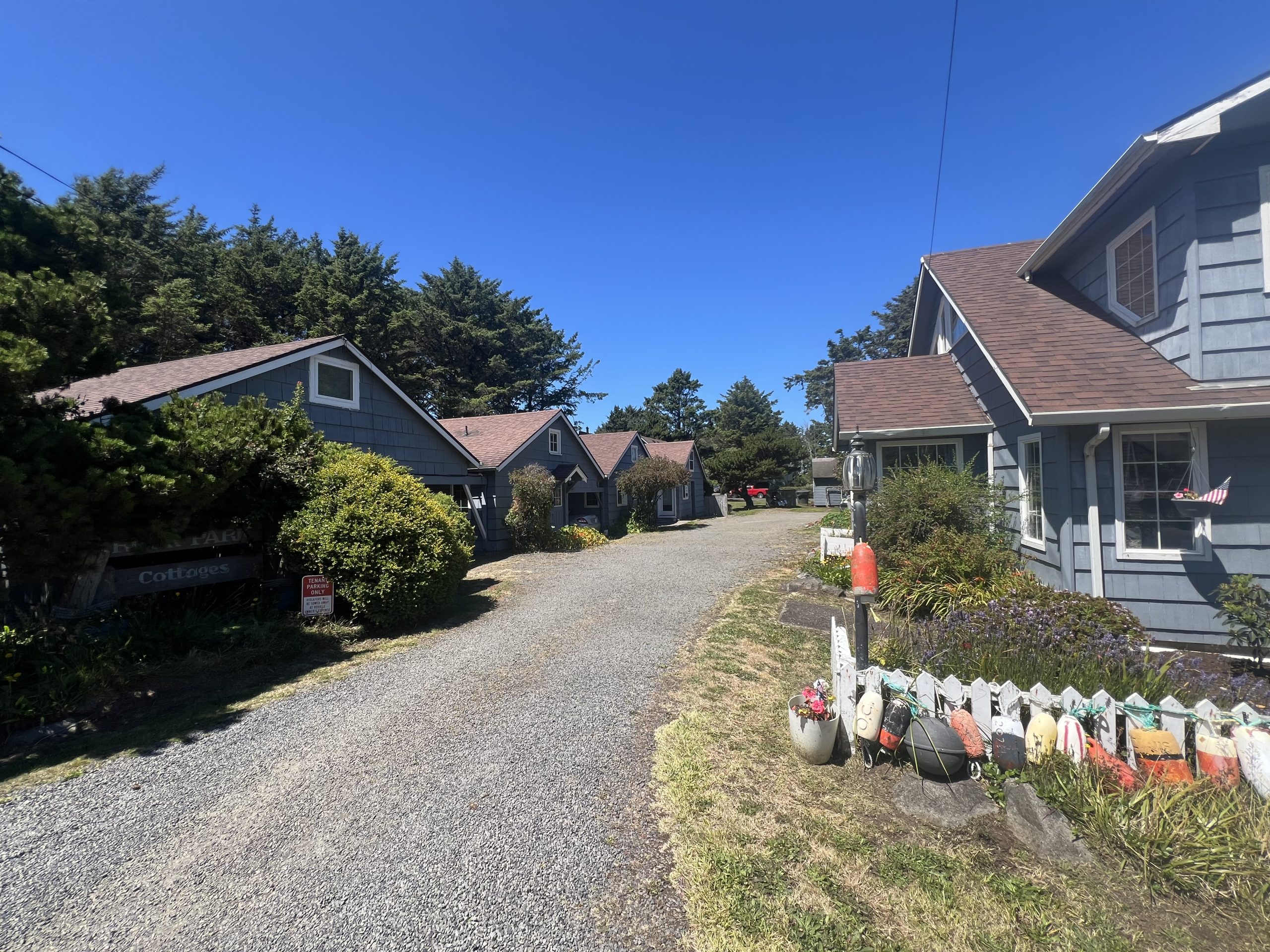 Rock Park Cottages on West Second Street in downtown Yachats was originally a motel built in the 1940s. It no longer meets the standards for that use and now all but one, which is available for nightly rental, serve as long-term rentals. (Quinton Smith/Lincoln Chronicle)
The optional proposed changes, which community feedback can help to shape before the final amendments, include:
- Allowing accessory dwelling units in all locations that allow a detached unit dwelling;
- Allowing a wider range of middle housing types — plexes, townhomes and cottage clusters — in residential zones;
- Allowing two-unit dwellings in the R-1 zone and three-unit dwellings in the R-2 zone;
- Allowing non-residential and residential uses on the same lot in retail, commercial zones;
- Modified development standards (including lot area and coverage) for ADUs, middle housing and multi-unit housing; and
- Modified parking standards for duplexes and ADUs.
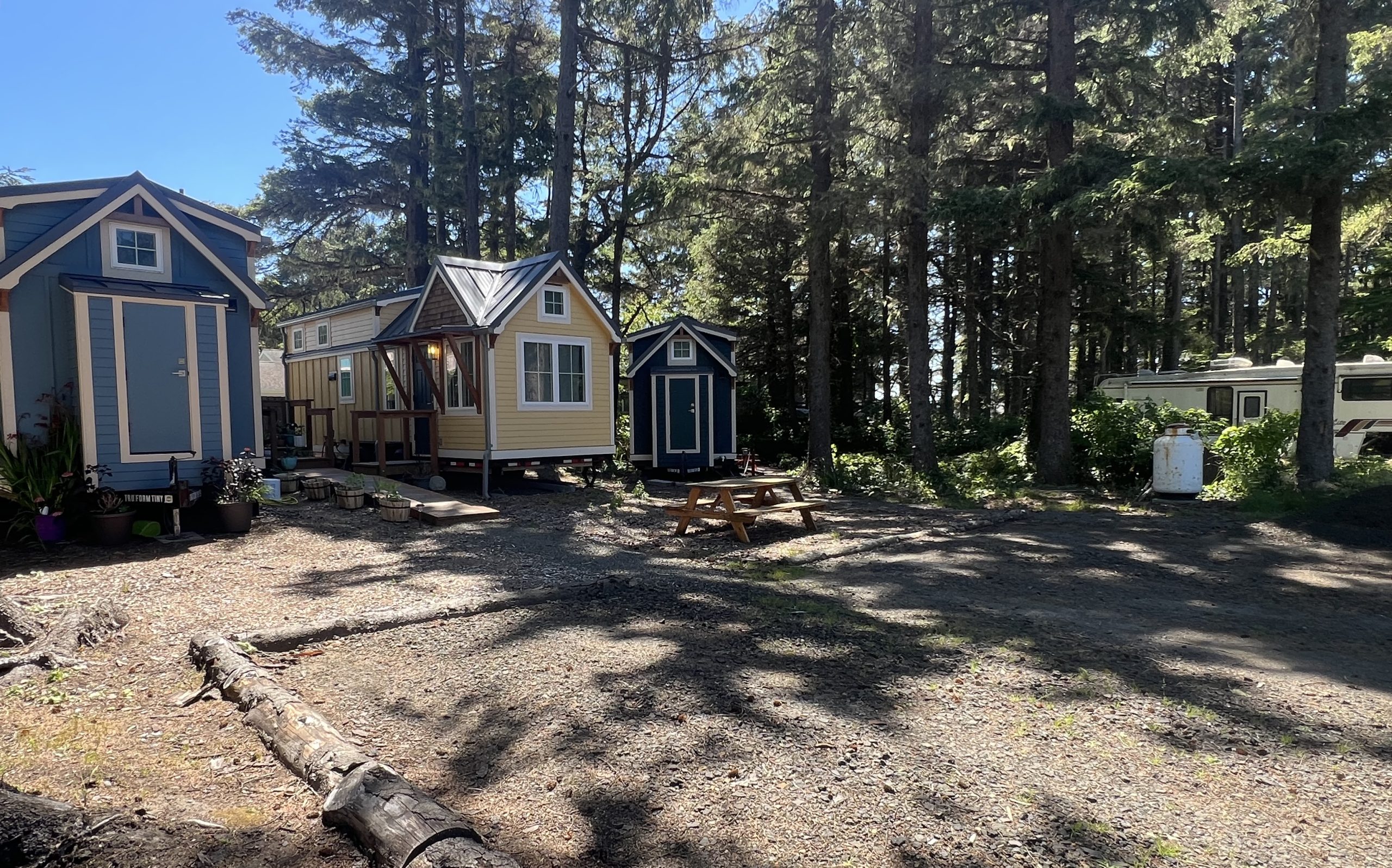 The owners of the Fireside Motel and Overleaf Lodge in Yachats spent $500,000 and received a conditional use permit from the city in 2023 to buy and set up tiny homes and create a small RV park for employees. (Quinton Smith/Lincoln Chronicle)
Community feedback
The proposed changes have received pushback and opposition from two of seven planning commission members and some residents countered by support from others. While most of the commentary has played out on local Facebook pages, 14 people testified during the public comment period at the planning commission’s June 16 meeting.
“We’ve heard that there’s worry and concern that the draft that’s before us is a done deal, and I want to ensure you all know that it is not,” Price said at the meeting. “Last week, the planning commission held two intensive work sessions, where they did go line-by-line on the review of the draft, raising concerns and proposing changes.
“The job of our planning commissioners is to take the template that was provided to us by the consultants, and make sure that it fits Yachats, fine tune it to fit Yachats, (and) hear your voices to make sure that it fits Yachats.”
People who spoke in support of the proposed optional changes mentioned ways the code could be tweaked to include a future prohibition of single-family dwellings in the commercial district, adding language to enforce density standards at the time of development, and increasing the suggested number of off-street parking spaces for duplexes.
Another proponent said “gentle density” already exists in Yachats and pointed out that ADUs, duplexes, and bed and breakfasts on King Street coexist with the neighborhood without changing its character. They also said allowing an additional unit per property will help residents accommodate family members, downsize, or share housing costs through rentals.
Expanding housing options is vital to creating a stable workforce and customer base that protects the local economy from a sole reliance on seasonal tourism, one person said, while also noting the four-year process to study housing issues and develop codes has offered ample opportunities for input that some critics say did not happen.
Bob Barrett, pastor of the Yachats Community Presbyterian Church, said he recognizes the community’s fear of change and peoples’ desire to preserve the city’s character. But, he said, the community has to balance that against the severe housing crisis facing local workers.
People who spoke in opposition to the optional amendments emphasized that state law does not mandate housing capacity analyses or dense zoning changes for towns with fewer than 2,500 residents. They also argued the city is pursuing unnecessary measures that threaten the small, rural, and quiet coastal character of the community.
They raised concerns regarding the city’s infrastructure and environmental constraints, noting that Yachats faces regular summer water shortages and an aging pipeline system. Residents living in the areas already zoned for duplexes said the introduction of multi-story buildings, ADUs and cottage clusters would drastically impact property values, eliminate green spaces, and worsen traffic.
Several speakers criticized the city’s lack of public engagement, stating that most residents were left unaware of the proposed changes. They also expressed skepticism the proposal would generate actual workforce or affordable housing, predicting instead that developers would build high-market-rate units and second homes for wealthy retirees and that ADUs would could quickly turn into unmanaged private vacation rentals.
Don Phipps, who has led the charge against the optional changes with at least 46 lengthy posts on Facebook since April, challenged the city’s justification for the up-zoning, testifying that the data used to claim “broad support” was statistically unreliable due to flawed, unrepresentative sample sizes. He further noted that resident surveys failed to mention affordable housing or specific zoning modifications. Phipps said he has formed a group to oppose the proposals and is calling for a voter referendum to decide the issue.
In a Facebook post Tuesday, Phipps suggested local businesses could pay for a shuttle to transport workers who cannot afford to live in Yachats to and from town. He also floated the idea of building worker dormitories on land zoned for motels.
“To live in the dorm, workers would have to be working for the for-profit businesses that would contribute to the construction and maintenance of the dormitory,” Phipps wrote. “Dorm rooms would have shared bathroom facilities and there would also be a shared kitchen. But the rooms would be private. There could also be a dormitory facility for families.”
That drew a response from a self-described business owner and longtime local worker Emily Jayne who has struggled to find affordable housing and who suggested opening up seldom-used second homes for long-term renters.
“Oh, so I don’t deserve my own home!?” she wrote. “I get a dormitory!? That is so unhinged! I get to be bused in like some animal to serve the rich. No thanks! We are skilled labor! Don’t treat us like we deserve sub-par homes so that the rich can go out to dinner!”
- Garret Jaros covers the communities of Yachats, Waldport, south Lincoln County and natural resources issues for Lincoln Chronicle and can be reached at [email protected]



















The following message is my opinion as a resident and does not represent the Yachats Planning Commission.
In an effort to enhance clarity while reducing confusion, the Planning Commission should separate the state legislated code changes from the optional code changes that are currently blended into a single complex draft code change proposal of over 100 pages. The Planning Commission could create a resolution of approval of those code changes that are required by state law for all cities and forward those changes to the Oregon Department of Land Conservation and Development for their review.
The remaining and voluminous optional code changes, and controversial code changes, that are not required for cities with a population of less than 2,500 could be the subject of community engagement sessions and public hearings.
It saddens me to watch and listen to the dialogue percolating around this issue. I believe everyone on the various committees and groups are doing the best they can. We all are stretched and stressed beyond this small town. Politics, hateful global cruelty and pain combined with environmental crisis influences how we deal with our smaller world. I don’t have the answers, but I do know we can make a difference by being kind in our daily dealings, keeping our tone appreciative and listening to each other. Let’s hold the space to work this out for all concerned.
That’s an an amazing idea – force Yachats workers into off-site dormitories and bus them to work. That way wealthy Yachatians will never have to live next door to a working-class person. It works in Saudi Arabia, why not here?
The following message is my opinion as a resident and does not represent the Yachats Planning Commission.
Alex-I’m not sure if you are aware that SRO (single room occupancy) housing is one of the State of Oregon required housing types that must be allowed in all cities including Yachats. Allowing Boarding Houses, Dormitories, etc in Yachats is not up for debate. Apparently the State legislature feels that is an appropriate solution for state wide work force housing.
I’m sure SRO is a great option for some people. But it does not replace the need for actual housing. The two options should not be live in a dorm or buy a house when there is clearly the possibility of building some more affordable housing. The refusal is nothing not than the wealthy residents thinking they are superior to the people that serve them their coffee because they were able to buy a home before this insane market ballooned
Like this poster above and Emily Jane, I reacted to the use of the words “working class” and the idea that dormitories would be an equitable and decent solution. Many of us are small business owners, artists, musicians and other creatives who can’t afford to buy or build. (I’m a long-term renter.)
I don’t know why I’m shocked by this blatant classism. But it is disheartening and hopefully not espoused by most of the lovely people I’ve met here.
There are those of us who are not in favor of the proposed code changes because they, in fact, do nothing to ensure “affordable” housing, nothing to ensure “workforce” housing. Cascadia Partners and the City were putting those terms forth as what the code would do. They have stopped using those terms and are now using “middle housing”. I assume that change in language is in recognition of the fact that the code does not ensure affordable/workforce housing. The fact that our local news organization is perpetuating an inaccurate representation of the impact of the proposed code by using the terms “affordable” and “workforce” troubles me. Would you consider correcting the language used in this article?
Additionally, there are credible rationales to be considered around why the proposed code changes could have the exact opposite impact – instead of making housing less expensive, they could make it more expensive. I hope this possibility will be addressed by the decision makers.
To the entitled lower-wage employees who think they should be given a single-family home, how much do you think you should pay in monthly rent? Maybe you think someone should just give you a vehicle, too. I was in the minimum-wage workforce for many years and I would have welcomed the opportunity to pay lower rent and have my transportation paid so that I could save money faster and pay for education or training to get a better-paying job to be able to afford a single-family home. Not every person who lives in a single-family home is rich. Most of us have to work our asses off and live frugally~ or have room-mates or get married (2 incomes) or receive an inheritance~ to achieve that privilege.
Who is asking for that? I understand perhaps it is easier to paint the people saying this as entitled people living a fairytale but all people want is to be able to contribute to a workforce and live in the area without having to have enough money to buy a home in this ridiculous market. There is ONE single rental available at the moment which runs $1500 for a 780 sqft apartment in very poor condition. There are people constantly turning down jobs all along the coast because of how insanely difficult it is to secure housing because half of the properties are short term rentals bought up by investment companies and private investors and vacation homes for rich people.
Apparently, the 21st Century Road to Housing Act is going to pass today, so that should offer some guidance and help via grants, etc. “Supply and Zoning Grants: Authorizes new competitive grant programs (e.g., $200 million annually) to incentivize local governments to streamline permitting and change density zoning.” [AI]
https://nlihc.org/sites/default/files/21ST_Century_ROAD_Explainer.pdf
A quick glance at Cascadia Partners will highlight their thinking. “Equity” and “equitable” are apparently two of their favorite words.The sentence “We know there is an imbalance of power and decision making in planning and decision making that is the result of exclusionary and racist power structures” begins the section on “Equity”. They talk about “marginalized communities” and climate change. They are big believers in high density housing and mass transit (they have a picture of happy people sitting in a bus).
Now, take a look at the condominium project at ninth street and highway 101 (I’ll leave the description of that edifice up to one of the buildings developers who in a meeting with city council described it as. being “ugly”). That is what Cascadia and our current city leaders have in mind for our city’s future. The city green lit that project even though it violates our present zoning laws by having attached ADUs. One might assume the city okayed this project knowing that they are going to change the zoning codes.
There is no confusion in what they want to do. There is clarity in what they intend. It’s standing at 9th and 101.
I wish to expand on Lauren’s comment about the fact that the proposed code changes do not guarantee that new housing options will be workforce house and/or affordable. It’s true that the code cannot guarantee that a worker will inhabited one of these new spaces, or that she will be paying an affordable price. But those things can be guaranteed by the landlord, or the developer. These folks are the parties ultimately responsible for setting up the conditions and rental prices of their spaces. The City’s role is to provide options that make it more likely a worker or other person can find a place they can afford to live in our community. It’s not the City’s role to guarantee that.
It’s also important to remember that our workforce is not the only type of resident that needs housing here. Aging into a smaller space is a real thing in our village. Needing space for a family member is also common.
Lastly, the argument that our village will be ruined by allowing these housing types falls flat when you reflect on the fact that we already live among many of these housing types in Yachats, as was pointed out in detail in Garret’s thorough article.
To be clear, I want to the revised code created with the utmost care. Reasonable gain, with reasonable restraint is my guiding mantra as I analyze the proposal. Bring your ideas and constructive critique to the July 14 community meeting.
The vitriol that has been introduced into the conversation is a symptom of fear. Let’s toss the high-temperature claims on both sides of the argument (e.g., “these proposals will destroy Yachats and turn it into a commie haven!” and on the other side: “these proposals will address racial divides and finally make life equitable for everyone who lives and works in Yachats”) and instead, let’s be honest partners and start the conversation from the middle.
It might make sense, as Mr. Diamond suggests, to more clearly separate required proposed changes from non-required proposed changes. After reading this article, (excellently written by its author), I must admit that it’s still a little unclear to me what Yachats is actually required to do.
Forming the proposed changes into more bite-sized pieces of “required” and “not required, but needing thoughtful consideration” will reduce confusion, even if there’s a danger of occluding some of the integrated goals that include both categories, (required and non-required). Would it not be possible to vote on proposed solutions to the required changes first and then move on to address non-required proposals second? Re-clarification of any tie-ins—and contextualization of how one domino might impact another— can take place during the second phase of the work, where non-required changes are solidified into a final proposal.
The Planning Commission and the city have been “yachatsifying” Cascadia Partners’ recommendations. Let this process continue by participating in the upcoming meeting on Tuesday. It’s an opportunity for clarification and further exploration. Separating required from non-required changes will lower the mountain a little.
For those who are so intent on getting their way that they resort to contentiousness and verbal bludgeoning, consider that there’s more than one way to harm the character of this city. The “how” is at least as important as the “what” and the “why.” A less contentious, lower temperature conversation will only increase the probability that Yachats will choose a course based on wisdom.
It seems to me an interview of the two Planning Commissioners in opposition to the proposed changes should be published as an article of it’s own, not just as a reply and with their actual knowledgeable background understood.
These are extreme changes to make in a town the size of Yachats.
If there are already problems with the infrastructure as it is, why the rush to make changes no matter how long the city has been working with this ‘plan’ or how much money has been spent, if it is in fact a flawed plan. If the city continues to apply for ‘Tourism Grants’, bringing more people into a town of this size, where is the quality of life many have moved here for gone? Yes, it is happening everywhere, but where in fact does it say we that live here must move forward with a plan that may in fact make it worse?
People do not make the meetings or give input because in fact this isn’t a major city, this is Yachats. There are facts and there is emotional responses to the quality of life and what will actually work for Yachats.
Is one more important than the other? There are those here attempting to survive, with children, jobs and busy lives. There are elderly folks here and second home owners living in other places that cannot in fact know what is being planned or decided upon or participate. There also those who in fact have lost faith in the way the city is going about things, have been treated poorly when they do object, and are in fact afraid of contacting them.
Why has the city allowed certain things to move forward as if this plan is already in place. Just drive down Overlook Dr, south of the bridge as an example of what is being allowed. Stretching the codes and / or allowing building as well as permits that are obviously being built as potential duplexes was unheard of not long ago.
Citizens of Yachats have a right to resist these changes.
Keep in mind, the Planning Commission and the City Council are all volunteers and should be treated with respect, by everyone including the City staff.
I long for the days when I could rent a 1 bedroom cottage in Yachats for $150 a month. That was easy to afford on my $5.25 minimum wage.
Where will the fresh water to serve these new units come from?
The city currently lacks a sufficient supply and needs to purchase water from other districts which are also expanding their own customer base.
In discussions I see on the need and demands for “affordable” housing, the vital components that are often left out are the realities of the job market, the burden of public and private debt and the reality of the Nation’ s frightening debt- $39 trillion and growing faster. Wages have not come close to matching the cost of living, for decades. The people who decide what gets built and who and what gets taxed, respond to immediate crises, without looking at the bigger picture. Of what use is more housing if the people who cook your food and fix your roof can’t afford it ? Decision making has to include an unfiltered understanding of the state of the economy. Take a look at how financial analyst, George Gammon, puts it all together. We’re on shaky ground folks.
https://youtu.be/42cunoNk_HA?si=uQLCtSS9Fkkv15HB
Some additional thoughts on Cascadia Partners and our city leaders who hired them to reshape our little village:
A perusal of the Cascadia Partners website will reveal that they believe that some humans must radically change the way they live to save the planet we live on. If you live in a single family home with some land and use your own private vehicle to get around they believe you are part of the problem. That describes most residents of Yachats. I am deeply troubled that our city leaders hired these people with our money to advise them on what they want to do to our city.
Some time ago I attended a meeting concerning this issue and was fortunate to sit at a table with Mayor Berdie and members of the planning commission who are all pushing these changes. I asked them a very simple question: “why?”. I received silence in response. Some time later Mayor began talking about a city employee who lives in Toledo. The Mayor had apparently realized that silence is a very poor response to the question of why they are doing what they are doing and had spent some time formulating an answer.
Why?
To bring up another area I am questioning.
In the city newsletter on page 4, No. 3 Mayor Berdie included the past sidewalk issue as a similar issue as to what we are dealing with now. Back then the current mayor in frustration after a lot of back and forth, resentment etc., had two choices, either figure it out or let the Oregon Dept. of Transportation handle it. Some were angry and very upset when the former mayor finally let ODOT figure it out and design the sidewalks. That was the back up plan. It wasn’t even a plan, it was a ‘do it’ or else situation.
No choice in the matter. Very few were happy and complain to this day. The current code changes have no back up plan. Smaller set backs narrow streets, smaller lots, view disruption and doing away with some in place zoning cannot be changed back. In my opinion this is risky business with potentially problematic outcomes.
Once again I am asking this publication to please find out who of the city planning commission and council members are not in favor of this current plan or the small adjustments they are thinking of making, be interviewed. We want to hear their opinion. We have a right to hear what they have to share, we are not hearing or reading enough in opposition from them.
They are more than likely exhausted by this process, and again volunteers. Let’s hear what they have to say.
I do not envy the council’s job of creating affordable housing. On one side, minimum wage jobs need to be filled, and those hard working people need a place to live. On the other hand, we do not want to repeat the mistakes of the 70’s when low income housing turned into problem developments. Let’s face it. The coast is a very expensive place to live. Many of us spent a lifetime working two and three jobs making preparations to someday be able to live on the coast. We started with low income jobs in areas we didn’t like living in, and used those jobs as a stepping stone, not as a lifetime occupation. For those who didn’t go through the pain of years of preparation, affordable housing should come with many stipulations as we need to protect our quality of life. This is probably the most difficult task for our council. The Portland area blew it, but Roseburg, Coos Bay, North Bend, Medford, and Grants Pass seem to have made good choices.
Adopting a comprehensive land-use plan and implementing it are two different things. It is a policy of the 2019 comprehensive land-use plan that Yachats develop a formal public involvement plan. A written plan describing how the public will be involved in all phases of land-use planning. It remains an adopted, but unimplemented policy. The public will get ad-hock listening sessions, consultants and facilitators, but they won’t get public policy.