
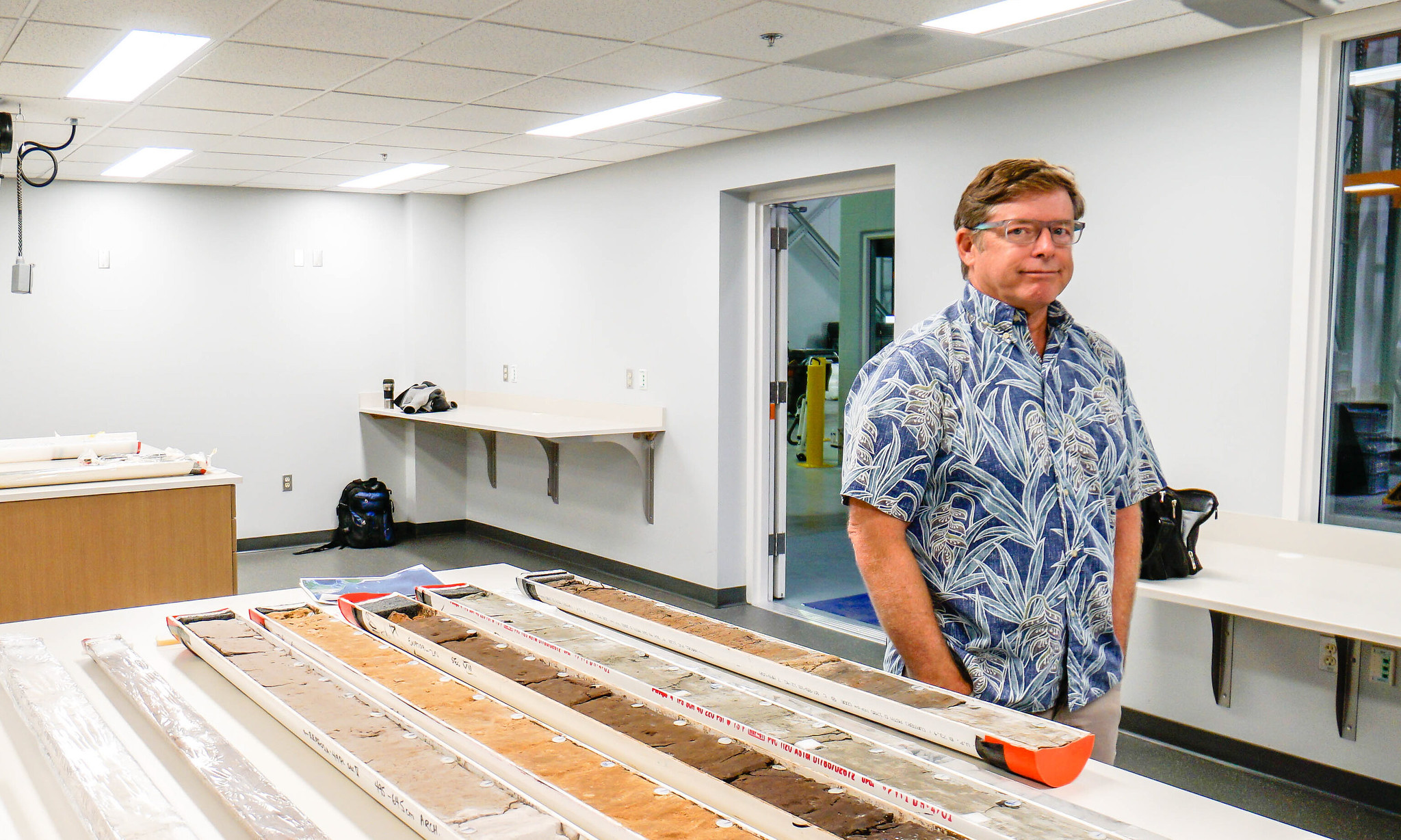
 OSU marine geologist Chris Goldfinger stands near a table of sediment cores drilled from deep in the ocean floor near the Cascade subduction zone and near the San Andreas fault in California.
By LIZZY ACKER/The Oregonian/OregonLive
A Cascadia subduction zone earthquake is coming for the Pacific Northwest, and when it hits, scientists now believe, it could cause the San Andreas fault in California to go off.
“It would be a very bad day on the West Coast of the U.S., that’s for sure,” said Chris Goldfinger, a professor at Oregon State University who studies marine geology, geophysics, paleoseismology and subduction earthquakes.
Goldfinger is one of the authors on a paper published in late September called “Unravelling the dance of earthquakes: Evidence of partial synchronization of the northern San Andreas fault and Cascadia megathrust.”
 Red lines show the general location of the Cascade subduction zone and the San Andreas fault.
The idea, Goldfinger said, is that “when a fault ruptures, it’s relieving stress locally, but it’s transferring stress to areas nearby,” Goldfinger said. “So when Cascadia ruptures, it transfers stress to northern California.”
Goldfinger and others have been working on this idea for about 30 years, he said, and they first published a paper in 2008 hypothesizing that a Cascadia event could trigger a quake on the San Andreas fault.
Back then, using radiocarbon dating, they knew that some ancient Cascadia and San Andreas earthquakes happened in similar time frames, but using that technique, they couldn’t prove exactly how close together the events took place.
So they tried something different — relative dating.
With relative dating, Goldfinger said, “you can try to determine if two things happen closely together in time, even if you don’t know the absolute timing very well.”
Looking at geologic deposits, paleoseismologists were able to determine that San Andreas quakes followed Cascadia quakes closely and in some cases, almost instantly.
“Now,” Goldfinger said, “we have the smoking gun, we think, to nail down the timing to be very close.”
Goldfinger and a team of researchers drilled deep-sea sediment cores representing 3,100 years of geologic history, and analyzed layers known as turbidites that are deposited by underwater landslides often triggered by earthquakes. They compared turbidite layers in cores from both fault systems and found similarities in timing and structure, suggesting the seismic synchronization between the faults.
In most cases, it’s difficult to determine the time separation between the Cascadia subduction zone and northern San Andreas fault ruptures, but Goldfinger said there are three instances in the past 1,500 years, including a most recent one from 1700, when the researchers believe the ruptures were just minutes to hours apart.
The findings have significant implications for hazard planning, he said.
“We could expect that an earthquake on one of the faults alone would draw down the resources of the whole country to respond to it,” Goldfinger said. “And if they both went off together, then you’ve got potentially San Francisco. Portland, Seattle and Vancouver all in an emergency situation in a compressed timeframe.”
 Looking at geologic deposits, paleoseismologists were able to determine that San Andreas quakes followed Cascadia quakes closely and in some cases, almost instantly.
Good records of 1700 quake
The 1700 Cascadia subduction zone quake is well documented by the geological record, the people living along the coast and the people of coastal Japan, where a tsunami landed sometime not long after the earthquake occurred.
“It turns out there was also a 1700 San Andreas earthquake,” Goldfinger said.
Whether the San Andreas quake happened on exactly the same day as Cascadia is not known, since there is no specifically dated material available.
The first Spanish installations were built in the San Francisco Bay Area around 1770 and there was not a continuous presence of Spanish or English speakers and writers before that in the area, so there is no colonialist record of the San Andreas quake.
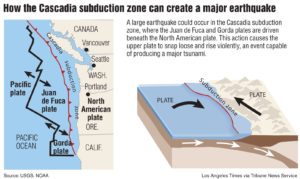 Graphic and map of the West Coast shows the location of three underground plates in the Cascade subduction zone and how they would interact to create a tsunami that would inundated coastal areas.
According to Goldfinger, at least one researcher is looking into the question of whether the native people of the area have stories of an earthquake from around that time.
Either way, Goldfinger said the geological evidence points to the San Andreas quake coming minutes to hours after the Cascadia quake.
The sediment created by Cascadia had not yet settled, he said, when the San Andreas quake happened.
The next step, Goldfinger said, is for emergency managers at the state and national level to take note of the possible implications of back-to-back major West Coast earthquakes.
“Regionally,” Goldfinger said, “having two disasters in close timing proximity would be a huge thing for the country to try to respond to.”
It’s also possible that a Cascadia earthquake could act as a warning system for a San Andreas earthquake, though there are still many variables and unknowns.
One of the complications is that, though the 1700 earthquakes happened within minutes to hours of each other, scientists don’t know the probability of that version happening again.
Instead of minutes, Goldfinger said, “It could be weeks. It could be a couple of decades. It could be 50 years even.”
- Lizzy Acker is a reporter at The Oregonian/OregonLive and can be reached at [email protected].