
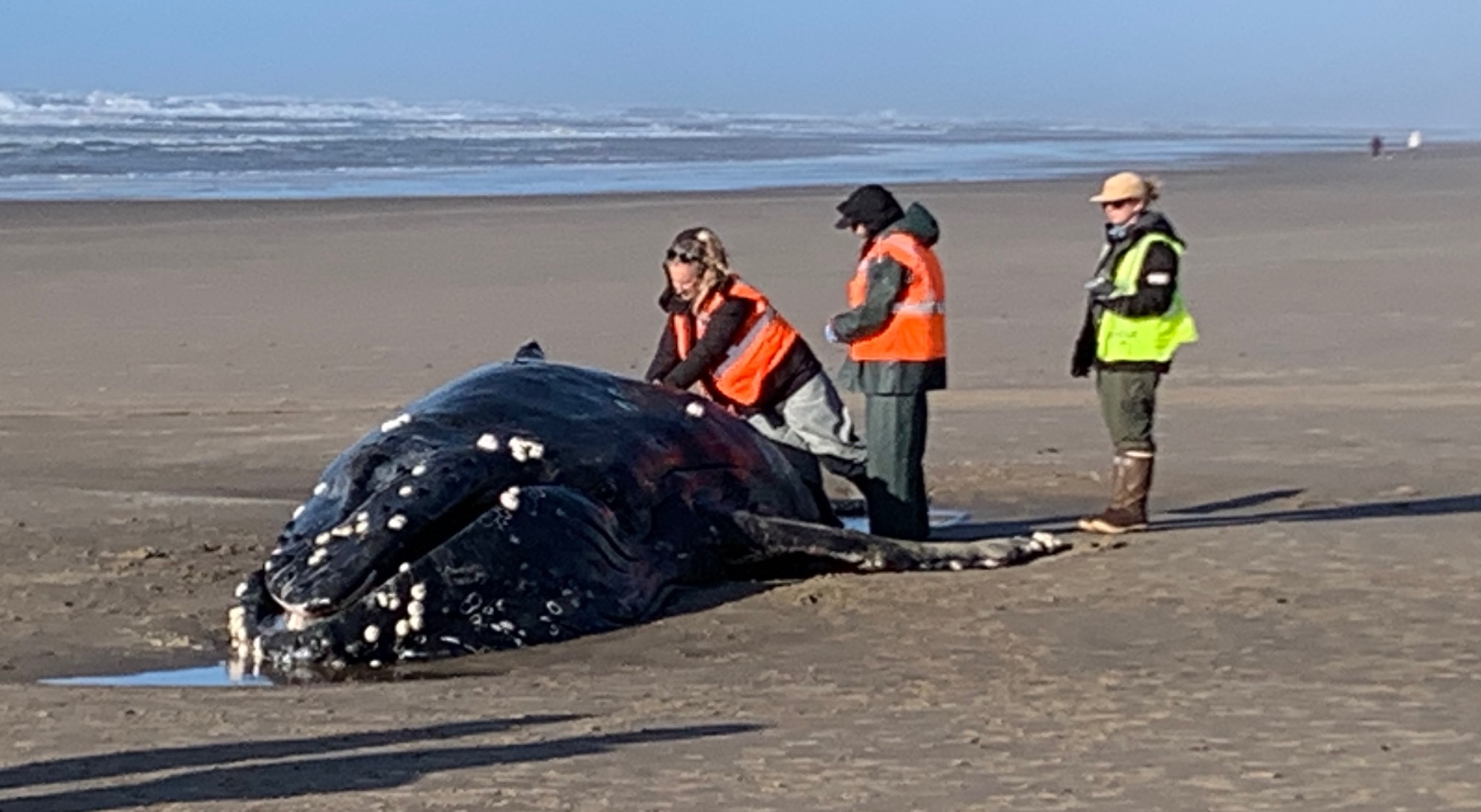
 Veterinarians sedate a stranded juvenile humpback whale Nov. 17 after a failed rescue attempt at the morning’s high tide and then low tide left it high on the sand two miles north of Yachats. (Garret Jaros/Lincoln Chronicle)
By GARRET JAROS/Lincoln Chronicle
Although efforts were unsuccessful to return a juvenile humpback whale to the ocean after it washed onto a Yachats beach in November tangled in Oregon commercial Dungeness crab gear, the stranding did trigger conservation groups to call for increased safeguards to protect marine mammals.
With four confirmed cases of humpbacks tangled in commercial Dungeness gear from Oregon in 2025 – surpassing three in 2024 – four conservation groups petitioned the Oregon Fish and Wildlife Commission in December to adopt new measures and amend rules for how crabbers operate.
The Center for Biological Diversity, Oceana, the Natural Resource Defense Council and the American Cetacean Society are asking the commission to strengthen Oregon’s current entanglement measures, create a process for using line-free “pop-up” gear and establish a process for timely reporting of marine mammal or sea turtle entanglements.
“This year’s horrific entanglements show that humpbacks are in a lot of danger from Oregon crab gear,” Ben Gundy of the Center for Biological Diversity told the Oregon Capitol Chronicle in December. “If state officials don’t move to adopt whale-safe fishing gear, like pop-up buoys for Dungeness crab pots, endangered whales will continue to suffer and die preventable deaths.”
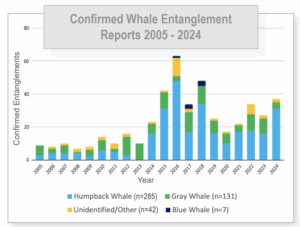 Humpback whales because of their feeding and migration timing are the most likely to get tangled in fishing and crab gear. (NOAA Fisheries)
In addition to establishing a process to authorize the use of pop-up gear – something not currently allowed in Oregon’s Dungeness fishery – the petition calls for adjusting late-season crabbing to reduce the number of pots by 40 percent and a 180-foot depth restriction (exempting pop-up gear) after April 1 until 2028 and prohibiting conventional gear after April 1, 2028.
Pop-up gear, also known as ropeless or on-demand gear, stores ropes and buoys with traps on the seafloor rather than using vertical lines that pose entanglement risks. When fishermen are ready to retrieve their catch, they use an acoustic signal to trigger the release of the buoy, which rises to the surface for retrieval.
State law requires the commission, whose next meeting is Feb. 20 in Springfield, to respond to the Dec. 11 petition in writing within 90 days and either deny it or begin rulemaking proceedings. The commission said this week it expects substantial interest in the meeting, and outlined how people can submit comments, attend or view it online.
Newport-based ODFW marine resource program manager Justin Ainsworth said he knows the petition is something people are talking about, that fishermen are concerned about, and that agency staff will be providing information to the commission to help it reach a decision whether to eventually deny or accept the petition.
“That said, the commission could direct us to do more work, maybe pull some elements out of the petition and say ‘Work with this’,” Ainsworth told the Lincoln Chronicle. “So they could deny it, but take things from it, or accept it.”
 Scientists and veterinarians examine the young humpback whale that came ashore Nov. 15 north of Yachats. It was entangled in 2023-24 Oregon commercial crab gear when it first became stranded.
But accepting the petition doesn’t mean all the proposed rules are in effect, he added. It just means a rule-making process would begin so the commission could make decisions around the different ideas.
“It’s a subtle difference, but I’m concerned that the general public or fishermen might say it’s either all these measures are going to be rules as of February or they’re going to deny it, and it’s actually not the case,” he said.
Ainsworth, who called the increased number of entanglements “a very concerning situation,” also noted that the humpback population is growing at 8 percent a year.
“We’ve had a crab fishery that whole time that we’ve watched these populations recover,” he said. “And they are recovering and doing really well. These smaller segments may not be growing at the same rate as the whole population so I think every entanglement is impactful and can be really sad, especially with what we saw in Yachats. But even with the fishery happening and unfortunately entangling whales, the whale population is healthy.”
Based on data collected by the National Oceanic and Atmospheric Administration between 2019 and 2021, the distinct Mexico-California-Oregon-Washington population of humpback whales is estimated between 1,494 and 3,477 individuals and growing. The population is listed as threatened under U.S. Endangered Species Act.
Overall population estimates for the entire north Pacific ranges from 26,000 to 30,000 humpback whales, according to NOAA. While many populations are recovering, reports this month suggest some migration counts in certain areas have been at historical lows due to environmental stressors like starvation.
While threats from entanglement and rising ocean temperatures — which affects food sources — along with noise pollution interfering with communication, humpbacks also face a major threat from vessel strikes which accounts for an estimated 22 deaths a year along the West Coast.
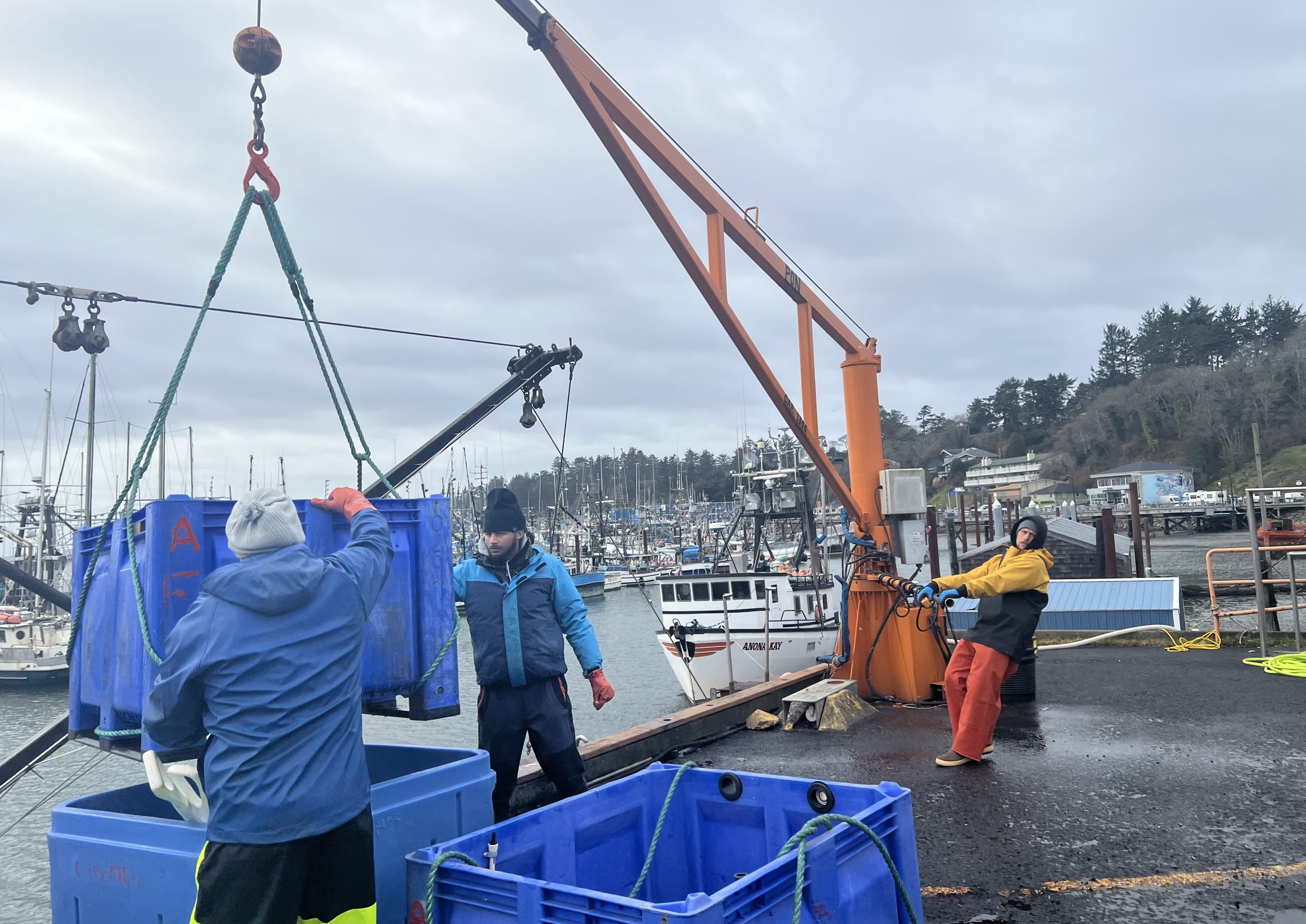 Crew from the F/V Cap Elza and West Coast Seafood employees unload totes of Dungeness crab Wednesday at the Port of Newport for shipping to retail seafood stores in the Willamette Valley, Portland and Seattle area. (Quinton Smith/Lincoln Chronicle)
Proposed rule changes
The Dungeness crab fishery is Oregon’s most valuable. Last season was the most lucrative in history at $97.1 million paid to crabbers despite a significant drop in the overall catch. The previous record was $91.5 million during the 2021-2022 season, which was about $1 million more than the 2023-2024 season.
The Dungeness season, which runs until Aug. 14, can open as early as Dec. 1 but is often delayed to allow crab to pass meat-fill requirements and be free of domoic acid.
Beginning in 2021, ocean Dungeness fishermen planning to crab beyond May 1 were required to purchase “late-season” buoy tags to identify gear as part of suite of measures designed to reduce the risk of whale entanglements. Other measures after May 1 include limiting pots to a depth of 240 feet (about 15 miles offshore) and reducing the allowed number of pots for each permit holder by 20 percent.
The intention is to keep crab gear out of deeper waters where humpbacks are more likely to be foraging or traveling along the Oregon coast during their annual migration between cold-water feeding grounds and the warmer waters off Mexico where they mate and give birth.
The current Dungeness season began under an ODFW fleet advisory urging fishermen to remain vigilant and move or avoid setting gear in areas where whales are traveling or foraging, removing gear not being actively attended, and keeping lines tight and to a minimum.
And then last week, ODFW officials announced they were implementing a temporary rule to move up the late season measures from May 1 to April 1 to further avoid entanglement risks.
But none of the four whales entangled in 2025 had late-season tags, leading ODFW officials to question whether their regulations may not be addressing some of the higher-risk times.
Data compiled by the agency through survey flights, shipboard observations and whale distribution models overlayed with logbook data where fishing occurs revealed April as a high exposure month.
“And that’s kind of a combination of the whales starting to show up in that month in some abundance – though not the peak of their timing – with having quite a bit of crab gear out in the water,” said ODFW fishery manager Troy Buell.
Historically, the vast majority of the Dungeness landed in the Oregon fishery – more than 50 percent – occurs within the first three to four weeks of the season. And in Oregon and Washington, 75 percent to nearly 90 percent of the total season’s catch is landed in the first eight weeks, according to fish and wildlife officials.
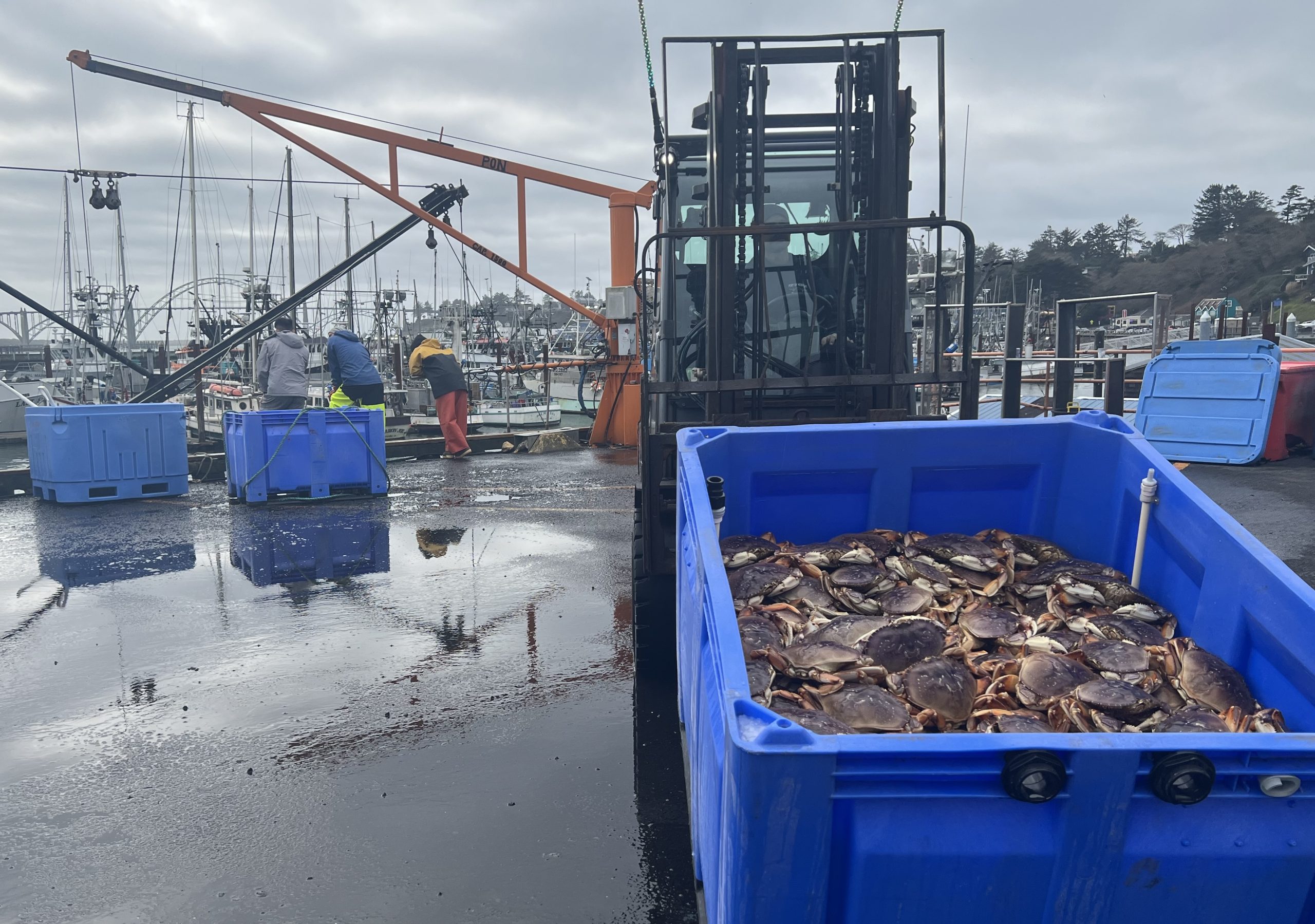 Although the height of the Dungeness crab season has passed, there are still plenty of boats bringing in crab to the Port of Newport where wholesale buyers await. (Quinton Smith/Lincoln Chronicle)
Preparing opposition
Oregon crab fishermen are banding together to oppose the petition.
The first meeting of the newly revived Oregon Coast Crabbers Association, which was formed in 2019 to fight issues around area restrictions and gear reductions because of whales, had its first meeting Thursday in Newport.
“We are bringing it out of mothballs so to speak,” said association president Gary Ripka, who is also the president of the Newport Crab Marketing Association. Ripka has been crabbing for 45 years and owns two larger boats.
“We love whales,” Ripka said in an interview with the Chronicle. “We don’t want to entangle whales. But the petition is asking us to by 2027 move our fishing area and our gear inside of 30 fathoms and reducing our gear by 40 percent – a huge economic hit, especially to the small boats. It’s really going to hit them hard — and the small live buyers, not the big corporate guys so much but the smaller operations.”
The petition also wants to have nothing but pop-up gear beyond 30 fathoms by 2027, gear that’s never been used or tested on the Oregon coast. It was used successfully in a smaller area off San Francisco inside of 30 fathoms but never in deeper ocean, Ripka said.
“That’s a big ask,” he said. “One, financially it’s a huge, huge ask for the fishermen. Most people won’t be able to afford it. Two, the smaller boats won’t be able to use it because (conservation groups) want us to long-line pots (pots strung together on the ocean floor attached to a single crab pot with pop-up capabilities). Most little boats aren’t capable of doing that, they won’t have the hydraulics or the deck space and it’s dangerous to the crew and a safety issue.”
One pop-up pot costs about $1,000, which if long-lined with a string of say 20 pots, would cost a crabber with a 500-pot permit $25,000.
Ainsworth agreed with Ripka that while the test in central California was small, albeit very successful – and that pop-up fishing is used for different crab species and lobster on the East Coast – the ocean currents and conditions along Oregon’s coast are “a whole different beast because the currents are strong and the bottom is different.”
Ainsworth also noted that the timeline requested by petitioners would not allow enough time for testing along the Oregon coast. But he added that ODFW is already committed to pursuing rulemaking that would allow for testing.
 Storms and strong currents can tumble crab pots for miles, tangling the lines and leaving their buoys splayed out in what fisherman call a “flower.” (Garret Jaros/Lincoln Chronicle)
Ripka said fishermen do agree with some management strategies to curb entanglements, particularly programs to clean up derelict gear that’s been left in the ocean.
“There is a derelict gear recovery program in the state and we want to see that stepped up, we want that drastically increased, the funding for it, everything about it,” he said. “Getting that gear out of the water is a good fishing environmental practice.”
The whale that washed up in Yachats was entangled in gear that had 2023-2024 Oregon season tags. Another of the four noted entanglements had tags from the 2022-2023 season and the final two had tags from the 2024-2025 season, according to ODFW.
The post-season derelict crab pot recovery program managed by ODFW, which is more than a decade old, collected 1,289 pots following the 2024-2025 crab season. Another in-season derelict recovery program is operated by industry’s Dungeness Crab Commission.
Ripka said fishermen also want to see the measures they’ve already begun to implement, like colored lines to show which state the gear comes from to continue and a federal “take permit” instituted which would allow for an incidental number of whale fatalities each season.
“We’ve been working on that for 10 years and haven’t gotten anywhere,” Ripka said. “And we wouldn’t have had this petition if we had our take permit.”
He believes the measures sought by conservationists is a slippery slope that never ends.
“The Center for Biological Diversity has gutted the California crab fishery,” Ripka said. “They start with this and then move to reduce our gear stacks. This is their template on how they operate. It just never stops.”
He also questioned the methods by which NOAA and ODFW count humpback populations
“I mean the ironic thing that’s very frustrating to me is I grew up fishing and 25, even 10 to 15 years ago, if you saw a whale when you were crab fishing, you would stop and say ‘Hey look at the whale over there – pretty neat’,” Ripka said. “Nobody bothered or worried about whales at all. Now they’re thick as fleas, they’re like sea lions. I’ve never seen so many whales.
“It would be mind-boggling to people if they actually knew how many humpbacks are out there now. They’re like an everyday occurrence and the only reason we have a problem is because there are so many whales.”
- Garret Jaros covers the communities of Yachats, Waldport, south Lincoln County and natural resources issues for Lincoln Chronicle and can be reached at [email protected]















Maybe some of the “tourism tax” could be used to help subsidize equipment upgrades for folks that need it. I’d imagine saving baby whales would be considered a form of promoting tourism.
This should be a non issue. There are over 80,000 Humpback whales worldwide. They are not endangered. Overreach by the ODFW.
The humpback whale population continues to rebound at a significant rate. I think we also need to consider our crab fishing business as an “endangered species”. If we burden them with more and more expensive regulations they will go the way of the California, and Oregon will need to import crabs. A reasonable balance needs to be found between these two forces and as long at the whale population continues to grow, let’s give the fishermen a break.