

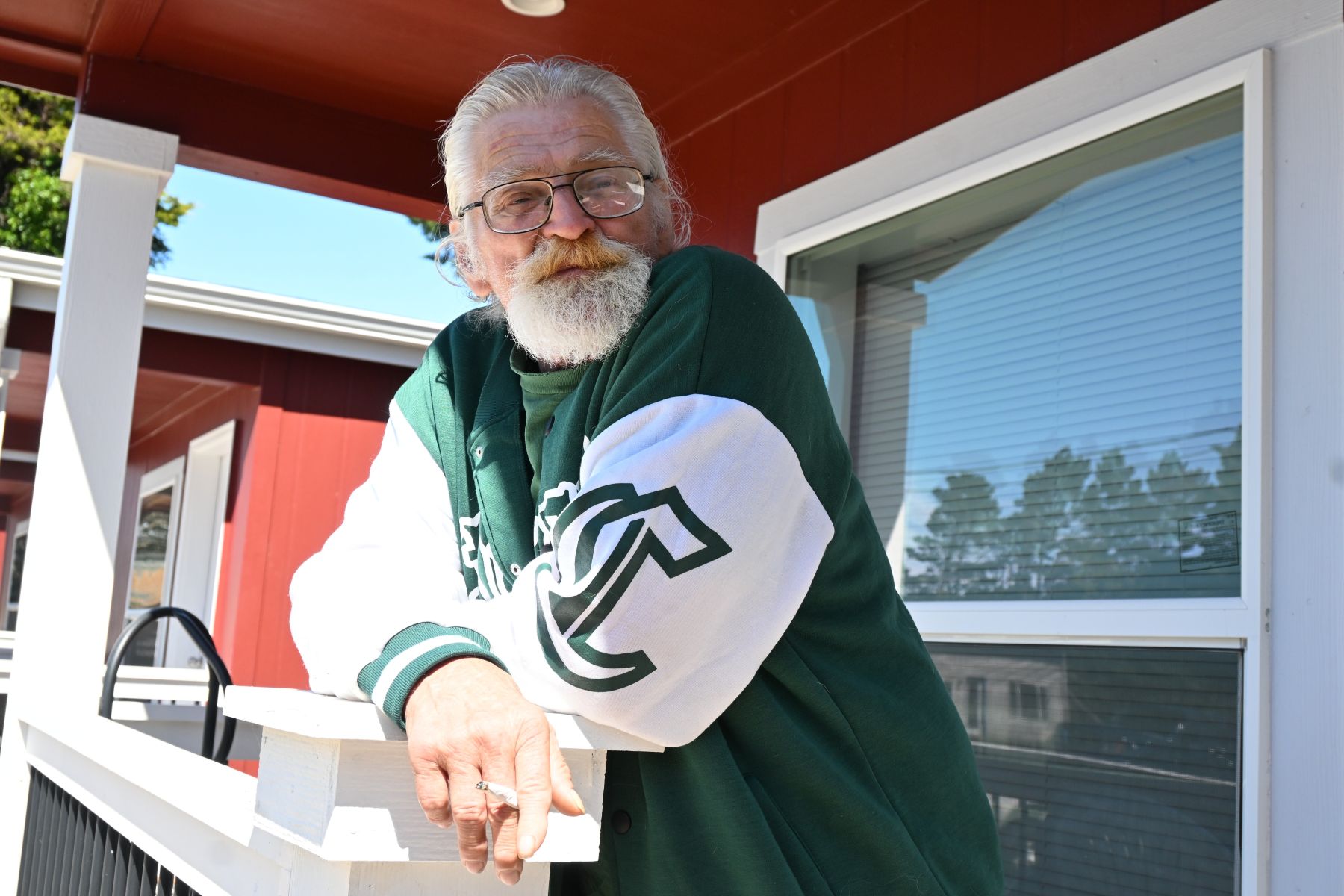
 Jim Bowles, 69, stands on the front porch of his tiny home in Coast Vineyard Village in Lincoln City. He moved in May, after nearly six years of being shuffled around after the 2020 Echo Mountain Fire claimed his home in Salmon River Mobile Village. (Shayla Escudero/Lincoln Chronicle)
By SHAYLA ESCUDERO/Lincoln Chronicle
Jim Bowles stands on his front porch, leans on the railing and takes a drag from a cigarette – one of two indulgences that he allows himself. The other is coffee at the Lincoln City McDonald’s where the bus drops him off at 7 a.m. before work.
But today is a day off, which means the afternoon is for catching up on bills and planning the week ahead.
Bowles lives in a tiny home painted barn red and nestled in a cluster at the end of Northeast 10th Street in Lincoln City. It’s the most stable housing Bowles has experienced since the Echo Mountain Fire six years ago claimed his home in Salmon River Mobile Village. Since then, the 69-year-old has lived with friends, in motel rooms, a travel trailer, and a temporary one-bedroom apartment.
Six homes have been prioritized for wildfire survivors at the new village, a $1.7 million pilot effort that involved a partnership between Lincoln City, Northwest Coastal Housing, Coast Vineyard Church, Lincoln County, and Oregon Housing Community Services.
Bowles is one of two Echo Mountain Fire survivors to have made a permanent home at Coast Vineyard Village, paying $675 a month in rent. But many households are still waiting for housing and most have extreme barriers.
Hundreds of people throughout the Northwest could soon be experiencing what Bowles has gone through. Oregon has already seen a record 2 million acres burned in wildfires in central and eastern Oregon this summer. In Spokane this week, 600 homes burned and 65,000 people were evacuated because of fires on the edges of the city.
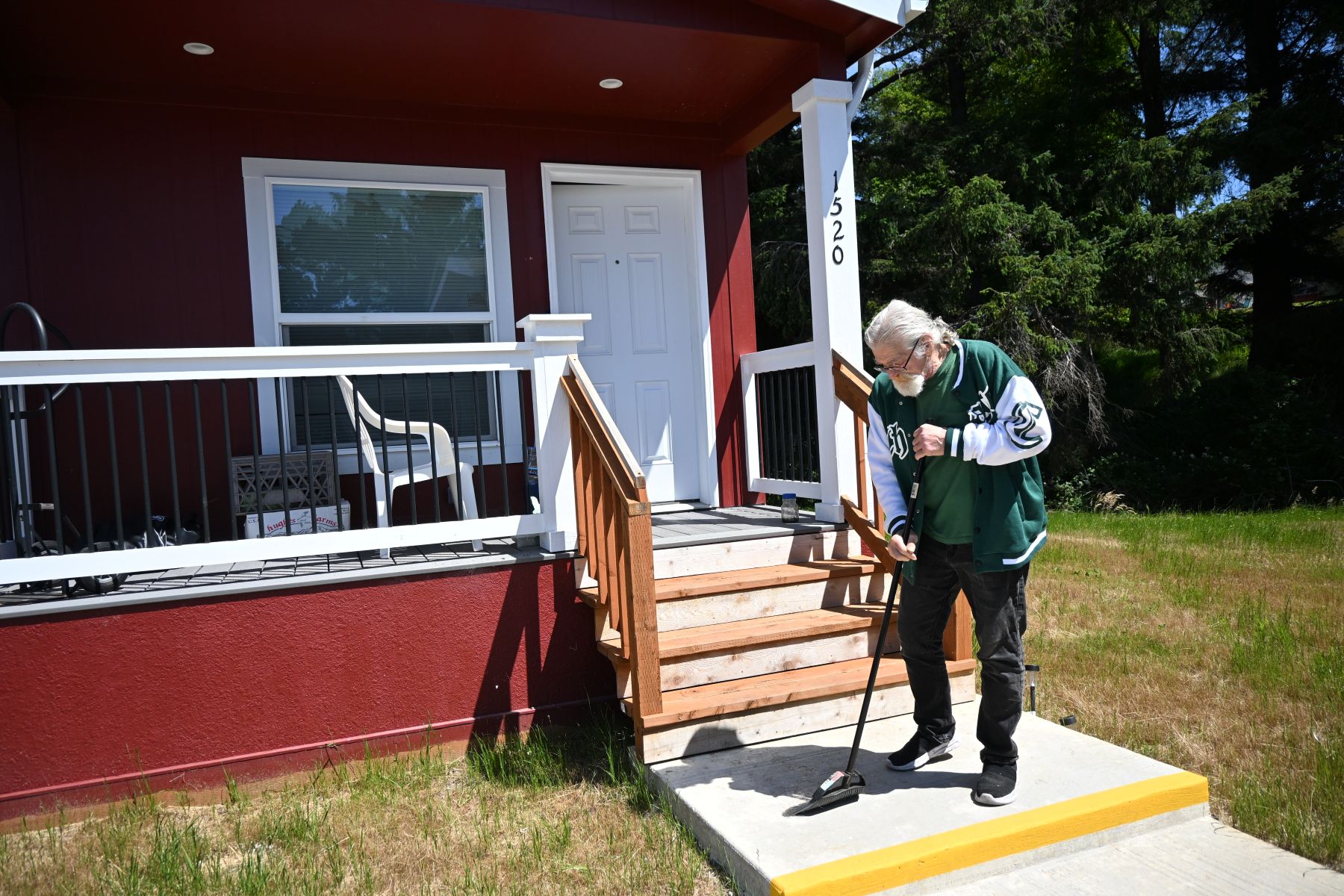 Jim Bowles sweeps the entry to his tiny home in Coast Vineyard Village, where the 398 square foot space provides the most stable housing he has had after living on friends’ couches, motel rooms, a travel trailer, and a temporary one-bedroom apartment. (Shayla Escudero/Lincoln Chronicle)
Barriers and cracks
After the fire Bowles lived in a 20-year-old travel trailer he thought would be only temporary while waiting for disaster relief funds. The heater didn’t work and the roof leaked.
He thought he should have been eligible for funding to rebuild or replace his mobile home in Otis but wasn’t able to prove that he owned it. He started out as a renter and bought the unit from his former landlord. But any documentation of the transaction burned in the fire and Bowles had no way of tracking down the previous owner. For all he knew, she was dead.
“I find every crack in the system and I fall right in between,” he said.
The regional Community Services Consortium helped him replace the travel trailer for a newer drier space, but he still didn’t have permanent housing.
To make matters worse, his health deteriorated in the six years since the fire. He had a stroke that affects his ability to get around, his cataracts make it difficult to see, so he lost his driver’s license and his car, and his medical insurance won’t cover the procedure to restore his sight. He’s become more reliant on the bus system to get to work. Getting food from pantries is difficult when he can’t walk very far carrying cans and boxes.
“Getting older feels like getting tossed out to die,” he said.
He wishes that Medicare took better care of people like him. He wishes food was more accessible to seniors and people with disabilities in Lincoln County. His only consolation is that maybe if he slips through the cracks and he shows people how the different systems have been failing him, maybe that gap will get filled so that the next person doesn’t fall through.
Bowles almost didn’t meet one of the qualifications for an affordable tiny home. His FEMA identification, which verified his status as a wildfire victim, took months to locate. Not all wildfire survivors have them, but they are often a requirement to move into affordable housing because it’s one way that verifies that someone survived a disaster.
 The Echo Mountain Fire burned 29 of the 31 homes in the Salmon River Mobile Village on the north side of Oregon Highway 18. (Quinton Smith/Lincoln Chronicle)
Six years later
The 2020 Echo Mountain Fire claimed 288 homes and more than 15,000 people in north Lincoln County were put under evacuation orders. While the fires were put out almost six years ago, the fallout continues – survivors are often in a state of limbo, shuffling around in different temporary housing.
Lincoln County started a wildfire recovery program in 2024 to help people reach permanent housing and so far, 33 households have done so. But that doesn’t mean that they have affordable housing, said recovery navigator Gabby Santos. Her job is to manage wildfire survivors and help them navigate the processes of applying for rental assistance, funds to rebuild their homes and get them into permanent housing. And over the years, the people she helps have become very disillusioned.
The county has been in touch with 42 households and has 21 active cases.
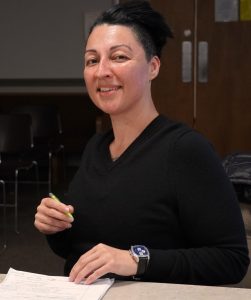 Santos
Like Bowles, many survivors lost their paperwork in the fire that destroyed their home. That can make it difficult to apply for assistance programs. And that means going through several different state and federal agencies and banks to find them all again.
“There’s no one stop shop for replacing documents,” Santos said.
Some Lincoln County survivors owned their homes for generations and are now having to jump through hoops they didn’t have to before – such as the county’s permitting processes to rebuild or proving they have an income when they get by selling wood carvings, she said. Some have large pets or livestock that makes it difficult for them to find somewhere to stay that will allow animals. Many are older and may have difficulty navigating all of the processes that are on the internet, while others may not speak English. Some have criminal records, mental health and substance abuse disorders. The list goes on and on.
Eighteen percent of Echo Mountain Fire wildfire survivors left the county, Santos said, although three households eventually returned.
In some instances, Santos has to get really creative to get people into housing. One survivor’s criminal record was holding him back from renting even though he had been out of jail for 10 years and not reoffended. On one trip to Otis, she noticed an empty house and found out it was an unused second home. She connected with the owners and explained the survivors’ specific circumstances, and they ended up renting to him.
She hopes that more community members can have a radical approach to housing to overcome some of the barriers holding them back.
“I want to encourage empathy for different walks of life because there are many, many barriers,” she said.
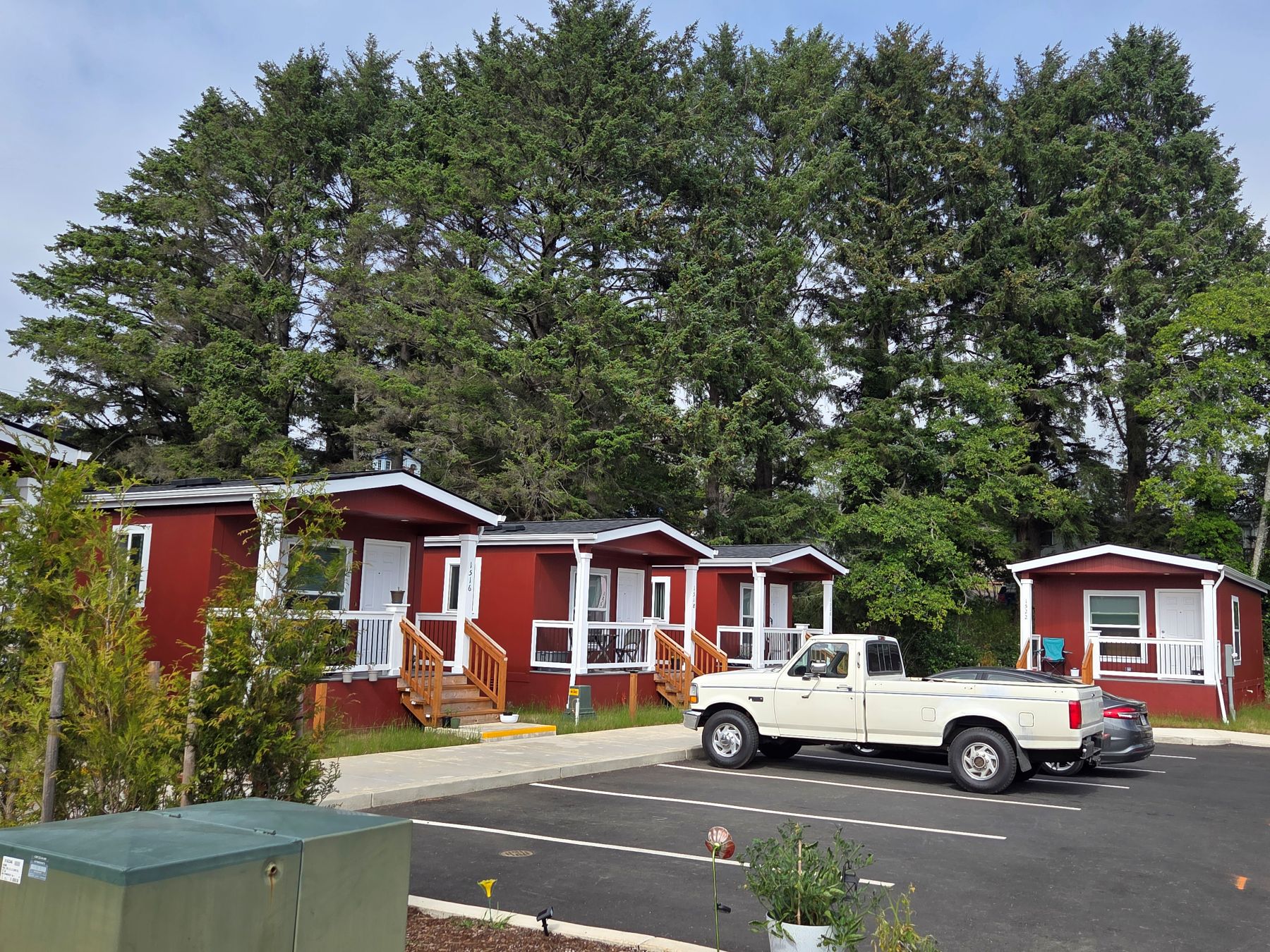 A coalition of groups built 12 tiny homes in Lincoln City as part of a $1.7 million affordable housing project largely funded by state grants for disaster recovery. Half of the tiny homes are long-term while the other half are transitional units. Wildfire and disaster recovery survivors are given first priority with secondary preference for those facing homelessness. (Shayla Escudero/Lincoln Chronicle)
New housing
The 12 tiny homes in Lincoln City were completed in March and Bowles moved in May.
He’s one of two survivors to get long-term housing at the property. The space is split into six long-term and six transitional units serving individuals under 80 percent of the area’s median income.
The project was the first of its kind banding together several different agencies – the county, the city of Lincoln City, Northwest Coastal Housing and Coast Vineyard Church.
 Stiley
“We’ve never had five different agencies bring this type of housing together and they went up super fast,” said Northwest Coastal Housing executive director Sheila Stiley.
The project cost $1.7 million with $1.6 million coming from state allocated grants for disaster recovery. The city provided land for two lots to Northwest Coastal Housing and Coast Vineyard Church provided the third lot. After 10 years, the church has the option to take over the project completely.
Because the space is also transitional housing, service providers work closely with Northwest Coastal Housing’s shelter, Coastal Phoenix Rising in Lincoln City. A pantry owned by the church is also a stone’s throw away.
 Jim Bowles tapes bus schedules to the wall of his tiny home in Lincoln City. Although things are easier now that Bowles has permanent housing, he spends most of his time doing the math to figure out how to get to work and make ends meet. (Shayla Escudero/Lincoln Chronicle)
Bowles is still getting adjusted to his new space. He still spends most of his time doing the math to make ends meet between the medications he needs after his stroke to his cellphone bill.
“I hate that I still have to work even though I get social security,” he said.
Bus schedules are taped to the wall inside and a calendar filled up with his shift times at Dollar Tree. Everything inside his home feels a little too large for the 398 square foot space – his couch takes up most of the entryway and living room and the television that isn’t yet hooked up leans forward precariously. Some items are still in boxes.
He likes the porch and from his particular spot on the property he has one of the best views to watch the deer that meander through.
“Things are still stressful, but I do feel more stable here,” Bowles said. “It’s small, but it’s mine.”
- Shayla Escudero is an enterprise reporter for the Lincoln Chronicle covering local governments, education, housing and social services and can be reached at [email protected]




















Shayla Escudero, thank you for another well-written article. When I went on an extended journey awhile back, I bought a name-brand “fireproof” file box about the same size as a very large briefcase, and I made the concerted effort to gather my important documents to keep in this case.
It’s no guarantee that my documents would survive a disaster, however, at least I did something. I have been finger-printed twice, once because I was working the US Census, and once when I was applying to be a certified care-giver for a friend. It’s been over 10 years ago for me, but if a disaster survivor has their prints on file, I would hope it would help establish identity. Odd, how important that is… from my POV, one of the most horrendous aspects of the ICE pogram– er, program– is that the detainees are stripped of their identities in a real and literal sense. That might be more harmful than any physical deprivation.
Are there more units planned to be built with the $1.7 million? If not, each unit cost over $141,000. The land was free, and I estimate each unit cost no more than $60,000.
$60K? Including building permits, land preparation, electrical, water, and sewer infrastructure and paving the parking area? Rick, you might be right, but if you can build a tiny home from scratch with appliances and paved parking for $60K, please let me know.
That being said, it seems that those who have, rarely kick down unless there is a financial benefit to help them have more.