

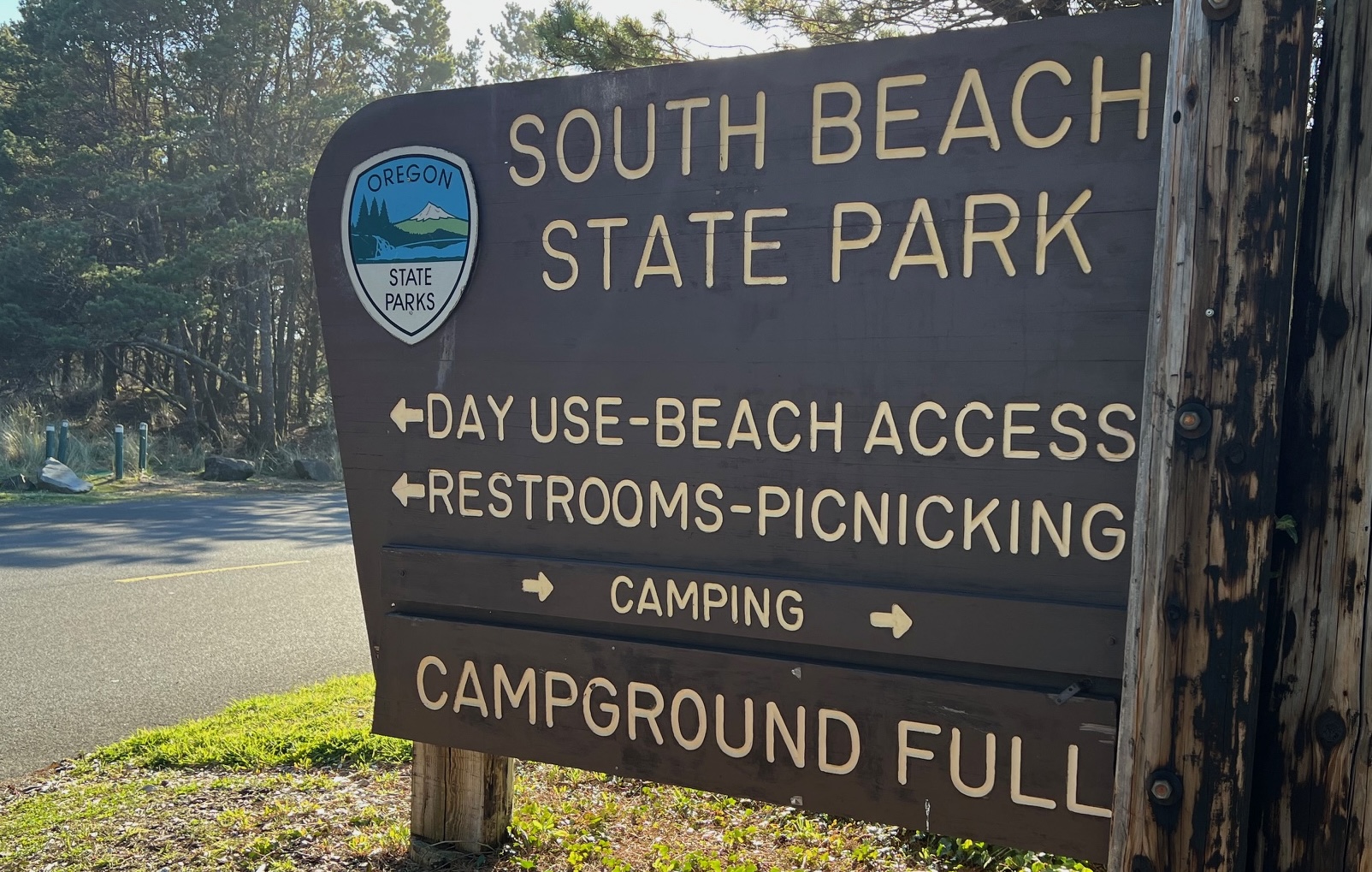
 South Beach State Park is the largest on the central Oregon coast and is often full on sunny weekends or holidays. (Quinton Smith/Lincoln Chronicle)
By JAMIE HALE/The Oregonian/OregonLive
It might not have felt like it, but 2025 was the quietest year at Oregon state parks since the pandemic.
Visitors logged a total of 51.45 million daytime visits to Oregon’s state parks last year, the Oregon Department of Parks and Recreation has announced.
While a moderate decrease from the previous year’s record total of 53.8 million day-use visitors, it is the lowest number of state park visitors since 2020, when the park system shut down during the Covid-19 pandemic and registered fewer than 43 million visits.
Overnight numbers saw a more dramatic decrease, especially along the coast.
In 2025, visitors logged 2.6 million camper nights, down from 2.83 million in 2024. It was the lowest number of annual camper nights since 2015.
Camping numbers decreased across the state but fell most dramatically on the coast, where camper nights fell by 11 percent last year. Those decreases were the largest at Fort Stevens near Astoria and Jessie M. Honeyman state park south of Florence, where camper nights fell by 45 percent and 48 percent respectively. Both parks experienced partial campground closures last year, however.
“Temporary campground closures at popular parks like Collier Memorial, Silver Falls, Fort Stevens, and Nehalem Bay contributed to the decrease as critical maintenance and infrastructure work moved forward,” the parks department said in a news release.
Park officials said while parks on the coast and in the Willamette Valley saw decreases in day use visitors, parks in central and eastern Oregon received a few more visitors, collectively increasing by 2 percent over 2024. However, the majority of that increase can be attributed to a single park, Minam State Recreation Area in northeast Oregon, which saw a 139 percent increase in day-use visitors last year, largely thanks to a repaired traffic counter and an increase in popularity of fishing and rafting there, the agency said.
Several popular parks in central Oregon, including Smith Rock, Tumalo and The Cove Palisades, saw decreases in 2025.
The news comes as the Oregon Parks and Recreation Department increases parking and camping fees across the state in an effort to raise more money for the department, which is facing a massive budget shortfall as maintenance costs rise and lottery revenue (which largely funds the department) falls.
Park officials highlighted the budget issue in the announcement of last year’s visitor numbers, noting that “every visit, every pass, and every act of stewardship matters.”
“Even with small year to year changes in visitation, the love people have for Oregon State Parks is clear,” interim director Stefanie Coons said in the news release. “We want to do everything we can to continue to provide high quality experiences and create treasured memories for our visitors. Every visit and every supporter truly make a difference in helping us care for these special places.”
- Jamie Hale is a travel and outdoors reporter at The Oregonian/OregonLive and can be reached at [email protected]
















Canadians and Europeans used to comprise a pretty big share of the numbers too. Why are they not visiting? Did somebody here in the states tick them off?
Lived here all my life and all I’ve seen is our parks go to hell and fees are absolutely outrageous
Part of the problem is that Canada’s GDP is almost the lowest of all the developed countries – their economy is poor. I have personal friends in BC, Alberta and Saskatchewan. They all hate their new Prime Minister but love Trump even with the tariffs. The Canadian dollar is 0.73 to the US dollar so when they come here it costs 27% more for park fees, motels, etc. As Oregon keeps raising fees and taxes you will see more of this.
Charging too much.
Mr. Spulnik,
Your comments and explanation re; Canada’s GDP, etc., are spot-on. Thank you.
It’s not just Canada. Oregon used to be a place where people felt free, and the taxes were minimal. There were very few laws, rules or regulations. I owned several R.V.’s and loved to travel, but Oregon got so expensive, and controlling I sold my last R.V. this year. Another issue is that us boomers are almost extinct. Millennial’s and Gen Z’s don’t want houses, let alone R.V.’s. R.V. companies are going broke. Idaho, Wyoming, Texas, and Utah are flooded with vacationers. We could learn something from them.