
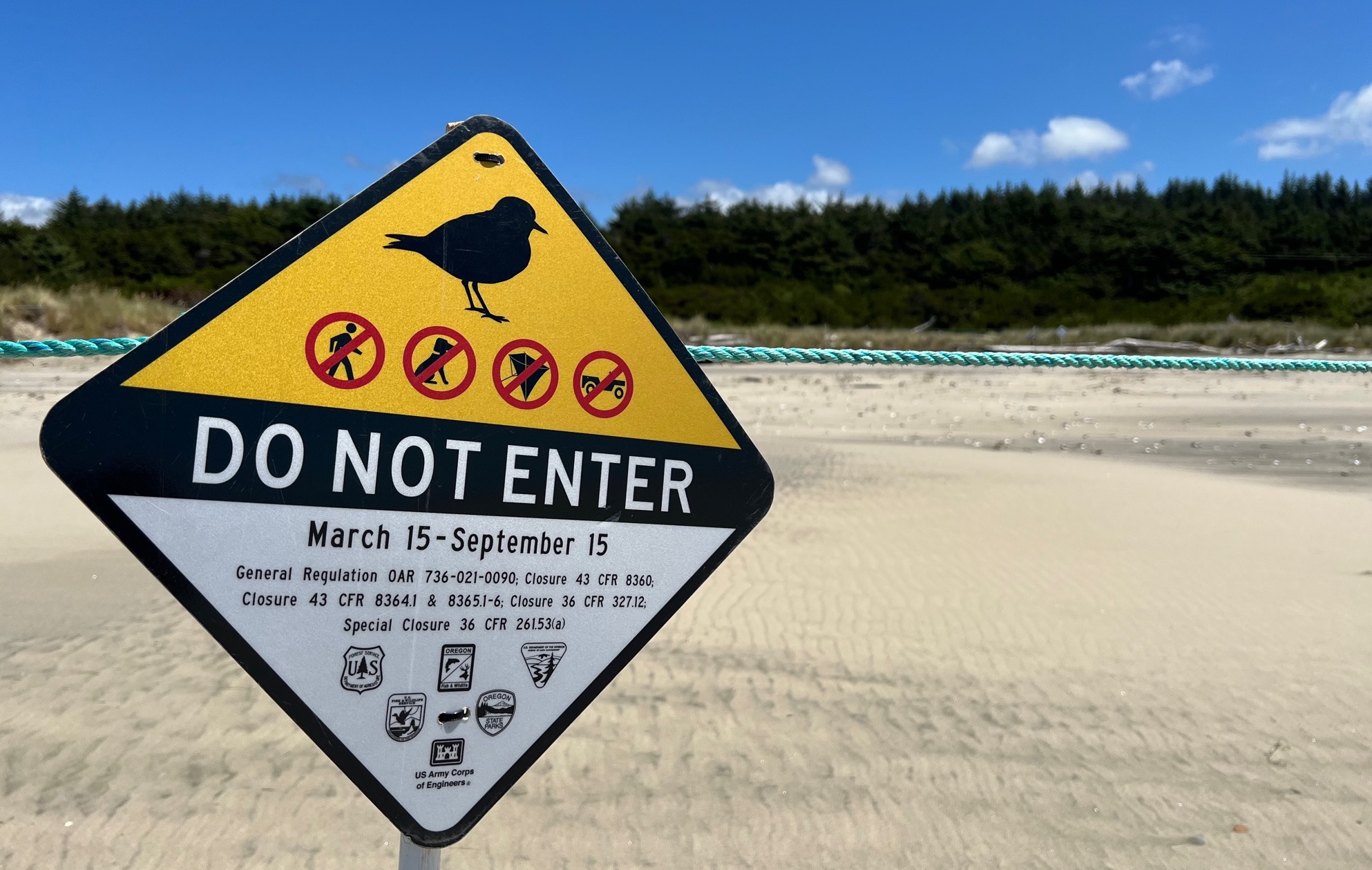
 Oregon State Parks rangers will rope off areas of central coast beaches when they spot new snowy plover nesting sites to keep people and their dogs away. (Quinton Smith/Lincoln Chronicle)
By GARRET JAROS/Lincoln Chronicle
Nesting season for the western snowy plover has arrived and that means beach goers should take extra precautions not to disturb the diminutive and well-camouflaged birds that hatch their clutch in dry sand above the high tide mark.
The small shorebirds, recognizable by distinctive black cap behind white foreheads nest in small crevices in the sand beginning this month and through Sept. 15.
Wildlife biologists put ropes up around known nesting sites, along with signs warning visitors not to enter those areas. Sensitive plover nesting areas are identified on maps for the northern Oregon coast and southern Oregon coast. Signs may also be present at some trailheads with additional rules and limits.
 A female snowy plover digs a nest scrape while the male watches. (Roy W. Lowe photo)
The bulk of restrictions occur in Lane, Douglas and Coos counties. There are no closed beaches in Lincoln County and here, as elsewhere, wet-sand areas are always open to the public.
The western snowy plover was listed as a threatened species in 1993 by the U.S. Fish and Wildlife Service when officials counted only 45 breeding pairs. Populations have steadily increased due to ongoing conservation efforts resulting in 546 plovers counted during the breeding season survey in 2025.
Recreation restrictions will be designated in plover management areas where the birds nest or may nest. These areas combined account for about 40 miles of Oregon’s 362 miles of shoreline. Restrictions include:
- No dogs (even on a leash), driving a vehicle, riding a bicycle or e-bike, camping, burning wood, flying kites or operating drones.
- Foot and equestrian traffic are permitted below the high-tide line on wet, hard-packed sand.
- Respect signs and barriers to protect nesting habitat.
During the nesting season, human disturbances can flush adult plovers away from their nests as they attempt to defend their young, according to U.S. Forest Service and Oregon Parks and Recreation Department officials. Left alone too long, or too often, eggs or chicks can die from exposure and predators.
Habitat loss from invasive plants and human disturbances — including litter and discarded food scraps that attract predators — also contribute to the birds’ decline.
- Garret Jaros covers the communities of Yachats, Waldport, south Lincoln County and natural resources issues for Lincoln Chronicle and can be reached at [email protected]