

 The F/V Eclipse berthed at Port of Newport property is one of 17 derelict vessels the port is seeking to have removed by contractors after being abandoned by their owners. (Shayla Escudero/Lincoln Chronicle)
By NIGEL JAQUISS/Oregon Journalism Project
Three years ago, the Oregon Legislature accelerated the messy job of removing derelict ships and boats that clog waterways across the state — rotting fishing boats in Newport, abandoned tugs in Coos Bay, rusting barges on the Columbia River.
Lawmakers allocated nearly $19 million to remove and demolish the abandoned vessels. The Department of State Lands, which oversees Oregon’s waterways, quickly began the work, removing large junk boats from waters near Coos Bay, Rainier and St. Helens.
It’s difficult and expensive work — getting rid of a single derelict vessel, the F/V Tiffany, an 84-year-old, 200-ton fishing boat that sank in the Columbia near Rainier, cost $1.42 million in 2023. To date, some of the highest-profile abandoned vessels have been removed, but there are hundreds more to go.
But in December, the Oregon Bureau of Labor and Industries suddenly increased the costs of the work, angering local government officials at Oregon’s 23 public ports.
Specifically, BOLI decided that the removal program, which has been underway for more than two years, must now pay prevailing – or union — wages to the private contractors who do the work.
The decision cast a cloud over plans to remove 17 derelict vessels from the Port of Newport because the change would add costs and record keeping requirements. Studies in other industries show that prevailing wages can add 10 percent to 20 percent to total project costs.
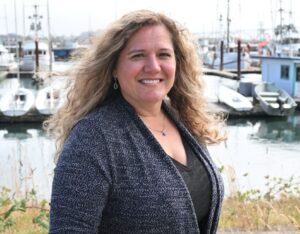 Miranda
“It makes no sense to us,” said Paula Miranda, executive director of the Port of Newport, home to the state’s largest fishing fleet. “This just makes things worse.”
Port managers responsible for getting rid of the fleet of junk vessels say BOLI’s ruling is wrongheaded and will slow the response to a chronic problem.
Since BOLI Commissioner Christina Stephenson won election in 2022, her agency has increasingly ruled that projects that use public money must pay union wages. That has pleased the unions that supported Stephenson with most of the $1.8 million she raised for her election campaign. But it has also made that work more expensive.
As the Oregon Journalism Project has reported, BOLI’s prevailing wage determinations on planned housing projects across the state have added costs to many and caused others to be delayed or canceled.
The agency had not previously taken a position on boat removal work. But on Dec. 11, BOLI issued a ruling that Siletz Boat Works would have to pay prevailing wages on its work in Newport because getting rid of unwanted vessels would include demolition of “structures.”
Generally speaking, BOLI requires public works projects, including construction or demolition of structures that spend at least $50,000 in public money, to pay prevailing wages. Stephenson ruled that scrapping junk boats met the agency’s criteria.
“Demolition’ includes the dismantling, razing, destroying, wrecking, or removal of buildings or other structures,” Stephenson wrote. “The common meaning of ‘structure’ is ‘something constructed or built’,” citing a dictionary definition.
 The Port of Newport is trying to remove derelict boats that are clogging its berths in Yaquina Bay, but a state agency’s ruling on contractor’s pay is complicating that effort. (Photo courtesy of Port of Newport)
Darien Loiselle, an attorney for the Port of Newport and the Oregon Public Ports Association, wrote to BOLI on Dec. 23 to strongly disagree. He contends that work done on navigable waterways is not governed by the state but by federal maritime law and that classifying derelict boats as structures is incorrect.
“Removal of derelict vessels does not involve work on a ‘structure’ as a vessel is not a ‘structure’ under state or federal maritime law,” Loiselle wrote. In his letter, the ports’ attorney asked for a hearing — effectively an appeal — of BOLI’s determination.
BOLI’s ruling came as a surprise to the port industry.
Miranda says if the agency’s determination stands, fewer derelict vessels would be removed because the prevailing wages the agency wants contractors to pay are significantly higher than market wages.
“This will deplete the amount of money the Department of State Lands has to spend,” Miranda says. “That means fewer vessels will get removed.”
- Nigel Jaquiss can be reached at [email protected]. The Oregon Journalism Project is a nonprofit news initiative whose goal is to inform, engage, and empower Oregonians.

















Oh OK, I thought paying a good wage to the people who do the actual work was designed to prevent uncontrolled market forces from undercutting labor standards when public money is being spent, and also a great way to counteract some of the relentless and unfair wealth consolidation going on everywhere, not to mention giving workers in depressed areas and underpaid industries/jobs a little bit of dignity and value compared to their corporate-exploited counterparts. Come to find out, via this misguidedly-CEO-voiced article, that it’s just something to insincerely please campaign contributors and “make things worse” and “add to costs” (“add to wages” is how a non-CEO sees it) and “complicate the effort” and “cast a cloud” and will result in “fewer vessels getting removed.” Yeah treating people well is always harder than exploiting them, sorry.
Yep, you’re right!
It’s a perverse little Catch-22. It would almost be acceptable to my thinking if the guy who flips burgers at the fast-food joint were given the same consideration of caring for his wages. Can you imagine the uproar if fast-food chains were required to pay union wages and benefits? I can’t see that it makes any sense to basically eliminate boat demolition work because it becomes too expensive of a burden. I don’t think auto salvage yards have to pay union wages. As long as a contractor has the proper insurance for his workers and the job and follows OSHA rules, it’s good honest work. There are plenty of non-union workers who would rather work demolition than flip burgers.
Public money rules apply in this case so the government entity can’t undermine union wages.
I guess the Port of Newport has a problem paying living wages. Here is a thought why doesn’t the Port use its terminal as it was intended for cargo? Then they could generate revenue to do the projects they need to do. And what about Rogue Brewing owing all that money to the Port for the rent that they never collected?
We need to be prepaying through registration and licensing fees the disposal costs much like bottle deposits. Boats, docks, RVs, etc.
Why should the general public sport boaters or dock users pay even more licensing fees, to dispose of business owned or commercially owned vessels. Thats not equitable. The commercial boats should have to pay a deposit , when they start their mortgage contract so that if they end up going derelict , they pay a twenty or thirty thousand dollar bond to cover part of the cost during that would also keep many of them from going as they would sell them before it got that bad.