

 Samaritan Health Services says its proposed merger with a Tacoma-based medical provider will not immediately affect the operations of Samaritan Pacific Communities Hospital in Newport and Samaritan North Lincoln Hospital in Lincoln City. (Lincoln Chronicle file photo)
By NICK BUDNICK/The Lund Report
Oregon healthcare officials have signed off on the request by Corvallis-based Samaritan Health Services to merge with MultiCare Health of Washington state, but two hurdles remain.
The state’s Health Care Market Oversight program on Monday approved the merger on several conditions, including that the much larger MultiCare system follows through on its promise to invest $700 million in Samaritan and makes sure that, for at least five years, any money made from its newly acquired Oregon facilities is reinvested in the communities that Samaritan serves.
The merger, along with MultiCare’s proposed takeover of Samaritan’s Medicaid plan for lower-income Oregonians, had been in a holding pattern while state officials and executives discussed details of how the deal might affect Oregonians. The systems announced the proposed merger last October and finalized their application to the state in December.
The systems are awaiting two additional approvals from state regulators, both concerning MultiCare’s application to take over the health plans offered by Samaritan, including the InterCommunity Health Network that serves about 87,000 Oregon Health Plan members.
However, the approval by the state’s merger review office signals an end to the regulatory process that is viewed by industry executives as the biggest hurdle to a merger. Reviews by the office can last years for complicated mergers as officials seek details of how transactions might affect costs, working conditions and access to care.
 Samaritan Health Services chief executive officer Marty Cahill addresses a public forum on his organization’s proposed affiliation with a Washington state nonprofit.
“This approval is an important step forward for the communities we serve,” Marty Cahill, Samaritan president and chief executive officer said in a statement. “Our affiliation with MultiCare will provide additional resources to invest in our workforce, facilities, technology and services — and help make it easier for people to receive high-quality care close to home.”
However, the deal is not expected to be finalized until later in the year, according to Samaritan.
MultiCare operates more than 300 primary, urgent, pediatric, and specialty care locations across Washington and Idaho, as well as 13 hospitals in the Pacific Northwest. The Samaritan affiliation marks the nonprofit’s first foray into Oregon, although it offers outpatient cardiology services in the state via an office of Pulse Heart Institute in Bend.
Samaritan, a nonprofit, employs more than 6,000 people while operating five community hospitals and more than 100 physician clinics that serve residents in Lincoln, Benton and Linn counties. It also has health insurance plans.
Samaritan executives have said that in order to save itself without cutting its way to profitability it had to find a larger, more robust partner.
Like all health care systems, Samaritan has been squeezed by economic pressures, from workforce shortages to reimbursements from both government and commercial insurers that it says don’t cover their costs. According to filings with the state, Samaritan has been running narrowly in the black, avoiding financial catastrophe, but without the resources it wanted to make substantial investments in its hospitals, technology or ambulatory centers.
 Tacoma-based MultiCare Health System has facilities across much of Washington, but its merger with Samaritan Health would be its first foray into Oregon.
State requirements
The market oversight program’s review is part of a process set up by Oregon lawmakers in 2021. It’s intended to ensure major health care transactions don’t raise the cost of care or hurt patient access and employee working conditions.
Under the proposal, Samaritan Health will maintain its own board. The specific conditions required by the merger program include:
- Maintaining access to care and services currently offered by Samaritan hospitals for at least the next five years;
- Posting a summary of MultiCare’s plan to invest $700 million in Samaritan over 10 years on the Samaritan website; and
- Providing a more detailed copy of the plan to each Samaritan hospital board.
Also, the state is requiring that MultiCare spend $300 million of its $700 million commitment in the first five years on maintaining or expanding Good Samaritan Regional Medical Center; maintaining or expanding the clinical workforce across Samaritan’s current operations; and on establishing new facilities. Specifically, it requires MultiCare establish six to eight urgent care centers in the Samaritan service area; an off-campus emergency department in or near Albany; and one or two ambulatory surgery centers in or near Corvallis and Albany.
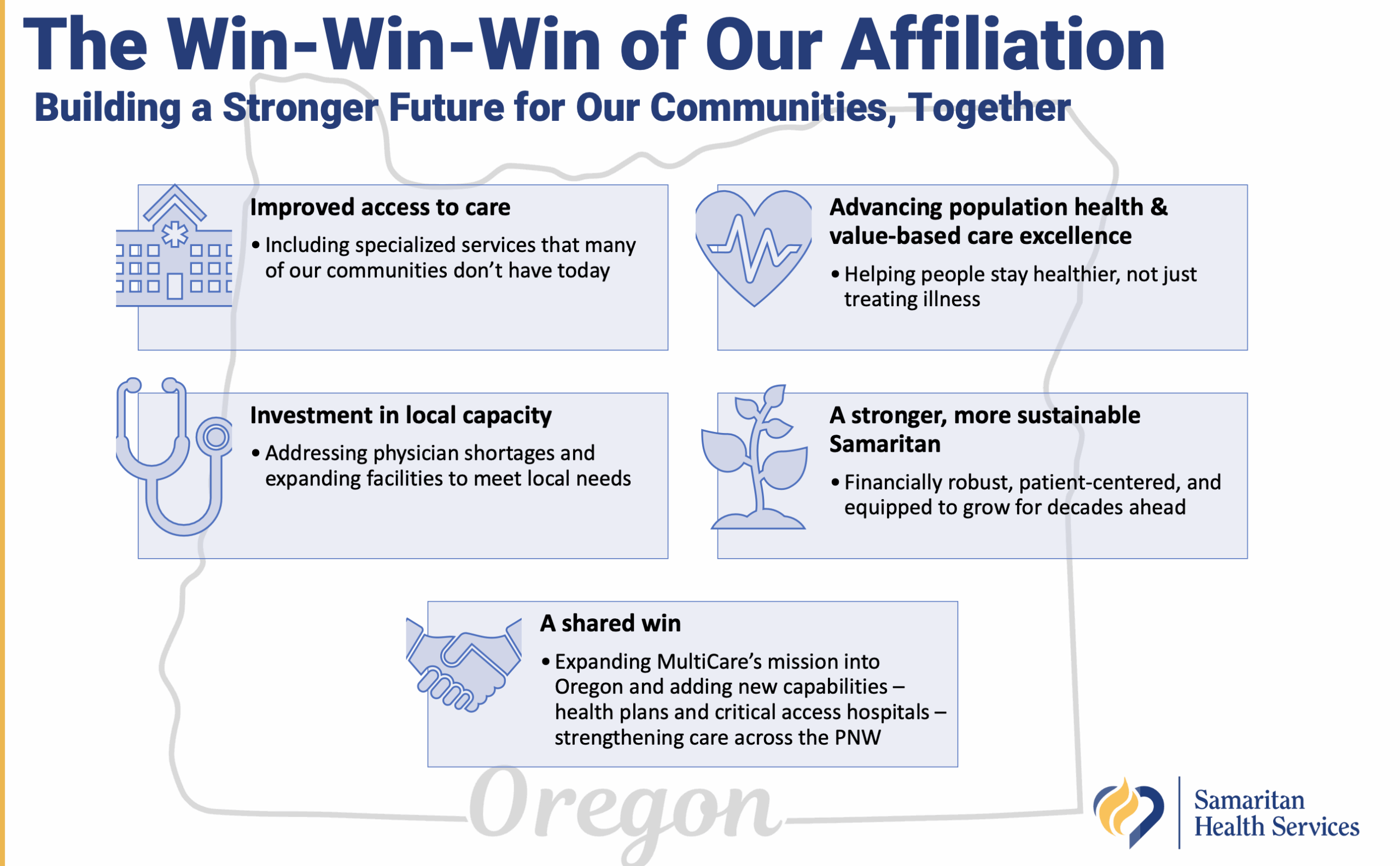 Samaritan Health Services says it has five overarching goals with its proposed merger with MultiCare Health System of Washington.
The other two reviews of the deal that are still underway include the Oregon Health Authority’s “Form A Review” program for coordinated care organizations like InterCommunity Health, and a separate Form A review by the Oregon Department of Consumer and Business Services, which oversees commercial health plans offered by Samaritan.
It’s unclear when the Oregon Health Authority will conclude its remaining review process, where public comments are still being accepted.
In June, a subcommittee of the state Medicaid Advisory Committee recommended the merger be approved and that MultiCare post a dashboard so the community can hold the system accountable.
Meanwhile, a Department of Consumer and Business Services spokesperson said a decision on Samaritan’s commercial health plans is likely to come in September. Public comment in that process closes Sept. 4.
- Nick Budnick is the editor of The Lund Report, an independent nonprofit health news organization based in Oregon. You can reach Budnick at [email protected].














Samaritan owns the Lincoln City hospital and the taxpayers of the Pacific Communities Health District own the Newport hospital. Does this mean that the new owners will pay off the debt of hospital district?