
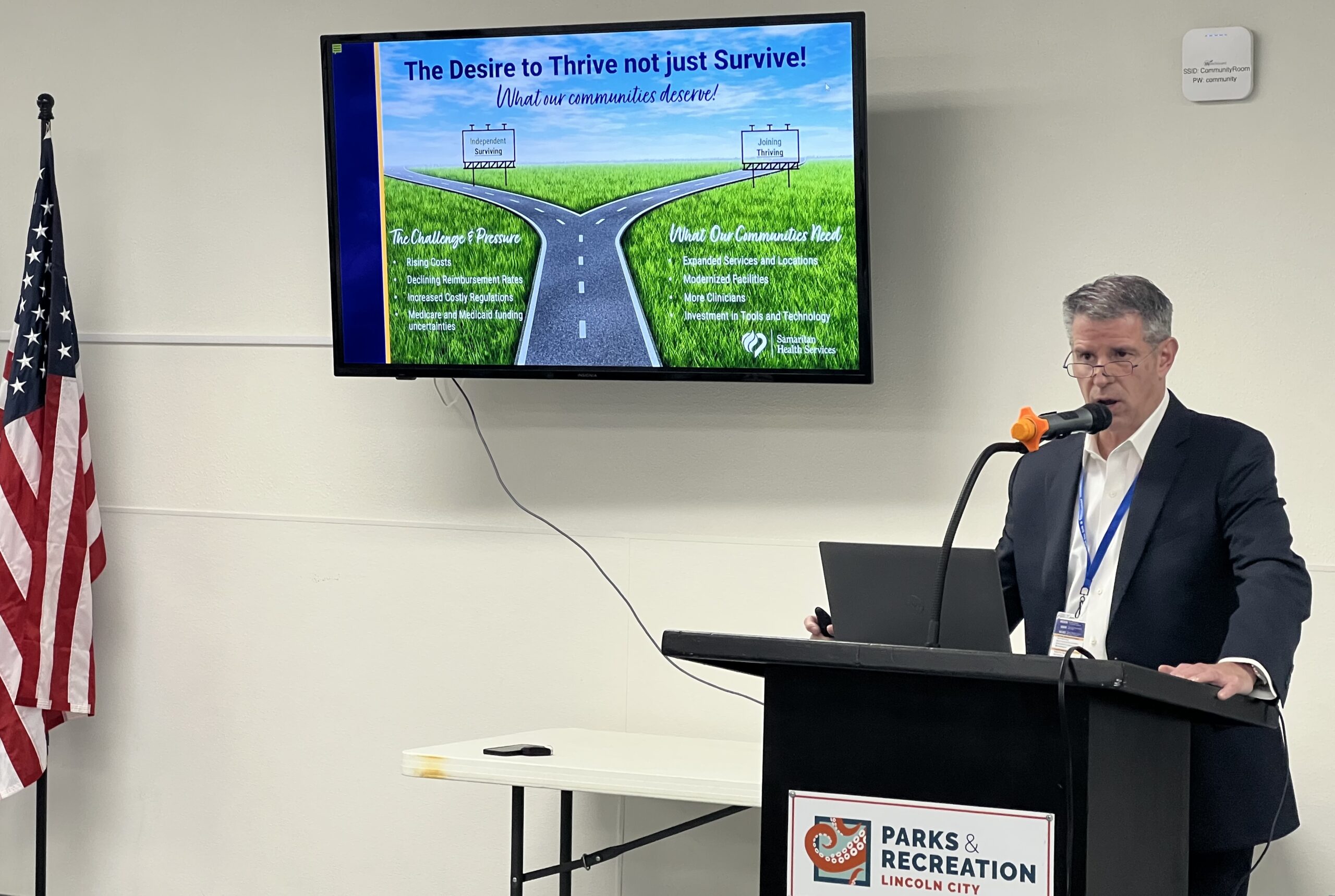
 Samaritan Health Services president and chief executive officer Marty Cahill explains a proposed merger with MultiCare Health System to a Lincoln City audience late last year. (Quinton Smith/Lincoln Chronicle)
By MIKE FRANCIS/The Lund Report
Public comment so far has been mixed on whether state officials should approve the proposed absorption of Corvallis-based Samaritan Health Services by MultiCare, which operates 12 hospitals in Washington state.
The proposed deal would bring the dominant health care provider in Lincoln, Benton and Linn counties under the wing of a much larger system that’s based in Tacoma. Leaders of the two health systems have told the state the deal is necessary to rescue Samaritan from its precarious financial condition and allow the system to stabilize and expand.
Samaritan operates five hospitals and employs more than 6,000 people. Under the proposed merger, MultiCare agrees to invest $700 million in the Oregon system over 10 years, as well as supply additional funding to back its health plans serving Medicaid and Medicare members.
Early this month state officials launched an initial 30-day review of whether the merger raises concerns or should be approved. The state merger review office is welcoming comment by email, voicemail or using the public comment form posted online. No formal deadline has been set, but comment will be accepted at least until the initial review ends, which could be as soon as early March.
So far, opinions range from outright enthusiasm for the deal to calls for caution before proceeding.
“This is a beautiful marriage that blends the strengths of each business,” a letter-writer named Steve wrote. “It will make both stronger.”
The Oregon Nurses Association, on the other hand, urged regulators to evaluate the proposed merger carefully. “We particularly fear that the affiliation, under the terms currently proposed, does not do enough to ensure that essential health services will be preserved in all communities served by Samaritan,” union members wrote, citing Samaritan’s earlier efforts to close its birth centers in Lincoln City and Lebanon.
And the three Linn County commissioners asked regulators to add conditions to the deal to ensure that MultiCare will invest in all its communities, and that the proceeds from the sale of any local assets be reinvested in the local community.
“If those conditions are included, Linn County will support the affiliation agreement application,” the commissioners wrote.
A state health care merger program set up by lawmakers in 2021 will consider the comments while conducting its own analysis. The Health Care Market Oversight office is charged with reviewing major deals to ensure they don’t hurt working conditions, cost and patients’ access to care
 Robertson
Critics cite research suggesting hospital mergers often increase cost, hurt care quality, or both. But MultiCare chief executive officer Bill Robertson told The Lund Report that affiliations such as the one proposed between MultiCare and Samaritan provide an opportunity to provide patients with “better care, better outcomes, [a] [a] better experience.”
Samaritan Health Services president and chief executive Marty Cahill has been giving public presentations around Samaritan’s three-county service area since late last year. “
“This is just the next step in the evolution of Samaritan Health,” he told a Newport audience in late January. “We found a like-minded partner.”
Cahill said Samaritan was especially attracted to MultiCare’s behavioral health care system, which he said was the largest in Washington state and which the Corvallis-based organization lacks. MultiCare provides both outpatient and in-hospital behavioral health services to adults and adolescents, operates the Navos Behavioral Health Hospital in Seattle, and is a partner with Virginia Mason Franciscan Health in operating the Wellfound Behavioral Health Hospital in Tacoma.
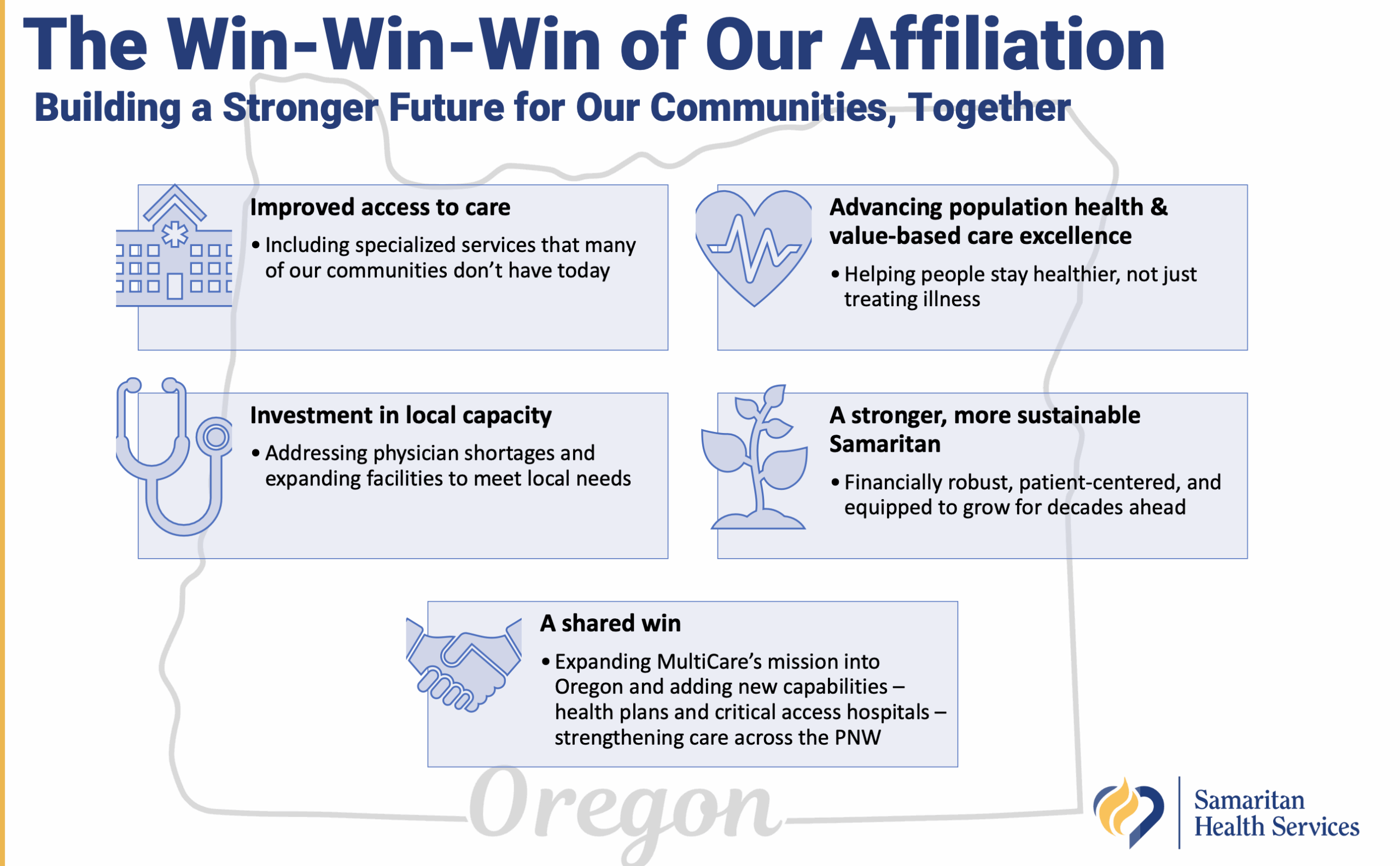 Samaritan Health Services says it has five overarching goals with its proposed merger with MultiCare Health System of Washington.
First steps if approved
If regulators approve the deal, Samaritan will recruit and hire 15 to 30 primary care, pediatric and behavioral health physicians, another five to 15 specialists, expand and upgrade its flagship Good Samaritan Regional Medical Center in Corvallis, add an emergency department in Albany, add six to eight urgent care centers, two ambulatory surgery centers, four to eight rehabilitation centers and one or two imaging centers, according to the merger application.
Also, MultiCare would pump additional money into Samaritan’s health insurance plans and work to improve their federal quality ratings, which it calls “a critical component” for success.
By backing Samaritan’s bonds, MultiCare could lower the system’s costs and improve its “access to capital,” the application said.
Cahill told The Lund Report he expects one of the first improvements to be a new emergency department for Samaritan Albany General Hospital, the busiest in the system. He expects the organization to build a new, off-campus emergency department with 10 to 12 beds within five to 10 miles of the hospital.
Other near-term improvements, which Cahill defined as taking place within three to five years, will include one or two ambulatory surgery centers, physical therapy services and outpatient facilities in Samaritan’s three-county primary territory.
After those upgrades, Cahill expects Samaritan-MultiCare to build an expanded wing of Good Samaritan Regional Medical Center in Corvallis. That project is probably five to eight years away, he said.
Samaritan will retain its name and branding, he said, but its building signs will incorporate the MultiCare name in a subordinate fashion.
 Dr. Lesley Ogden, chief executive officer of Samaritan’s hospitals in Newport and Lincoln City, helps explain the organization’s proposed merger with MultiCare Health System at a Newport Chamber of Commerce meeting in January. (Quinton Smith/Lincoln Chronicle)
Filings show change of direction
Samaritan Health Services has long been the dominant provider of health care in its territory of Lincoln, Benton and Linn counties, and portions of Marion and Polk counties. In addition to its flagship hospital, Good Samaritan Regional Medical Center in Corvallis, Samaritan operates hospitals in Newport, Lincoln City, Albany and Lebanon.
Like all health care systems, Samaritan has been squeezed by economic pressures, from workforce shortages to reimbursements from both government and commercial insurers that they say don’t cover their costs. According to filings, it has been running narrowly in the black, avoiding financial catastrophe, but without the resources it wanted to make substantial investments in its hospitals, technology or ambulatory centers.
The pressure on Samaritan emerged into view early last year, when the company went into technical default on its bonds. Then-CEO Doug Boysen acknowledged to The Lund Report that a purchase, merger, or partnership with an outside operator was possible, calling Oregon’s health care environment “unsustainable.”
Then the system’s consultant, Warbird Consulting Partners told Samaritan’s leaders the health care system could improve and stabilize its financial condition and remain independent by making a series of internal improvements, such as by finding a buyer or partner for its health plans.
Behind the scenes, though, Samaritan’s board “determined that remaining independent was not a viable strategy,” according to the merger application.
It retained another consulting firm, Juniper Advisory, which invited potential bidders to offer proposals to stabilize Samaritan’s finances and health care offerings. In all, Juniper approached 38 potential partner-acquirers, secured confidentiality agreements from 18 of them and got proposals from seven.
The choice eventually came down to MultiCare and another, unidentified potential partner, a health system that operates hospitals.
The unidentified system, which already operates in Oregon, wanted to spin off Samaritan’s insurance plans. Multicare, which has no Oregon presence and no health insurance business, said it would continue to operate them. In July, the two systems agreed to proceed toward a merger.
MultiCare, said Cahill, viewed Samaritan’s insurance business “as a strategic asset.”
MultiCare fields inquiries from potential partners “very frequently,” said Robertson. “We say no most of the time.”
Samaritan’s choice to seek a potential partner last year, said Cahill, “wasn’t a desperation play.” Samaritan had a bad year in 2024, recovering in 2025, he said. Along the way, “we just wanted to see what was out there for us.”
MultiCare was an appealing partner because of the two organizations’ cultural and organizational alignment, he said. And MultiCare provides the additional capital needed for Samaritan to expand access for residents in its territory.
 Tacoma-based MultiCare Health System has facilities across much of Washington, but its merger with Samaritan Health would be its first foray into Oregon.
MultiCare has been growing
Since 2021, Multicare has absorbed hospitals in Olympia, Yakima and Bellevue, while also partnering with Kootenai Health in Idaho. The nonprofit system is well known in Washington state and also operates three hospitals in Tacoma; and one each in Auburn, Spokane, Covington, Puyallup, Seattle and Spokane Valley.
The affiliation with Samaritan marks MultiCare’s first major foray into Oregon, although it offers outpatient cardiology services in the state via an office of Pulse Heart Institute in Bend. It also participates in a joint venture with Virginia Mason Franciscan Health to operate a behavioral health hospital in Tacoma.
MultiCare had 2024 revenues of $5.7 billion and employs more than 28,000.
Its investment income has kept MultiCare in the black for the last three years, although its operating losses have exceeded operating revenues each year. For the nine months that ended Sept. 30, the system’s revenues exceeded expenses by almost $194 million. These results don’t include the system’s recently acquired hospital in Bellevue, which added 349 inpatient beds to the 2,507 MultiCare is licensed to operate.
In its filings with the Oregon Health Authority, MultiCare discusses at length its experience in Yakima, where it acquired Yakima Memorial Hospital in 2023. Yakima was losing about $33 million a year on its operations before the takeover, and two years later reported an operating margin — or profit — of about $10 million.
The dramatic improvement happened, according to the merger application, because MultiCare helped the hospital reduce its lengths of patient stay, maximize reimbursements, reduce the reliance on contract labor, reduce supply chain costs, improve nurse retention rates and take other steps.
“Most importantly,” the application said, “Yakima achieved financial stability while improving clinical quality and keeping health care local.”
The acquisition proposal calls for MultiCare to invest $700 million over the next 10 years to recruit physicians and modernize and expand Samaritan’s health care delivery system, including its flagship hospital in Corvallis. When the deal is done, Samaritan will operate as a regional division of MultiCare, its sole member — essentially, its owner — while maintaining authority over Oregon operations, in collaboration with MultiCare.
“We’ll all be reporting to MultiCare,” said Samaritan’s Cahill.
While MultiCare holds ultimate authority, Samaritan will be managed by its Oregon leadership team, Robertson told The Lund Report.
“We’re very focused on health care being local,” he said. In Oregon “we’re going to rely on local leadership.”
MultiCare has no plans to cut Samaritan’s workforce, Robertson said.
“It’s hard to get health care staff as is. Why would we send them packing?” he said. “We want to keep the team members that we have.”
MultiCare and Samaritan insurance plans
MultiCare plans to take a hands-on approach to Samaritan’s health insurance business, which includes plans for commercial customers, self-funded groups and Medicaid members.
Last fall, Samaritan sparked concerns for nearly 14,000 customers in Lincoln, Benton and Linn counties when it announced plans to stop offering Medicare Advantage plans in 2026. It has continued to offer a smaller “special needs” plan to people who qualify for both Medicare and Medicaid, according to the merger application, and that would continue.
But a spokeswoman said Samaritan “is not able to determine whether offering a Medicare Advantage plan will be part of future plans with MultiCare.” Robertson also said MultiCare has not made a final decision on insurance it might offer “but we do feel the Medicare Advantage space is important to the future of MultiCare.”
Health plan officers would report directly to MultiCare, according to filings, while MultiCare invests in support of Samaritan’s insurance operations. The plan, in other words, Robertson said, is to “connect the health plan to … our corporate chassis and disconnect it from Samaritan Health.”
As part of that, MultiCare will take over control of the InterCommunity Health Network Coordinated Care Organization, which is the regional managed care entity Samaritan operates under contract for the Oregon Health Plan — the state’s version of Medicaid. The organization oversees care for more than 81,000 lower-income people in the three counties and has amassed more than $175 million in reserves and assets. The Oregon Health Authority is conducting a separate review of that transaction, and people can comment on that part of the deal as well.
As the Oregon Health Authority conducts its reviews, the state’s Department of Business and Consumer Services is conducting a separate review of MultiCare’s application to take over Samaritan’s commercial health plans. Those filings are available on the agency website. The agency’s protocol is to open the review to public comment after it conducts a public hearing.
MultiCare operates no health plans currently, but sees Samaritan’s plans as a business opportunity. They fit into MultiCare’s strategy of “population management,” in which a health system works to improve the health of a large population over a period of time.
“Scale is central to how a health plan works,” Robertson said. “When you get the law of large numbers in play.”
While MultiCare doesn’t offer health insurance to the public, it manages health coverage for its 28,000 employees and their dependents and also participates in Medicare’s Program of All-inclusive Care for the Elderly, or PACE, which is an all-inclusive, government-sponsored health program for dual-eligible seniors.
“We have over 400,000 individuals that our infrastructure already manages,” Robertson said. “And so there’s an opportunity to connect what we have with the health plan infrastructure that Samaritan Health has.”
- Mike Francis is a longtime journalist at The Oregonian, The Business Journal of Portland and The (Bend) Bulletin. He is an editor at large for The Lund Report and can be reached at [email protected].