 Supporters of Oregon’s ocean Dungeness crab fleet inflated a giant crab at the Oregon Department of Fish and Wildlife Commission meeting in Springfield in February. The meeting focused on a petition from conservation groups seeking to impose new regulations to reduce humpback whale entanglements in crab fishing gear. (Garret Jaros/Lincoln Chronicle)
By GARRET JAROS/Lincoln Chronicle
The Oregon Department of Fish and Wildlife is hosting a public meeting Tuesday to discuss Oregon’s commercial ocean Dungeness crab fishery and measures to avoid whale entanglements.
The meeting, scheduled from 1-4 p.m. at Oregon Coast Community College in Newport, will include updates related to whale entanglements and opportunities for fishermen and community members to comment on planned agenda items for the Aug. 14 ODFW commission meeting in Salem.
The meeting is one of three in a series hosted by the agency. The first was held Thursday in North Bend and the final one is in Astoria on Thursday, May 14. All of the ODFW staff involved in crab and fisheries management will be in attendance.
The Dungeness crab fishery is Oregon’s most valuable ocean fishery, fishermen had a record-breaking payout of $97.1 million in 2024-25, but there is growing concern over whales getting tangled in crab gear.
Tuesday’s agenda includes evaluating five-year risk reduction measures, vessel monitoring and electronic logbooks, and experimental fishing gear permits.
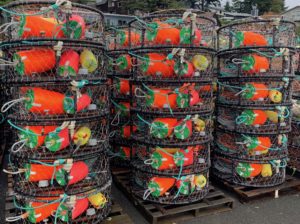 Newport is the center of the Oregon commercial crab fleet, with crab pots, rope and buoys stored all up and down the Bayfront. (Quinton Smith/Lincoln Chronicle).
Updates on entanglements touch on the four confirmed humpback whale entanglements in Oregon Dungeness crab gear in 2025 – a record for the state – and the resulting petition by conservation groups to fast-track protective measures that were supported by ODFW staff but ultimately rejected by the commission at its February meeting in Springfield.
“So we will be talking about that a bit and updating the public if they’re not familiar that there was a petition,” said ODFW commercial crab project leader Cathleen Vestfals. “And discussing the commission’s ruling.”
Updates will also include the pre-season fleet wide advisory around best practices to avoid conflicts with migrating whales, temporarily moving up late-season measures this season by reducing the number of crab pots allowed per vessel, limiting fishing to shallower waters a month early, and a progress report on completing a conservation plan that would allow for a pre-determined number of entanglements without affecting the fishery.
“There’s a lot of interest about the conservation plan and there was a lot of talk about it during the February commission meeting,” Vestfals said. “We have a draft conservation plan from 2021 that we’ve been working on with the National Marine Fisheries Service and going back and forth on. So people are asking ‘Why hasn’t this been submitted? Why don’t we have a take permit?’ So providing some updates and highlights on what the plan is about and where we are in the process.”
Risk reduction measures first implemented in 2021 will also be evaluated. These included a late season pot reduction, depth limits, and late-season tag requirements on gear to help better monitor when whales become entangled.
Electronic monitoring proposal
There will also be a discussion around vessel monitoring and electronic logbooks, which can be a way to better track where gear is set and the impact that may have on entanglements.
Washington and California have implemented electronic monitoring, Vestfals said. Washington requires a vessel monitoring unit and a hydraulic sensor. California just requires the unit. The unit shows where each boat is going while a hydraulic sensor indicates when crabbing is occurring
“And we will be proposing following the Washington requirement, having a hydraulic sensor to measure the pressure so you can see when vessels are actively fishing,” Vestfals said.
The proposals would also move crabbers from paper to electronic logbooks and is primarily driven by the need for faster, more accurate and efficient data collection to help improve fisheries management, ensure regulatory compliance and reduce administrative burdens.
Also to be discussed Tuesday is a proposal for experimental fishing gear permits. The suggestion to move from traditional crab pot gear to “pop-up” gear was one of the requests by conservation groups at February’s ODFW commission meeting and the one crabbers called the most “disastrous” because of the cost to the industry.
Crabbers say pop-up gear, also known as ropeless or on-demand gear, is cost prohibitive. This type of gear stores ropes and buoys with traps on the seafloor rather than using vertical lines that pose entanglement risks. When fishermen are ready to retrieve their catch, they use an acoustic signal to trigger the release of the buoy, which rises to the surface for retrieval.
The gear has never been tested in the tumultuous waters off the Oregon coast or the Columbia River where shifting tides can bury pots in sand and sediment and scatter them far from where they are initially placed. It has been tested with success off the central California coast.
“There’s been a lot of resistance to that from industry saying ‘Well that’s off of California and they have different conditions there’,” Vestfals said. “And so will it work in Oregon waters? We don’t know. And so this is an opportunity to work with the industry so that they can go out and test this gear, either pop up gear or long line gear or in combination so it’s reducing the lines in the water. And trying to get input on that from industry.”
There will also be a discussion Tuesday of long line crabbing, which involves dumping multiple pots that are connected by lines underwater instead of each having a vertical line connected to its own buoy.
“There’s some issues around trying to avoid gear conflicts and safety,” Vestfals said. “Because they used to long line in the past off of Oregon but then it became prohibited. It was difficult to enforce pot limits. And basically, it might be better for a larger boat versus a smaller boat because there may be safety and stability issues.”
ODFW staff will recommend to the commission in August testing both types of gear in different areas with different sized vessels “to get an idea of is this feasible” and to see if gear conflicts, which fishermen warn about because pots will not be visible via individual buoys on the surface, can be avoided.
“So we’ll just try to get input at these public meetings about the number of permits and some of the eligibility requirements, crab fishery participants, and take a look back at compliance history,” Vestfals said.
- Garret Jaros covers the communities of Yachats, Waldport, south Lincoln County and natural resources issues for Lincoln Chronicle and can be reached at [email protected]