 A five-member pod of killer whales swims close to the south jetty of Yaquina Bay headed back to sea after making a trip up river in search of seals for prey.
From news reports and Lincoln County staff
Those killer whales that thrill many Oregon coast residents when they prowl into coastal bays and rivers each spring have their own distinct population numbering about 350 individuals, according to a British Columbia researcher well-known for keeping track of the orcas off the central coast.
That’s the conclusion just published after years of research by Josh McInnes, a University of British Columbia master’s degree student who might be best known locally for establishing a highly popular Facebook page allowing coastal residents to report and track killer whale activity.
The findings of McInnes and a co-author show that the transient killer whales living along the West Coast between British Columbia and California are actually divided into two separate sub-populations known as inner and outer coast transients.
A study published in PLOS One used 16 years of information from more than 2,200 documented encounters to reevaluate long-standing ideas about these mammal-eating orcas. The results overturn earlier assumptions and point to a clear ecological split.
 McInnes
“I’ve been thinking about this possibility for 15 years,” said McInnes, who conducted the research as part of his master’s degree at the University of British Columbia’s Institute for the Oceans and Fisheries. “Now our findings show the West Coast transients are two distinct groups, split along an east-west divide. They eat different things, hunt in different areas and very rarely spend time with each other.”
Killer whales that frequent the West Coast fall into three recognized types — transients, residents and offshore. A fourth potential group, referred to as an ‘oceanic’ population, has also been proposed. Transients occur in six regions worldwide, and the West Coast transient population is the best studied, with its own identifiable genetic traits.
Researchers previously suspected that this West Coast community might be divided along a north-south boundary. Instead, the new data reveal that the differences align more strongly with the inner and outer coastal waters used by the whales.
“The inner coast killer whales are like city dwellers,” said co-author Andrew Trites, the director of the university’s marine mammal research unit. “They’re experts at navigating busy, maze-like streets of nearshore inlets, bays and sheltered waterways — whereas the outer coast killer whales are more like backcountry dwellers thriving in deep canyons and rugged underwater terrain along the edge of the continental shelf.”
To investigate these patterns, the research team analyzed social interactions using photo identification collected between 2005 and 2021. Images from scientific surveys and public sightings allowed researchers to match individuals and determine which whales were regularly seen together.
“We essentially drew friendship maps to see which whales spent time together, and then looked at where they were seen to figure out if they hung out in specific neighborhoods,” said Trites.
The team found that inner coast transients, estimated at roughly 350 individuals, typically stayed 3-4 miles from shore in relatively shallow areas. Their diet centers on smaller marine mammals including harbor seals and harbor porpoises, and they usually travel and hunt in groups of about five.
Outer coast transients, numbering about 210 orcas, were most often found within 12 miles of the continental shelf break, particularly near canyons. These whales ventured as far as 75 miles offshore and covered large distances. Their prey included larger species such as California sea lions, northern elephant seals, gray whale calves and Pacific white-sided dolphins, and they typically hunted in groups averaging nine individuals.
The researchers said the contrasts between the two groups may reflect the distinct marine environments they occupy or may be influenced by human activity in these regions, including the reduction or harvesting of key prey species.
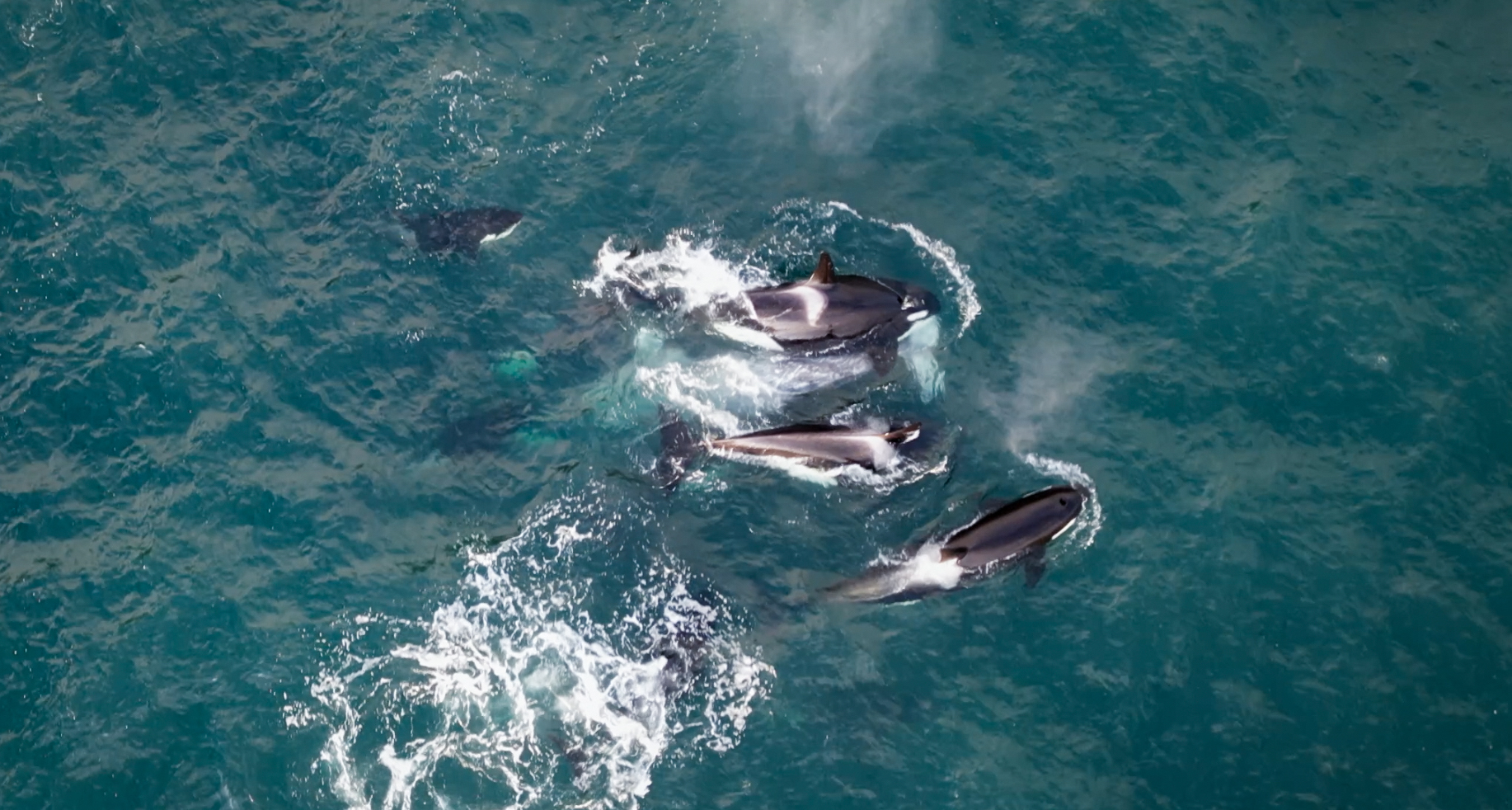 In an event witnessed by dozens of people nearby, a pod of 10-12 killer whales ram and try to drown a gray whale calf in May 2023 near the shoreline of Cape Foulweather north of Newport.
Rare interactions
Although both groups use a broad range that stretches from Southeast Alaska to southern California, they rarely interact. Less than one per cent of sightings involved both groups at the same time.
“I have seen outer coast transients acting strangely around inner coast animals,” said McInnes, co-founder of the Oceanic Research Alliance. “One of the sightings reported a group of single male outer coast orcas slapping each other with their dorsal fins and charging at inner coast females.”
Because offshore research is particularly challenging, scientists note that more subpopulations may exist in remote regions that have not yet been thoroughly surveyed.
The authors stress that their findings highlight how these transient killer whales move across jurisdictional boundaries and how conservation planning needs to account for their differing lifestyles.
“These two communities of transient killer whale inhabit very different worlds and lead distinctly different lives,” said Trites. “Protecting them will take more than a one-size-fits-all approach. Each needs a tailored plan that reflects their unique needs and the specific threats they face.”