

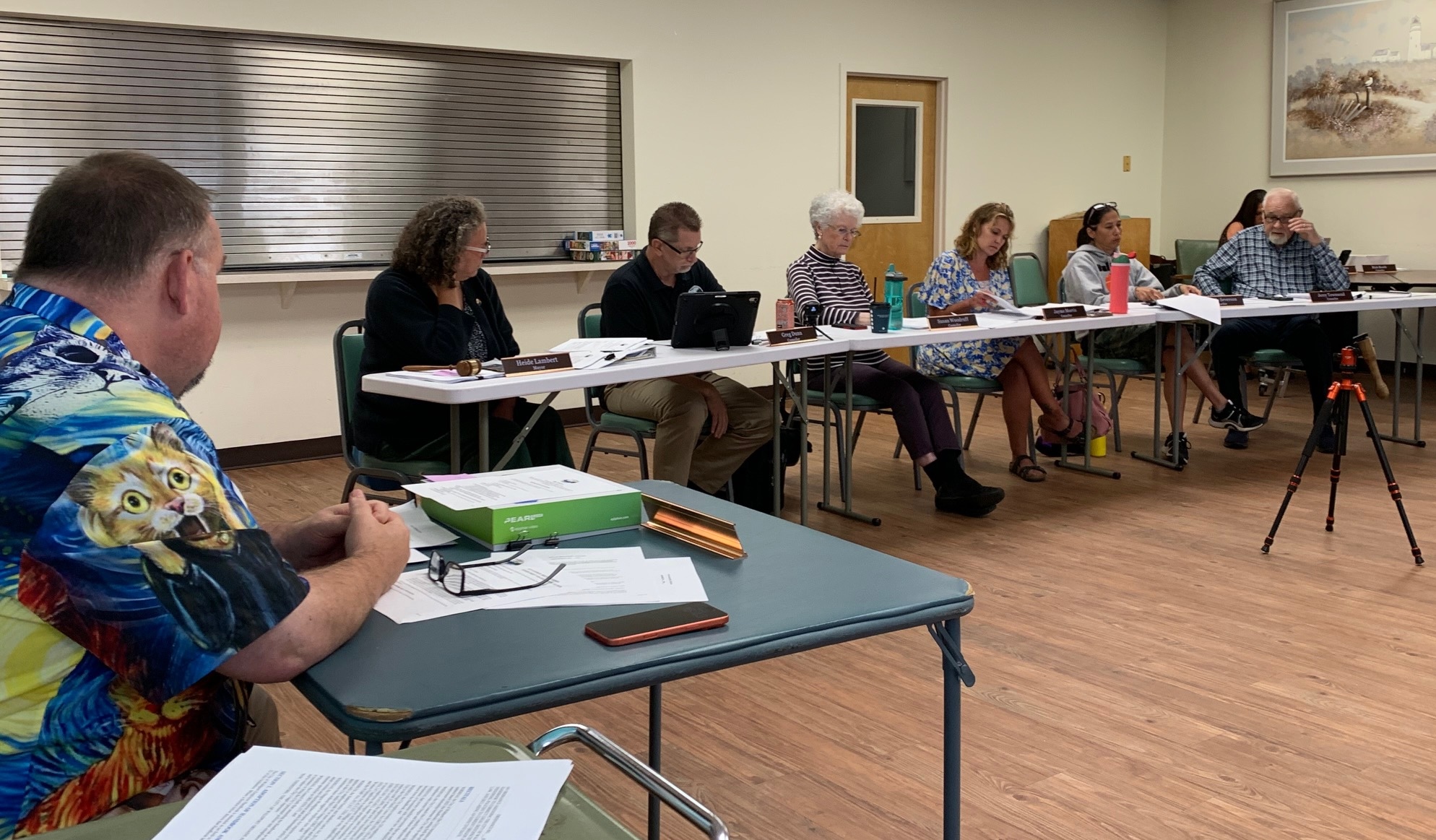
 Waldport Councilor Jerry Townsend, right, talks about complaints against city manager Dann Cutter, left, during a public hearing Thursday. (Garret Jaros/Lincoln Chronicle)
By GARRET JAROS/Lincoln Chronicle
WALDPORT – A long-awaited hearing to address complaints against city manager Dann Cutter over his conduct and communications resulted in a decision by the city council to send the issues back to attorneys for more review.
The five complaints under consideration by the council at a special hearing during its monthly meeting Thursday were filed in last August and September by two Waldport residents, the Confederated Tribes of Siletz Indians’ chief executive officer, and Waldport Mayor Heide Lambert.
Councilors promised to hold a hearing shortly after the complaints were filed but were delayed nearly a year while attorneys with the city’s insurance company and the city’s attorney conferred whether a public hearing and its outcome might result in a lawsuit against the city.
The complaints by Todd Swift and Judith Hees, and tribal director Kurtis Barker and Lambert, who filed two complaints, were posted on the city’s website. Cutter also posted his responses and 110 pages of exhibits to support his contention that the communications and actions were either part of his duties, authorized by the council, or protected under the First Amendment and Oregon’s whistleblower statutes.
Thursday’s hearing was not the council’s first review of complaints against Cutter. In an April 2025 letter posted on the city’s website, the council said it had received 12 letters of complaint, all from people associated with the Beachcomber Days organization, and after questioning Cutter sustained none of them.
The delay in a decision about whether to allow the special hearing on five complaints came down to options available to the council and any disciplinary actions it might choose to take. The council met in executive (closed) session July 23 where it heard from the city’s attorney the options if they chose a hearing.
That information was made public during Thursday’s hearing — and revealed that council’s hands were tied.
A memo from city attorney Corey Blake said the council had instructed Cutter to investigate the nonprofit group Beachcomber Days and to share the results of the investigation with “the press, law enforcement and the public.” Because of that, Blake said, no action should be taken against the city manager on those because it would expose the city to lawsuits.
Blake also noted Cutter has a protected free speech right to comment on public figures or matters of public interest and that punishing him for exercising that right could also result in a lawsuit. The attorney laid out four options for the council:
- Determine that no disciplinary action is warranted;
- Impose discipline short of dismissal, including suspension, demotion, a written reprimand or other corrective action consistent with Cutter’s employment contract, personnel rules and the city charter;
- Fire Cutter; or
- Refer the matter back to attorneys for further review.
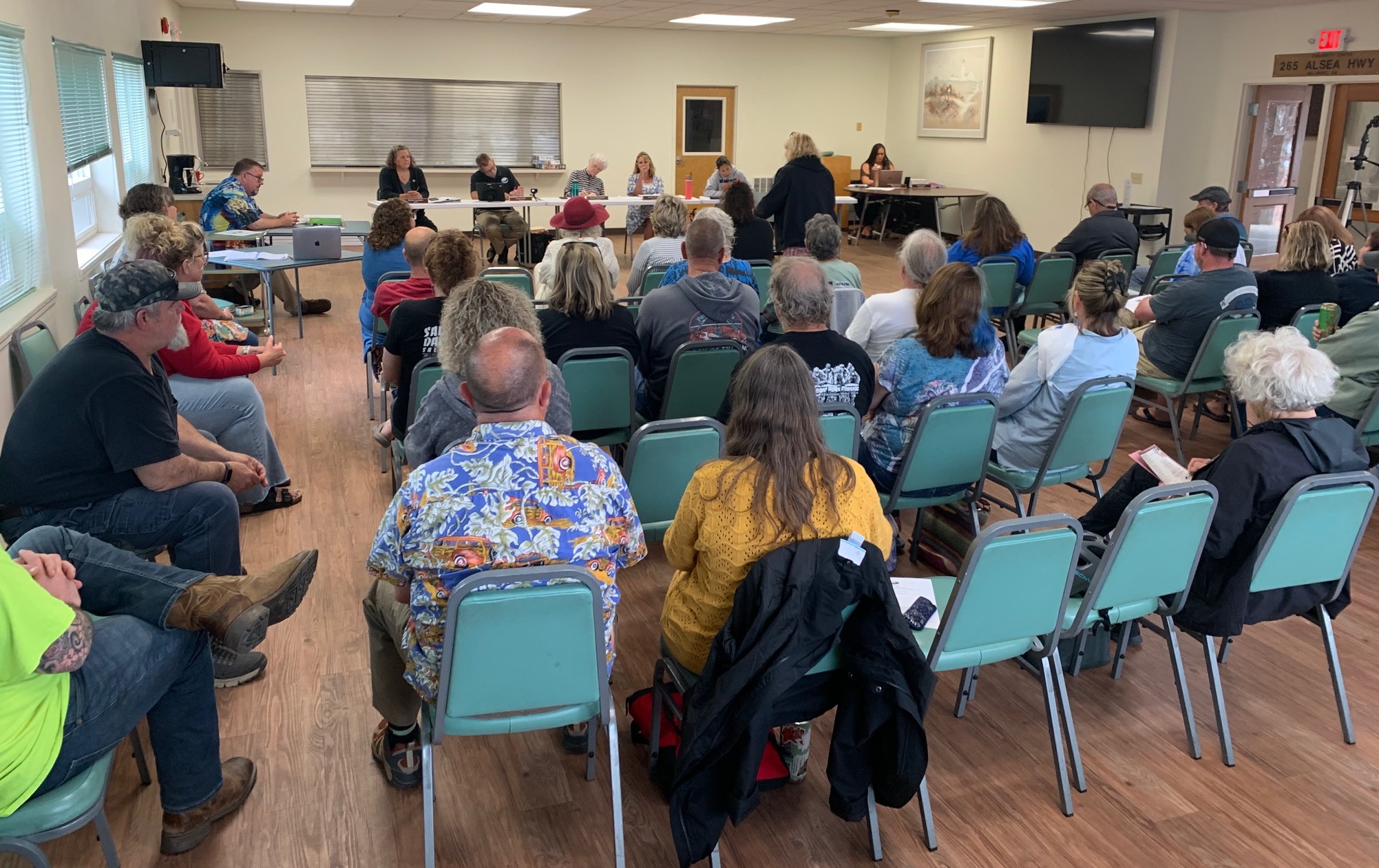 The Waldport city council meeting Thursday drew a large crowd to comment and then observe a public hearing on complaints against city manager Dann Cutter. (Garret Jaros/Lincoln Chronicle)
Hearing was public
It was Cutter’s choice Thursday whether to hold a public or private hearing to address the complaints. He chose a public hearing, telling the Lincoln Chronicle in January that a public hearing would allow him to detail the link between Beachcomber Days and the unsuccessful recall of the city council by two of the nonprofit’s volunteers — Tony Thimakis and Judith Hees — along with statements he alleged were made by Lambert about creating a “gray area” for Beachcombers.
“I would like nothing more than to tell that tale because I think it paints a pretty clear picture of corruption,” Cutter told the Chronicle.
While Cutter did raise the Thimakis/Hees connection during the hearing, he did not mention Lambert, who dropped two complaints from last September because she said they were made moot by a council resolution in January.
That resolution “authorized and ratified” the city manager’s actions to release documented information “to the press, to law enforcement and to citizens detailing the results of the city’s investigations; and that all actions taken … including advocacy to other governmental entities, are an expected part of the duties of the job of city manager to uphold the law and protect the citizens of Waldport.”
The resolution also gave blanket approval of Cutter’s email communications with Barker – whose Aug. 12, 2025, complaint, stemmed from emails that alleged fraud by Beachcomber secretary TiAnne Rios.
The council’s initial resolution came Dec. 12, 2024, following an executive session when the council approved Cutter turning information over to the Lincoln County Sheriff’s Office and the Oregon Department of Justice.
Eleven months later, council president Gregg Dunn, at the behest of the city attorney, proposed that they acknowledge they had instructed Cutter to communicate with and provide investigation materials and to ratify Cutter’s release of that information to the press and police.
The council discussed the need for that motion, and then noting they had already passed a resolution in December, rejected the motion 4-2.
The issue was again brought to the attention of council by request of the city attorney at its Jan. 15 meeting. Following an executive session, the council unanimously passed a resolution to clarify the intent of its December 2024 resolution. Lambert and Councilor Rick Booth were absent.
The complaints
On Thursday, the complaints against Cutter, having been reviewed by the council, were not read aloud. Instead, Cutter was allowed to respond to each of them followed by council discussions.
Confederated Tribes of Siletz Indians: Barker wrote to Lambert and the council on Aug. 12, 2025, saying the tribe found Cutter’s comments in a dispute over 4-H grants “highly offensive and out of line.” The dispute traced to a $3,181 grant the tribe’s charitable organization issued to a local 4-H club. Cutter asserted publicly the grant was misused before it was eventually returned. Barker said the tribe considered the matter resolved, did not view it as a victim, and asked to be excluded from any further media coverage of the issue.
In his response, Cutter acknowledged that his tone in communicating with the tribe had been sharper than required. But he stood by the substance of what he said, telling the council his statements were based on the original 4-H application, an Oregon State University 4-H investigation into the club’s finances, bank records showing most of the grant was withdrawn in cash shortly after it was deposited, and the eventual repayment months later under OSU pressure. He said the correspondence became public through the tribe’s own disclosure, not his, and that his statements were protected as both free speech and a whistleblower disclosure.
Todd Swift: Swift filed complaints in September 2025 that he said were compiled from a group of citizens who feared retaliation if they came forward. It raised four issues: Cutter’s emails to the Siletz tribe, which Swift said compared the tribe unfavorably to institutions associated with coverups; Cutter’s handling of a planned October workshop with the Township 13 Homeowners Association, which Swift said the city manager reshaped into a town hall format against the council’s wishes; Cutter’s contact with the sheriff’s office and the district attorney that Swift characterized as pressure to prosecute a case they had already declined; and, public Facebook comments in which he said Cutter accused him of lying and criticizing his former work in law enforcement.
Cutter’s response noted that two of the four issues were brought on Swift’s behalf by unnamed citizens which he said made a full response impossible. Cutter said his communication with the tribe was a private, official exchange within his duties as city manager. He said the October meeting was properly a public meeting of the council, not a closed negotiating session and that managing it was part of his job. He said his contact with the sheriff and district attorney amounted to a legitimate question about the value the city receives for a law enforcement contract worth more than $300,000, not an attempt to direct prosecutorial decisions. On the Facebook comments, Cutter said they were posted from his personal account in direct response to a post by Swift, that they addressed matters of public record from Swift’s law enforcement career, and that both the comments and his reference to Swift’s former employer were protected opinion and speech on a matter of public concern.
Judith Hees: Hees filed a complaint in September 2025 saying she suspected Cutter had investigated her background after he referenced in a comment on a social media post, a recall petitioner who was “just getting off probation” and owed the court money. Hees, who is the treasurer of a committee that sought to recall councilors, said she fit that description and viewed the comment as an attempt to intimidate her.
Cutter responded that the information on two convictions and an associated payment plan was drawn from public court records and required no investigation to find. He said he posted the comment from his personal account and not on behalf of the city, and that Hees, by serving as the recall committee’s treasurer, had voluntarily entered a public controversy. He also tied the comment to his broader whistleblower disclosures about Beachcombers’ handling of city and charitable funds, arguing any discipline over it would amount to retaliation against a protected disclosure.
A public hearing
In the public comment period prior to the hearing, Swift expressed his consternation that information from Cutter’s online comments that had spurred his complaint were now published on the city’s website in Cutter’s response, along with further detailed information.
During the hearing, councilors questioned Cutter about his choices and motives, including the information about Swift, with Woodruff asking what if any of that had to do with issues concerning the city and the community. Cutter replied that his comments were protected speech under the First Amendment, made from his Facebook account as a private citizen, and that he was questioning Swift’s credibility for his online statements.
 Lambert
 expressed frustration for not having full documentation of the underlying complaint material – online communications and email threads – to better understand and consider them. Cutter said Lambert was emailed those complaints.
Lambert also said she was frustrated that one of the options from the city attorney did not include having Cutter investigated by a third party, which she said the attorney last year said could be requested at the hearing. Blake did tell the council in order to have an investigation there needed to be a hearing, but only specified that a hearing had to occur in order to have any outside investigation.
Lambert was then the sole vote against holding a hearing.
As the hearing proceeded, councilors expressed multiple operational and procedural concerns regarding the grievances filed against Cutter. Lambert continued to raise concerns regarding a lack of documentation and consistently pushed for an independent, third-party investigation to determine whether online activities and background checks into citizens occurred during official city work hours or fell outside Cutter’s appropriate scope of work.
Councilor Michelle Severson questioned whether a third-party investigation could even determine whether Cutter was responding to people on Facebook during work hours or on his own time.
Woodruff then pointed out that according to his contract Cutter “manages his own time” and is not bound like regular city workers by the employee handbook. Cutter said social media posts were made on his own time but explained that under the terms of his contract, the “time, place, and manner” of his employment is entirely determined by himself.
Regarding Barker’s complaint, Severson and other councilors expressed serious concern over Cutter’s direct, harsh tone and forceful delivery.
While councilors acknowledged the severity of the operational and interpersonal issues raised, several noted potential legal constraints regarding protected free speech rights and in the case of the tribe, whistleblower statutes. Cutter told the council he had filed an official whistleblower complaint with the tribe based on his interactions with Barker and his complaint and the tribe’s own whistleblower policy.
Before Lambert dropped her complaints against Cutter, he made clear that his response to her second complaint made clear he considered it a continuing narrative in creating a hostile work environment for he and city staff.
Lambert countered that unless he has filed a formal complaint, it was not relevant to the hearing. Cutter disagreed.
“You need to read the letter that is included here because you will note that I have, at the last page, expressed a notice of intent to litigate and demand for dismissal,” Cutter said. “And that is the equivalent of a tort notice to the city.”
“So this is your formal letter?” Lambert asked.
“Yes,” Cutter said. “Specifically on the second to last page, notice the potential litigate and demand for dismissal. Effectively, I have provided more than enough detail in this that this is protected speech, whistleblower retaliation, and the filing and the maintenance of this grievance constitutes a hostile work act. And that I’m asking for it to be dismissed with prejudice. And failing that, I will act accordingly.”
The council acknowledged that any formal disciplinary action based on free speech could expose the city to significant legal liabilities before ultimately voting to refer matters back to attorneys for review.
 Townsend
Councilor Jerry Townsend maintained that while the council lacked the legal standing to issue formal discipline over the grievances, the significant issues raised should be addressed during Cutter’s upcoming performance evaluation.
“To me that’s where we should rightfully deal with all of it, because to me it’s clear that we don’t have the legal right to discipline based on any of these complaints, regardless of whether we consider them valid or not,” Townsend said. “We can’t really act on them in that way. Whatever happens is going to have to be collaborative. It’s going to have to be frank, and it’s going to have to be between the council and the city manager directly. Serious conversations about important issues that these complaints have raised with us, that I think we all acknowledge are significant and need to be addressed.”
- Garret Jaros covers the communities of Yachats, Waldport, south Lincoln County and natural resources issues for Lincoln Chronicle and can be reached at [email protected]














Setting aside all the Waldport drama, did anyone read the exhibits Mr. Cutter provided? How are we not aghast at Mr. Swift’s comment that he was ‘never disciplined?’ This is the equivalent of George Floyd’s killers bragging that they got away with it. Mr. Swift was a Corrections officer who watched an injured prisoner die while ignoring it. Watched him die painfully. Let him die without help. I can only thank Dann Cutter for calling attention to this person in our midsts.
This insane comedy show in Waldport has gone on far too long. Lambert and the other complainants ought to be ashamed of themselves. Cutter may be blunt, but in my book he’s a breath of fresh air fighting a bunch of small-minded people.
The council should sentence the city manager to one semester of public relations and communications coursework paid for out of the mayor’s discretionary funds. The mayor should offer to double the amount for a second semester and to fund his Masters Degree work should she receive any payments from the city for looking out for its best interests via her lawsuit.