

 Jim Adler has been unofficially tracking rainfall from his home above the Yachats River with an automated rain gauge for the past 17 years. And what he and other coastal weather watchers are seeing is a microcosm of conditions across the Oregon – less precipitation and dryer summer conditions arriving in the spring. (Garret Jaros/Lincoln Chronicle)
By GARRET JAROS/Lincoln Chronicle
Nestled in a patch of rainforest above the Yachats River three miles from the ocean is Jim Adler’s home where he has been unofficially tracking rainfall for 17 years.
What he and other weather watchers who measure precipitation have been seeing is increasingly drier springs and summers that state officials are now warning is becoming the new normal in a region renowned for its rain.
“I have a 4.94 inch average during May,” Adler said. “And we’ve got 1.15 so far this month. And for the first four months of this year, I noticed that we’ve been 30 percent below my average for those four months over a 17-year period. And I think 30 percent is a lot.”
 Jim Adler reviews his hand-written sheet of monthly and annual rain totals dating back to 2008. “The lowest year was 2013 with 64.43 inches,” he said. “And we actually had a better four first months in 2013 than we’ve got now.” (Garret Jaros/Lincoln Chronicle)
Adler is not interested in absolutes so much has relative measurements, he said while looking back over the years of his handwritten sheet of monthly and annual rain totals.
“The lowest year was 2013 with 64.43 inches,” he said. “And we actually had a better four first months in 2013 than we’ve got now.”
Adler’s little slice of heaven up the Yachats River is indicative of what’s going on all over Oregon.
Eighty-two percent of Oregon is in some form of drought, according to the U.S. Drought Monitor, with 31 percent of the state in severe to extreme drought.
Current drought conditions are being driven by persistent short- and long-term rain and snow deficits, below-normal soil moisture and streamflow conditions, above-normal evaporation and well below normal snowpack, according to the monitor.
Twelve counties including Coos County, have already received a state drought declaration and three additional counties have requested one. The northern Oregon coast, including Lincoln County, is experiencing abnormally dry conditions, according to the monitor, while the rest of the coast from south Lane County to the California border is in a moderate drought.
So far this year, Lincoln County is experiencing its 20th driest year in 132 years of state and federal record keeping.
Last year, Lincoln and Baker counties were the first to ask for and receive drought emergency declarations by Gov. Tina Kotek. Lincoln County commissioners, on the advice of an ad-hoc drought committee, sought the declaration in late June based on low river levels and past weather patterns that show the region would not receive substantial rain again until late September or October.
 The Siletz River, which provides water to Siletz, Toledo, Newport and the Georgia Pacific paper mill in Toledo, acts as a bellwether for precipitation and water availability across Lincoln County. This month the river dropped below half of its average flow, warning of possible water restrictions to follow. (Garret Jaros/Lincoln Chronicle)
Rivers dropping
Alan Fujishin is a Lincoln Soil & Water Conservation District board member and custom farming adviser in the Siletz area. He is also a member of the ad-hoc committee that includes county water and land managers, municipal water providers, the Oregon Department of Fish and Wildlife and the regional water master for the Oregon Water Resources Department.
“May is kind of when we start circling the wagons about whether there is a drought concern,” Fujishin said. “Because prior to that it’s just too hard to predict precipitation. But now we are going into our drier season and I think a lot of people are aware this spring that it’s drier than normal.”
 Alan Fujishin is again worried about flows in the Siletz River after another winter and spring of below-average rainfall and heavy summer use. (Lincoln Chronicle file photo)
While counties in other parts of the state can rely on reservoir levels coming out of winter to predict their situations, that is not the case on the coast which relies on precipitation alone to fill rivers and creeks and saturate soil, Fujishin said.
“If we get seasonal precipitation at even average rates, we’ll probably squeak by kind of okay,” he told the Lincoln Chronicle. “But if it’s below average or significantly below average, then we can have a problem.”
Seasonal climate forecasts by two Oregon agencies are “showing an average to maybe a little better than average precipitation profile for the next three months on the coast,” Fujishin said.
But what he’s seeing on the Siletz River has him concerned.
“We’re below average,” Fujishin said on May 1. “We’re somewhere around 500 cubic feet per second of flow and the average for this time of year is a little over a thousand cubic feet per second. Psychologically for me, 50 percent of average is when I start worrying about it at any time of year.”
The silver lining, he added, is that this time of year 50 percent of average is still enough not to stress fish and other aquatic organisms.
However, the U.S. Geological Survey, which provides flow data for rivers and creeks that water purveyors in Lincoln County rely upon, showed the Siletz just above 300 cubic feet per second earlier this week.
The cities of Siletz, Newport, Toledo and the Georgia Pacific paper mill all have water rights on the river. Toledo manages its water system by alternating between the Siletz and Mill Creek to account for seasonal variations in water quality but primarily uses the Siletz in the summer when Big Creek experiences low flow or algae blooms. Newport turns to the Siletz during dry summer months or in times of drought. There’s also an intertie between Toledo and Seal Rock Water District for auxiliary water.
The Lincoln Soil & Water Conservation District is working with municipalities and water districts like Seal Rock to help coordinate messaging about conservation.
“Each one of those has a conservation plan and basically a lot of those are triggered by low stream flow,” Fujishin said. “And their managers will decide when to implement those conservation measures.”
Siletz Mayor Willie Worman posted on social media that with summer approaching it is time to “start doing the right thing and get your minds wrapped around water conservation.”
Siletz has created a fine system for those who refuse to follow water restrictions and is asking other municipalities to do the same.
“We intend to pay visits this year to our sister cities and ask them to join us in taking our river’s health more seriously,” Worman wrote. “We would love for them all to join us and put a costly penalty out there for selfish people that won’t do the right thing.”
The topic was raised at Newport’s city council meeting Monday. There was no formal action, but Mayor Jan Kaplan did mention his concern and that he has been meeting with leaders in Siletz and Toledo to talk about it.
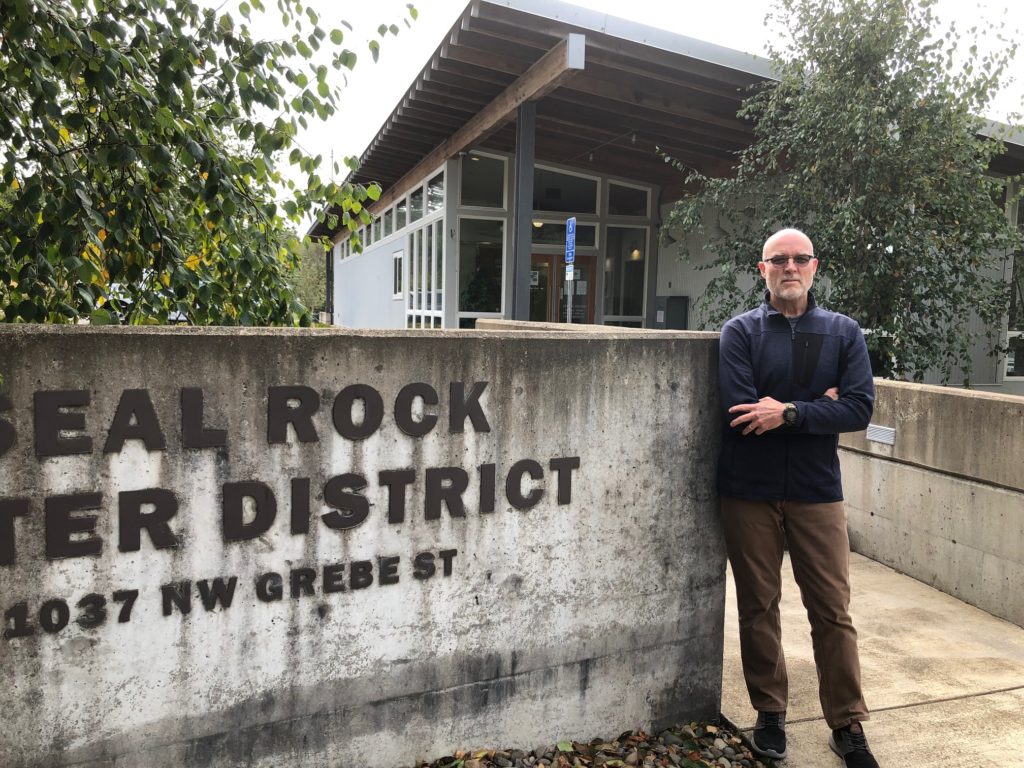 Seal Rock Water District general manager Adam Denlinger has been one of the leading participants in a consortium to put together an overall plan for supply, conservation, connectivity and resilience for the water providers on the central Oregon coast. (Lincoln Chronicle file photo)
Regional concerns
Seal Rock Water District general manager Adam Denlinger is also a member of the ad-hoc drought committee and has contacted county commissioners to see about engaging with the state over local drought concerns.
“I think the big issue for us, and this is always that struggle that we face as municipalities … is how do we educate and inform our community without sounding like alarmists,” Denlinger said. “I think the message that Seal Rock Water District would send is just one of awareness – just to be aware and concerned.”
 The northern Oregon coast is experiencing abnormally dry conditions, and the southern coast beginning in south Lane County is already experiencing moderate drought conditions, according to the U.S. Drought Monitor. (USGS)
At a meeting in April of the Oregon Water Utilities Council, which Denlinger chairs, there was a statement made by Oregon Water Resources Department officials that “water scarcity is becoming the new normal.”
It is not a message Denlinger is ready to embrace, preferring instead to reach out to communities about the value of water and the need for year-round conservation.
The purpose of the meeting was to discuss how the state can improve response to drought and requests for drought emergencies, Denlinger said. Oregon remains the only Western state without a state water planning process, so the state created a pilot program for place-based water planning.
The water resources department selected four basins across Oregon to identify water resource issues and mitigation strategies. Three of those basins are in Eastern Oregon — the other was Lincoln County.
That led to the formation of the Mid-Coast Water Planning Partnership, a 10-year effort officially recognized by the state in 2022. The group has 37 active members and is focused on water supply plans to meet the future needs of people, ecosystems and the economy.
“I think the state’s recognizing that they’re seeing more in the way of these requests for drought emergency declarations,” Denlinger said. “Typically, you see this every year probably in southern and eastern Oregon, or even in the central portion of Oregon, but not so much along the Oregon coast. But that is changing.”
A lot of emphasis has been on the diminished snowpack this season, Denlinger said, which peaked at roughly 50 percent of normal and dropped to 30 percent of normal in March — nearly tying 2015 for the worst on record — before dropping into the single digits in many regions by late April.
The snowpack is a direct reflection on the lack of rain passing over the central coast region as well, Denlinger said.
The state’s drought report, which comes out every month, shows below average rainfall for the past several months and very few months where the average was met.
Seal Rock also works with the Mid-Coast Water Conservation Consortium, a group of Lincoln County water providers promoting water conservation and improving supply.
The consortium enables water providers to pool resources and share knowledge to accomplish more water conservation activities than could be done individually.
 Water levels on the Alsea River near Tidewater were “much below normal” this week, according to the U.S. Geological Survey which tracks the flow of rivers and creeks across Oregon. (USGS Drought Monitor)
Supply and demand
Denlinger was one of several water experts who shared their perspectives for an article in the March/April edition of 1859 Oregon’s Magazine, about the work being done and challenges faced not only in Lincoln County but across the state.
Despite receiving six or more feet of rain each year, according to the article, the coast is beginning to suffer from drought, which despite popular belief means the rainy coast is seeing dry seasons begin sooner and last longer.
“When you’re dealing with levels of rain like in our community, it makes that messaging very challenging,” Denlinger told the magazine. “But in reality, we get the lion’s share of rain every year at a time when we don’t need it. And when we need it the most, that’s when we don’t get it.”
The Seal Rock District sees quite a seasonal fluctuation and demand for water, Denlinger told the Chronicle. At the end of April, it provided water for a population ranging between 6,000 and 10,000. That accounts for a daily demand of 180,000 to 200,000 gallons of water.
“But we’ll see demands of upwards of a half-million gallons a day in the summer months,” Denlinger said. “And that’s probably pretty typical for most communities along the Oregon coast. And it’s temperature driven. You have warmer temperatures in the valley and that just seems to pull people into our region.”
In the 1859 article, state climatologist and Oregon State University professor Larry O’Neill said while it might seem logical that a wet winter on the coast will lead to an ample supply of water in the summer, what is actually happening is really dry springs severing that connection.
Oregon’s coastal landscape, from the Coast Range to the shoreline, is not naturally equipped to retain water. The mountains seldom receive snow and have no deep aquifers. The coast’s water supply comes from its creeks and rivers which are reliant upon persistent and consistent precipitation throughout the wet season. But without sufficient spring rains, they quickly drain.
Saturated soils also play an important role in keeping streams flowing. They act as a sponge that recharge aquifers and contributes to stream flows during dry weather.
“We’re starting to get more of this whiplash where the dry periods will be drier and the wet periods will be wetter, so it’s just more extremes on either end,” O’Neill told the magazine. “And what the climate models are really consistently showing now is that into the future we will get more precipitation during the winter and less during the spring and summer …”
The new normal?
Last summer, the U.S. Drought Monitor showed north Lincoln County and all of Tillamook County, in “severe drought,” the worst in Oregon. By July, the Siletz River was 20 percent of its average flow, a historic low.
Lincoln County received drought declarations in 2018, 2021 and 2023. Drought conditions were pervasive in 2020 but no official declaration was made.
Administratively, a state drought declaration provides water managers with additional tools to address water shortages, prioritizing existing water resources and implementing conservation measures.
 Precipitation in the last 30 days across western and central Oregon, including Lincoln County, is 50 to 25 percent or less than the average for the same time period between 1991 and 2020. (USGS)
State water resources director Ivan Gall said in the agency’s policy and partnership update this spring that entering into May, Oregon is facing the most challenging drought season in memory — a historic drought taking shape not only in the state but across the West. He urged water suppliers to begin preparing to start conservation measures.
“Overall snowpack on April 1 was the lowest on record, when levels typically peak,” Gall said. “This past winter was among the warmest in recorded state history, and multi-year precipitation deficits will further deplete water supplies in many parts of the state.”
With the seasonal outlook for May through July indicating a likelihood of warmer- and drier-than-normal conditions, he said, drought will likely persist and expand across much of Oregon.
“Is that a new normal?” Denlinger said. “I don’t know. But it certainly does raise awareness to the conditions of our stream flows here regionally. And the need for those water providers that are working under water management and conservation plans to begin to use those plans as a tool to inform communities about water conditions.
“And not for the purpose to raise alarm,” he said. “I don’t want to scare people. I don’t think there’s any benefit in that. But I do believe we need to be out in front of this information to just raise awareness.”
- Garret Jaros covers the communities of Yachats, Waldport, south Lincoln County and natural resources issues for the Lincoln Chronicle and can be reached at [email protected]

















Whats not mentioned is the effect of logging in general and clear-cutting in particular. Without trees the landscape retains less water, and what snow there is melts faster on barren slopes.
Regarding logging-in addition to reducing precipitation retention, clear cutting plays a significant role in contributing to climate change.
There seems to be a trend of climate deniers when it comes to security of water supply in the face of climate change. I have heard the term “Wet Oregon” expressed as support for up zoning changes to the Yachats building codes for increased population density. This effort to increase Yachats housing and population density will hasten our community toward water bankruptcy.
Yachats city leaders have determined that high density housing is of critical importance to the city of Yachats. They have, in fact, deemed this to be so important that they are not going to leave the issue up to Yachats voters on the chance that the voters will not go along with their plans.
With the earth being over 4 billion years old, 17 years is a Planck time. Al Gore our most famous climate scientist (haha) in 1987 said all of our glaciers would be melted by 2000 but is now saying we are headed to a cooling period. The fact is that climate changes; it always has and always will. It will be up to the sun and the oceans, of which, man has no control.
Well said Phillip
And yet we continue to cut clear and build more homes needing more and more of the water that is not there. Maybe stop growth for awhile and encourage water savings. How much water is poured out without a thought in every rental vacation home, motel, and hotel? the vacationers do not care if they fill a hot tub 3 times in 2 days.
Some of us vacation renters come from states where water conservation and awareness is a way of life. Oregon is a beautiful state and we would like it to remain so.
Denlinger seems overly concerned about sounding “alarmist.” Meanwhile all the alarmists are out there blaring their alarmist alarms all day, alarmingly. People who are aware of actual alarms, things we really should be alarmed about, well, those people need to ramp up their messaging to match. Not ideal, but these are the times we’re living in.