

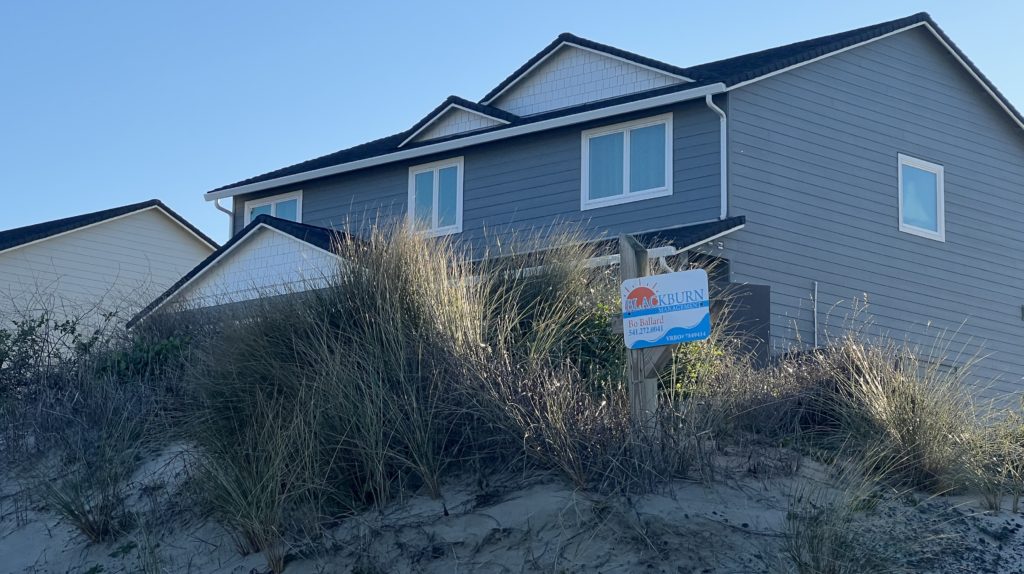
 The number of vacation rentals between Beaver Creek to the Alsea Bay bridge — including the Bayshore community north of Waldport — are expected to drop from 139 to 26 under Lincoln County’s cap on licenses. (Quinton Smith/Lincoln Chronicle)
By QUINTON SMITH/Lincoln Chronicle
Lincoln County’s tortured and tumultuous 10-year path to regulate and limit hundreds of vacation rentals in unincorporated areas may be over.
The Oregon Court of Appeals has ruled against 20 vacation rental owners who have spent the past four years challenging the county’s ordinance first in circuit court and then to the appeals court.
A three-judge appeals panel last week:
- Agreed that the county’s 2023 short-term rental licensing ordinance was not a land-use decision, backing rulings by the Oregon Land Use Board of Appeals and Lincoln County circuit pro-tem judge Joseph Allison.
“Past litigation before LUBA and this court has made clear that the county’s challenged actions are not land-use decisions,” the appeals court said.
- Rejected the vacation rental owners’ contention that each licensee needed special notice of county actions because the ordinance was effectively re-zoning their property
“The court did not err because there was no ‘rezoning’ of plaintiffs’ property,” the appeals court said. “Zoning (and “rezoning”) are terms of art that apply to specific types of land use decisions.”
- Overturned Allison’s December 2023 ruling that three provisions were unconstitutionally vague. Those included sections of the ordinance prohibiting “events, such as weddings, rehearsal dinners, and similar activities” at rentals that violated capacity limits, provisions governing how complaints were made, and delegating to the county counsel the authority to appoint a hearings officer, create procedures and rules to hear complaints, violations and citations against vacation rental owners.
The appeals court reversed that portion of Allison’s ruling and sent it back to Lincoln County circuit court.
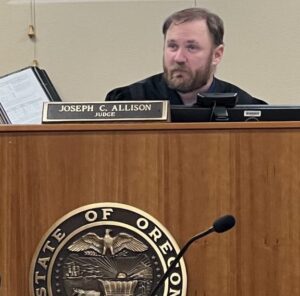 Allison
In part of his 2023 decision, Allison ruled against the vacation rental owners as they tried to stop a county ordinance regulating their properties as businesses and drastically reducing their number in unincorporated areas. Just days earlier, the Court of Appeals declined to stop part of the ordinance that created seven zones where the number of licenses could eventually shrink from 502 to 181.
In a news release Wednesday, Lincoln County called it “a significant legal victory for the county.”
“In February 2023, less than 30 days after I took office, we established geographic regions and limits on short-term rental licenses,” Commissioner Casey Miller said in a statement Thursday. “I had already spent many years as the county’s public information officer watching concerns escalate as residents called for stronger action. The court’s decision provides greater certainty that we can administer the licensing program, continue protecting neighborhood livability and make necessary adjustments as circumstances change.”
Walter Chuck, who was not appointed to the commission until the issue reached the appeals court, said in a statement that the county’s “license program allows rentals while also balancing livability for residents.”
VIA Oregon, the advocacy group representing the short-term rental owners, said in a statement that it was disappointed in the appeals court ruling and are “are carefully reviewing the opinion, including issues that may warrant a motion for reconsideration and potential review by the Oregon Supreme Court.”
“Other legal avenues available to property owners whose rights and property values have been directly affected are also being evaluated,” the organization said in a statement. “This decision is an important ruling, but it does not necessarily mark the end of this fight.”
“There is no question that Lincoln County prevailed in this round. But the implications of the decision reach far beyond short-term rentals,” the statement said. “At the heart of this case is a simple question — can a county restrict how private property is used through a licensing program and, by calling those restrictions ‘licensing’ rather than ‘land use,’ avoid the protections and procedures of Oregon’s land-use laws? The Court of Appeals has said yes. VIA Oregon believes that deserves further review.”
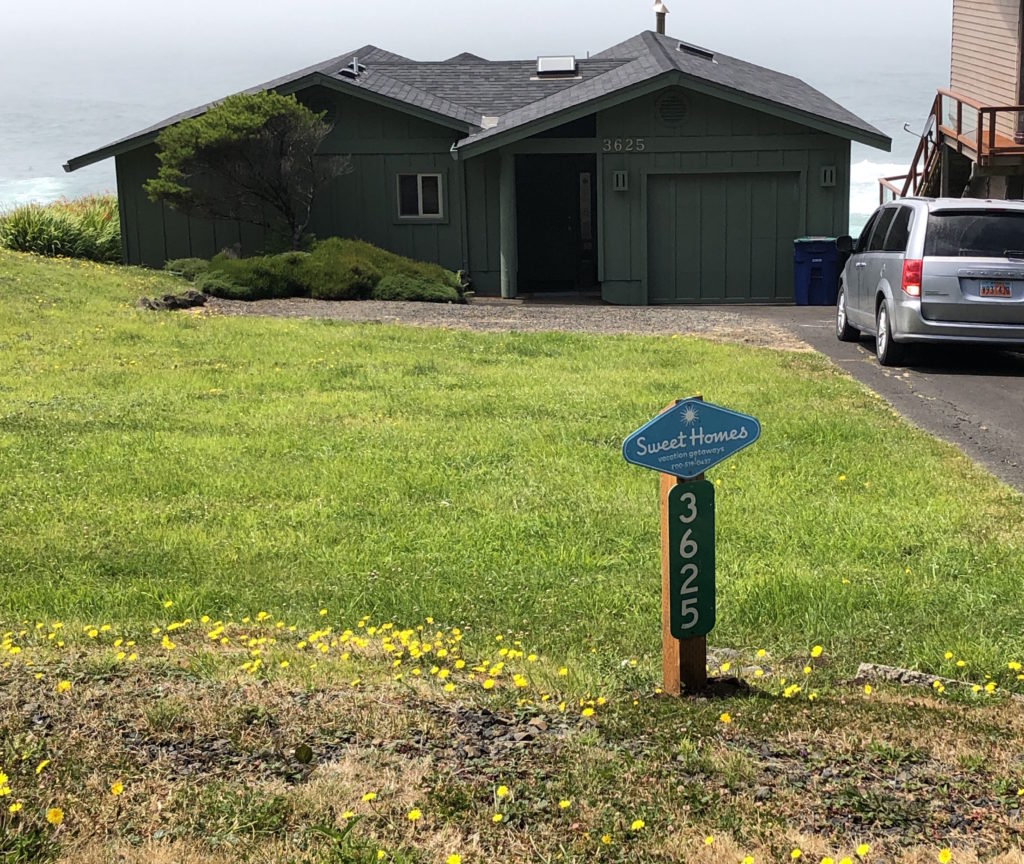 Residents of the Miroco neighborhood near Depoe Bay upset with the number of vacation rentals started a 2021 ballot measure that would have phased them out in residential areas. (Quinton Smith/Lincoln Chronicle)
Issue started in 2016
The county has been grappling with the issue since 2016 after the number of short-term rentals ballooned – reaching more than 600 — in unincorporated areas as coastal cities enacted limits and restrictions in their jurisdictions.
The cities of Yachats, Newport, Depoe Bay and Lincoln City have their own limits on vacation rentals; Waldport, Siletz and Toledo do not.
But dissatisfaction with the county’s effort to regulate short-term rentals led to a citizen-led ballot measure in November 2021 that would have gradually phased them out in residential neighborhoods. Commissioners then tried unsuccessfully to undercut it by passing a number of changes to their existing ordinance just days before voters resoundingly approved the measure.
A coalition of property owners represented by Via Oregon appealed both the ballot measure and the updated county ordinance to LUBA, contending both were land-use measures.
LUBA ruled in 2022 that the voter-approved ballot measure conflicted with Oregon land-use law and declared it invalid. But LUBA twice said the county’s ordinance was not a zoning or land-use issue and sent the rental owner’s lawsuit back to circuit court.
In February 2023 commissioners voted to create seven geographic areas and sharply limit the number of vacation rental licenses in each. Five of the areas are west of U.S. Highway 101 and two are east of it.
There are currently 422 vacation rental licenses in unincorporated Lincoln County, down from 502 when the seven areas were approved. That number is supposed to drop sharply via attrition – licenses cannot be transferred when properties change hands — to 181 licenses under the 2023 density requirements.
There are currently 138 property owners from the seven zones on a county waiting list seeking a license.
- Quinton Smith is the editor of YachatsNews.com and can be reached at [email protected]


















I haven’t been following this and don’t know all of the nuances but do have personal experiences. We lived oceanfront in Bayshore for 33 years and one of the deciding factors to move was due to being surrounded by rentals. It was a common occurrence for tourists to use our beach path crossing through our backyard to get to the beach and back. We’ve even had them using our picnic table and hose to rinse off. There was no longer a sense of community and the party atmosphere became very tiring. Fortunately we sold our home and moved to Bend.
I attended the meeting that Commissioner Casey Miller referenced and watched the vote. Commissioners Claire Hall and Kaety Jacobson proposed a lower cap for Regions 6 and 7. Casey disagreed and, “in fairness to everyone,” proposed a cap higher than the current number of licensed STRs. Although Jacobson pointed out that this would increase the number of STRs by about 25 in those Regions, Miller wouldn’t relent. Jacobson and Hall capitulated and accepted Miller’s higher cap.
Within weeks after the Licensing Moratorium was lifted, all of the available licenses in Region 7 (Beverly Beach) had been issued. Thanks to Commissioner Miller, Beverly Beach now had (and continues to have) more STRs than ever.
In April 2026, Miller’s campaign accepted a $250 campaign contribution from Heather Brann, the attorney for VIA Oregon and the STR owners.
Generally speaking, I think it’s bad to change the rules midstream on folks operating a business. However, when said business becomes predatory and counter to the greater good, changes are to be expected. Hundreds of short term rentals seems excessive, and puts residential home buyers in direct competition with people who can pay cash for an income stream. I therefore support the county for trying to do *something* to return the situation to something mutually beneficial for society.
Lincoln County is 1000 square miles – if we went back to 400 rentals for the county – that would be roughly 1 rental for every 2.5 square miles of land. Does not sound excessive. Most of the “cash sales” of beach homes are from rich 2nd home owners that let the homes sit empty for 75% of the year and do not rent them.
Yes, that doesn’t sound excessive on paper but there aren’t a lot of STR’s in, say, Eddyville. We all know they are clustered in our more populous areas by the beaches. My small neighborhood in an unincorporated area is overrun with STR’s. I am so tired of the speeding traffic on our narrow streets, excess garbage, people too lazy and gross to go a restroom instead of using the beach and having to chase strangers off our properties. The STR owners simply do not care, our neighborhoods are just a backdrop to sell the use of their businesses.
I live west of 101 in the Oceanlake area. Our neighborhood has an inordinate number of short term rentals. Fortunately, the owners are responsive to complaints about noise during quiet hours, but there are way too many barking dogs and screaming children. It used to be a quiet neighborhood despite a lot of foot traffic accessing the beach. I feel like to property west of the highway is being treated like a sacrifice area.
I guess the better solution is to have them owned by absentee 2nd homeowners that only visit 25% of the year. That would get rid of the kids and dogs and you’d have empty homes all around you.
Bob, what about this idea? It applies to second homes and STRs.
Astoria Housing For All qualified a 2026 ballot measure in Astoria, Oregon. If it passes in November, Measure 4-247 would:
1. Create a locally controlled Community Housing Fund.
Tax homes left vacant for more than half the year: $3,000 in the first year and $6,000 for each consecutive year.
Exempt homes that are occupied, rented, under renovation, in probate, or affected by medical or financial hardship.
2. Use the funds for affordable and workforce housing, down-payment assistance, rental move-in aid, eviction prevention, and emergency rental assistance.
astoriahousingforall.com
BOTH are problems: neighborhoods that are ghost towns part of the year and then sources of excessive noise, overcrowding, stressed septic systems, illegal parking, etc during the tourist season.
Most of the 2nd homes are absentee owners (28% of homes in LC are absentee owners – only 2.8% are STRs) How do you know the difference between activity from absentee/visiting owners/ friends of owners and STRs? And activity from tourists not staying in STR’s? Sounds like you are blaming all tourist nuisance on STR’s even though they are the smallest subset.
There is at least another alternative than the one you put forward. Have them be either owner-occupied or full time rentals. This would open up housing stock for so many families who are waiting to find a home.
You can’t stop people from owning a second home. That is unconstitutional. And 30% of all homes in Lincoln City are absentee owners (and they do not rent them – these homes sit empty for 70% of the year.) Only 2.5% of all homes in LC are STR’s.
Based on county housing capacity and demographic analyses, approximately 31% of all housing units in unincorporated Lincoln County are second homes or seasonal properties. When applied to the 14,634 total housing units located outside of city limits, this means there are an estimated 4,536 second homes or absentee-owned properties in unincorporated Lincoln County. There are 422 STRs – 2.88 STRs per hundred homes (or 2.88% of all unincorporated housing are Short Term Rentals 28.11% of the entire unincorporated housing stock (14,634 homes) consists of true absentee/second homes that are not STR’s. Short term rentals are not the issue and you cannot regulate the buying of 2nd homes.
When the nuisance is right next door with a sign stating that it is an STR it is easy to know it is an STR not something else entirely. Former Lincoln County Commissioner Jacobson asked to find the illegal STRs before installing any cap (that was the reason for at least one of the moratoriums); to find those operating without a license. People continue to report unlicensed STRs years into the county’s ordinance. As usual, STRs did not become a real problem until greedy, corporate interests got involved. When it was owner-occupied, mom and pops the complaints were few and far between. When the big guys came in and told everyone “you can be rich!” It became a problem for all but those making money on the backs of neighbors. Neighbors had to police the neighborhood, neighbors had to tell people they were trespassing, neighbors had to clean up the garbage, neighbors had to complain to the “local contact” or call the sheriff or police. Neighbors did not make a dime on these mini-motels but we sure did expend a lot of effort, energy and time on stopping the chaos caused by these invasive species.
What exactly are these “corporate interests” that you are talking about? Please be specific to move the debate forward. If you look at the list of licensed STRs in Lincoln City 100% of them are owned by individuals and families – they might have them listed in a LLC for tax / estate planning reasons – but there are no corporate giants buying beach homes in Lincoln City. Most of these homes have been owned by families for generations. All STRs in Lincoln City have occupancy limits. Can you please list what “mini motel” that you are referring to? Again, you would never know the difference between an STR with visiting tourists and a absentee owner that has loaned their home to extended family or friends – which is not illegal. Back to facts, almost a third of all homes in Lincoln City are absentee owners and only 2.5% are STRs. Which do you think has more activity in the summer?
The STR’s have more activity. STR’s are businesses that use the backdrop of local neighborhoods to entice a steady stream of customers to their properties. An “absentee owner” property may have a handful of people using it during the year, and if they are also “multi generational owners”, are probably respectful of the communities they have been part of for years. An STR? Possibly hundreds of people, paying customers really, stream through an STR during the year. They are here for vacation, barking dogs and all, to do what they want in a place they paid for. The number of STR’s might seem small, but the amount of people that use them and the problems they can cause are overwhelmingly outsized in relation to that “small” number.
re second homes: They should not qualify for mortgage tax deductions. That might discourage buyers who only want a tax write-off. People who really want vacation homes could still buy them.
To any rejector of STR limits: I wish it weren’t so, but the concentration of STRs in affected neighborhoods, and the ensuing problems, truly is a real thing.