

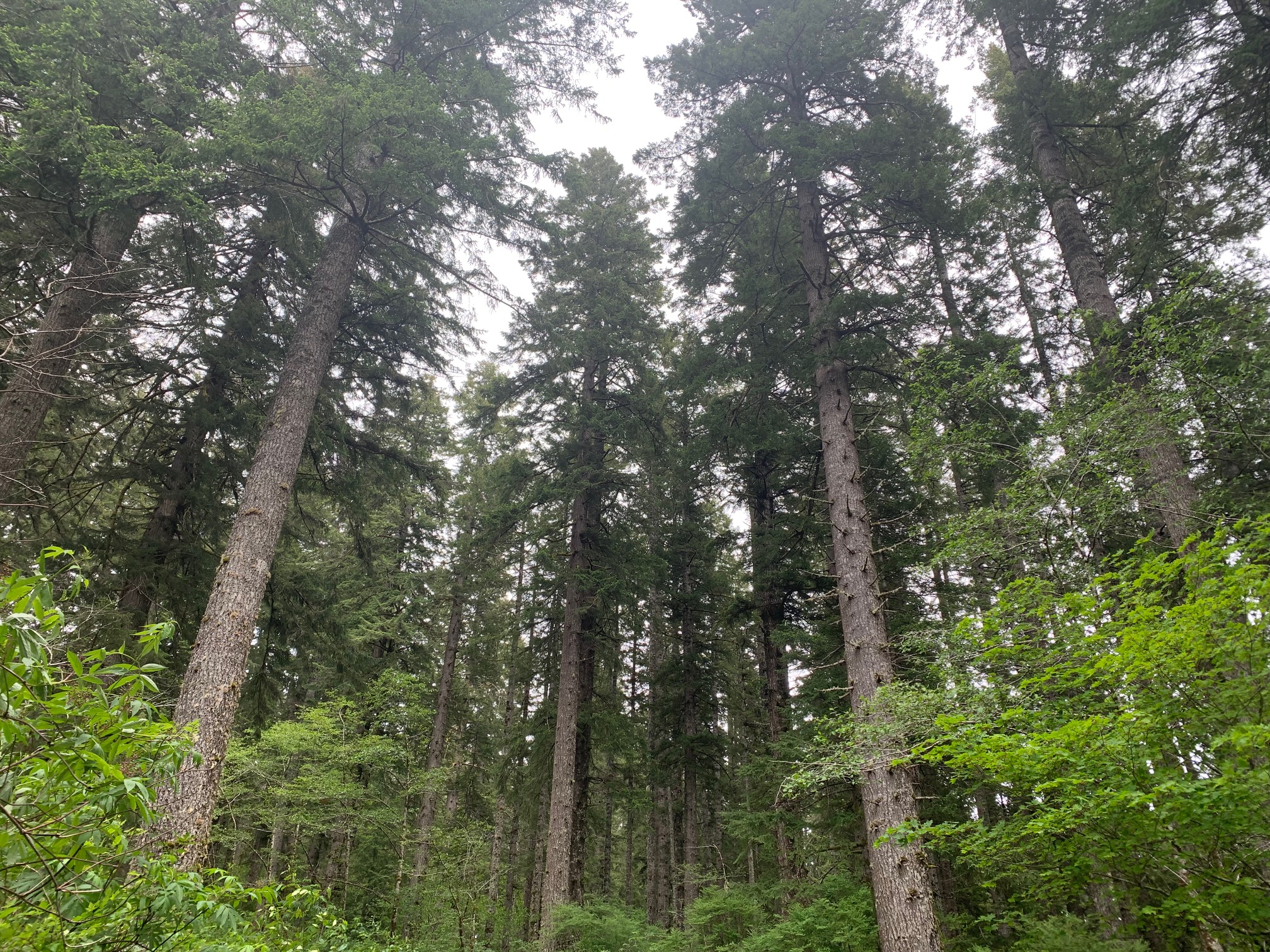
 The Siuslaw National Forest, which has a mixture of 80-year-old and younger trees on plantations, would be a part of any changes in the Northwest Forest Plan.
By APRIL ERHLICH/Oregon Public Broadcasting
A years-long endeavor to change logging and environmental policies for millions of acres of Pacific Northwest forests is getting a restart.
The U.S. Forest Service is going back to the drawing board with an update to the Northwest Forest Plan, a set of policies that broadly dictates where logging can occur on 25 million acres of forests in Oregon, Washington and northwest California. It came out of the timber wars of the 1980s and ‘90s.
Environmental groups worry new changes that could be made to this plan under the Trump administration will increase logging in mature and old-growth forests, potentially harming wildlife species that are already on the brink of extinction, including the spotted owl.
The Forest Service has been working on a Northwest Forest Plan amendment for a few years, holding dozens of outreach meetings with tribes, an advisory committee and the general public. The agency published its proposed changes in a draft environmental impact statement in November 2024 and received over 3,400 public comments.
Now the Forest Service under the Trump administration wants to issue a new draft.
Timber industry groups largely welcome restarting this Biden-era initiative. They’ve been calling on President Donald Trump for a complete overhaul of the Northwest Forest Plan.
“The Northwest Forest Plan is failing our communities and our environment,” said Matt Hill, executive director of the Douglas Timber Operators, in a March press release. “It’s time for a bold revision that prioritizes dynamic forest management and sustainable timber production.”
Agency officials say they are working on a “revised draft environmental impact statement.” No such term exists in national environmental policy.
The spokesperson provided few details about what could be in the new draft. They said it will “consider additional or refined definitions of forest types to reflect ecological diversity, clarify commercial timber opportunities, analyze potential refinements to Survey and Manage, and make other updates based on the comments we’ve received.”
“Survey and manage” is a set of standards outlined in the current Northwest Forest Plan. It requires land managers to survey forest areas ahead of projects that could harm the environment, like logging or prescribed fires, in search of rare or vulnerable species. It’s a time-consuming process that often slows logging and prescribed fire projects.
Mixed reactions
Under the Biden administration, the Forest Service had proposed limiting the survey and manage program near residential areas to facilitate prescribed burns. Environmental groups worry a new draft out of the Trump administration could limit survey and manage efforts in mature and old-growth forests, harming vulnerable species.
“By targeting programs like Survey and Manage, which safeguard rare species before logging occurs and emphasizing ‘commercial timber opportunities,’ the Administration is advancing the timber industry’s agenda to expand logging including clearcutting on public lands,” Oregon Wild conservation director Steve Pedery said in an emailed statement.
Initial efforts to amend the Northwest Forest Plan focused on getting input from tribes on how the federal government should manage their ancestral lands. Forest Service officials created an advisory committee made up of multiple tribal representatives, as well as people representing environmental and timber interests, to guide its policies. They also held forums with tribes to gather input ahead of drafting proposed changes.
“It was a tribal-centric effort,” said Ryan Reed, a former advisory committee representative and a member of the Hoopa Valley Tribe in Northern California. “That was the headliner of our work. It’s disheartening that they felt that wasn’t enough.”
Another former committee member who represents timber interests said he remains optimistic about this new process.
“We look forward to working with the Forest Service to improve the way we steward our federal forests in the Northwest to improve forest health, help reduce the impacts of catastrophic wildfires, protect communities, improve public access and recreation, and help sustain our world class forest products infrastructure,” said Travis Joseph, president of the American Forest Resource Council, a timber industry association.
In an emailed statement, Sen. Ron Wyden, D-Ore., said he is working on legislation that would create environmental protections for old growth in the Pacific Northwest.
“The best way to address the needs of special places in the Pacific Northwest is to build coalitions of people who are for smart resource management in – and with – the communities directly affected, not from 3,000 miles away in Washington DC,” Wyden said.
- This story originally appeared Oct. 30, 2025 on Oregon Public Broadcasting.
















I drive to Corvallis once a week and in the last several months, I have never seen so many log trucks. Off in the distance you can see fresh clear cuts. There seems to be a frenzied attempt to cut as much as possible as rapidly as possible. We all use wood, a valuable resource. With that said, I would like to see us slow down and bring all interested parties together to devise a sustainable, thoughtful plan for our forests. A plan that considers the need for wood and timber jobs down the line, as well as our shared responsibility to preserve and protect the natural beauty of our state; home to people, animals, streams and souls of the past and future.
It’s about time. The spotted owl was the means to shut the forests down, but in 30 years they have not rebounded! We need to harvest the timber and properly manage our forests so they all don’t burn up. Our fires are not due to climate change, they are do to the mismanagement of them.
Most of the clear cuts are on private land not public (Forest Service) land.