

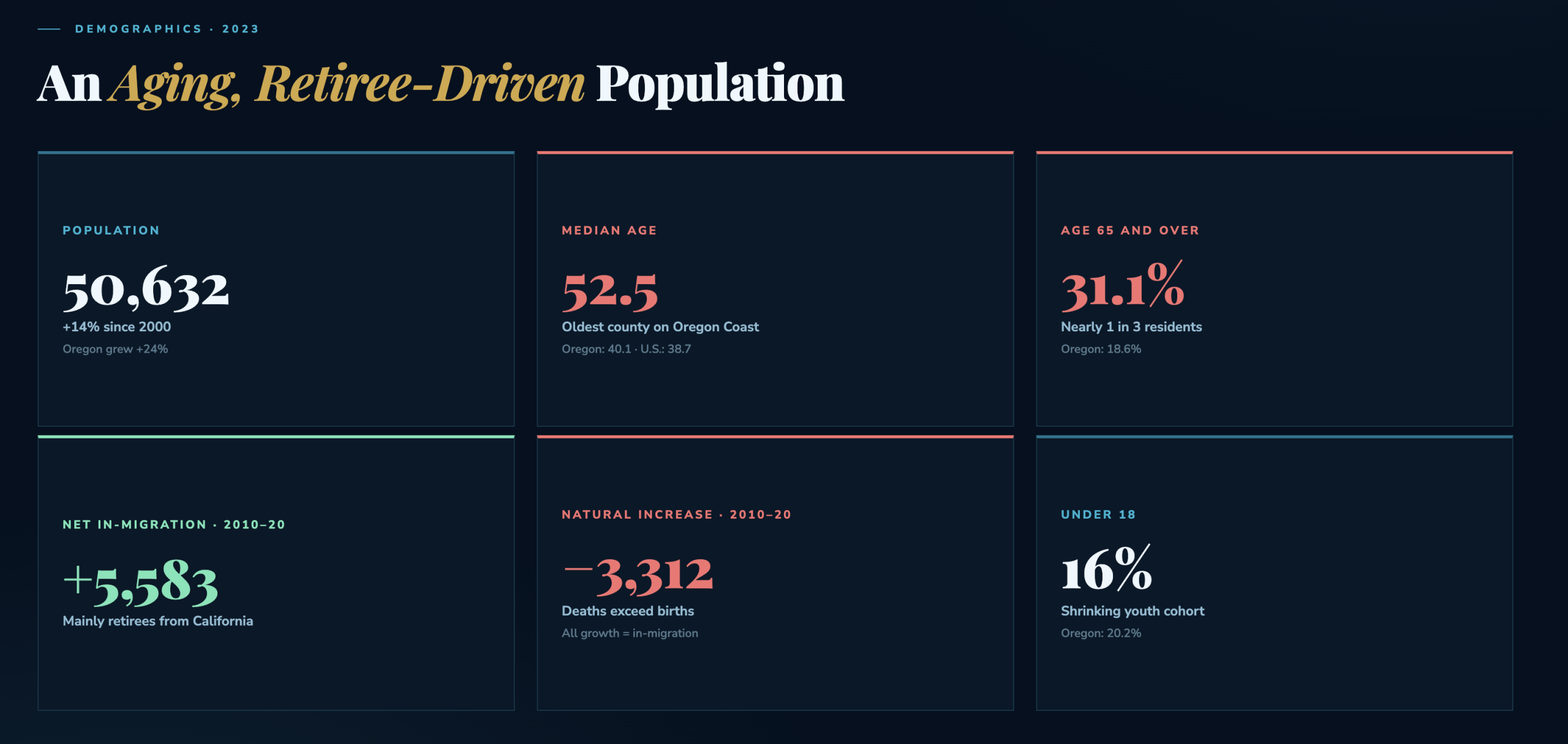
 Lincoln County’s population is growing older and the coast is attracting more retirees who bring with them social security and pension payments while the number of children declines. (Economic Development Alliance of Lincoln County)
By QUINTON SMITH/Lincoln Chronicle
Lincoln County’s economy has been “tepid” since the end of the 2020 pandemic, with income of working adults overtaken by the financial impact of more retirees moving to the coast with their social security payments and pensions.
That’s one of the many findings in the first study in a decade on the status and health of the county’s economy.
Funded by a $30,000 Lincoln County grant and overseen by the Economic Development Alliance of Lincoln County, the study by Corvallis and Yachats-based researchers builds off the last study completed in 2014.
People involved in the latest update stressed how it important it is to take a deep dive into economic data, see what’s changed in 10 years and possibly provide a roadmap for decisions by businesses, nonprofit organizations and local governments.
“This is the most accurate local data for what’s happening in the Lincoln County economy,” said Paul Schuytema, executive director of the economic alliance. “As an economic development tool, this can help point to what’s worked and what’s moved the needle.”
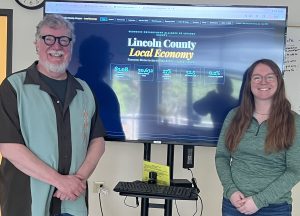 Paul Schuytema and Sarah Buddingh of the Economic Alliance of Lincoln County helped oversee the first local economic study since 2014. (Quinton Smith/Lincoln Chronicle)
The report says the county’s economy mirrored national growth until the 2008-10 recession but a recovery after that was interrupted by the pandemic and Labor Day wildfires in 2020.
“Since the pandemic beginnings, there has been a tepid regaining of economic activity levels,” the report said, adding that Trump administration changes in the federal government beginning in 2025 has created uncertainty in marine science, commercial fishing, trade and the renewable energy industries.
Among dozens of findings, key details include:
- Investment income and “transfer payments” – social security and pensions — from the growing number of retirees now makes up 55 percent of personal income in Lincoln County, up from 47 percent in 2004. That also compares with 42 percent for all of Oregon;
- Earnings from workers decreased from 54 percent of all income in the county to 45 percent;
- Lincoln County and other coastal counties have undergone significant economic transitions with traditional resource-based industries such as commercial fishing and wood products declining in relative importance while trade and service jobs associated with businesses serving tourism and retirees have increased;
- The data also indicates that the county’s economy is more diversified and healthier than 15 years ago and the decreased reliance on extractive industries has made the county’s economy less susceptible to national business cycle downturns;
- Lincoln County has the oldest average age of its residents of any coastal county and there are 16 percent fewer children in the county now than 10 years ago. Any change in population is due to “in-migration” of residents – most from California – as deaths now exceed births; and
- Wealth, when defined by total personal income, has increased in Lincoln County because both population and per capita income have increased. However, household incomes are lower than the rest of Oregon and there are more people working in lower wage brackets. In addition, there are more part-time jobs in Lincoln County and the coast than statewide and the poverty rate in the county is higher than the rest of Oregon.
“The couple of big things the study shows – total personal income grew substantially to $3 billion, and that’s good,” said Schuytema. “But net earnings are now less than 50 percent. We knew it was trending that way … and now we know.”
One of the keys for local businesses and leaders is to keep spending by retirees local, said Sarah Buddingh, the alliance’s research manager.
“Our retirees here generally have more money to spend than retirees across the U.S.,” she said. “The goal should be to keep as many purchases – especially large purchases – here.”
 Radtke
Hans Radtke of Yachats, one of the project’s researchers, said not a lot is known about the “retiree effect.” On the negative side, retirees have different spending patterns, tend to worry about their own problems and can feel fewer connections to the community, he said. On the positive side, many do take the time to become involved in their communities and have steady disposable income.
“I wish we knew more about the retiree effect,” he said.
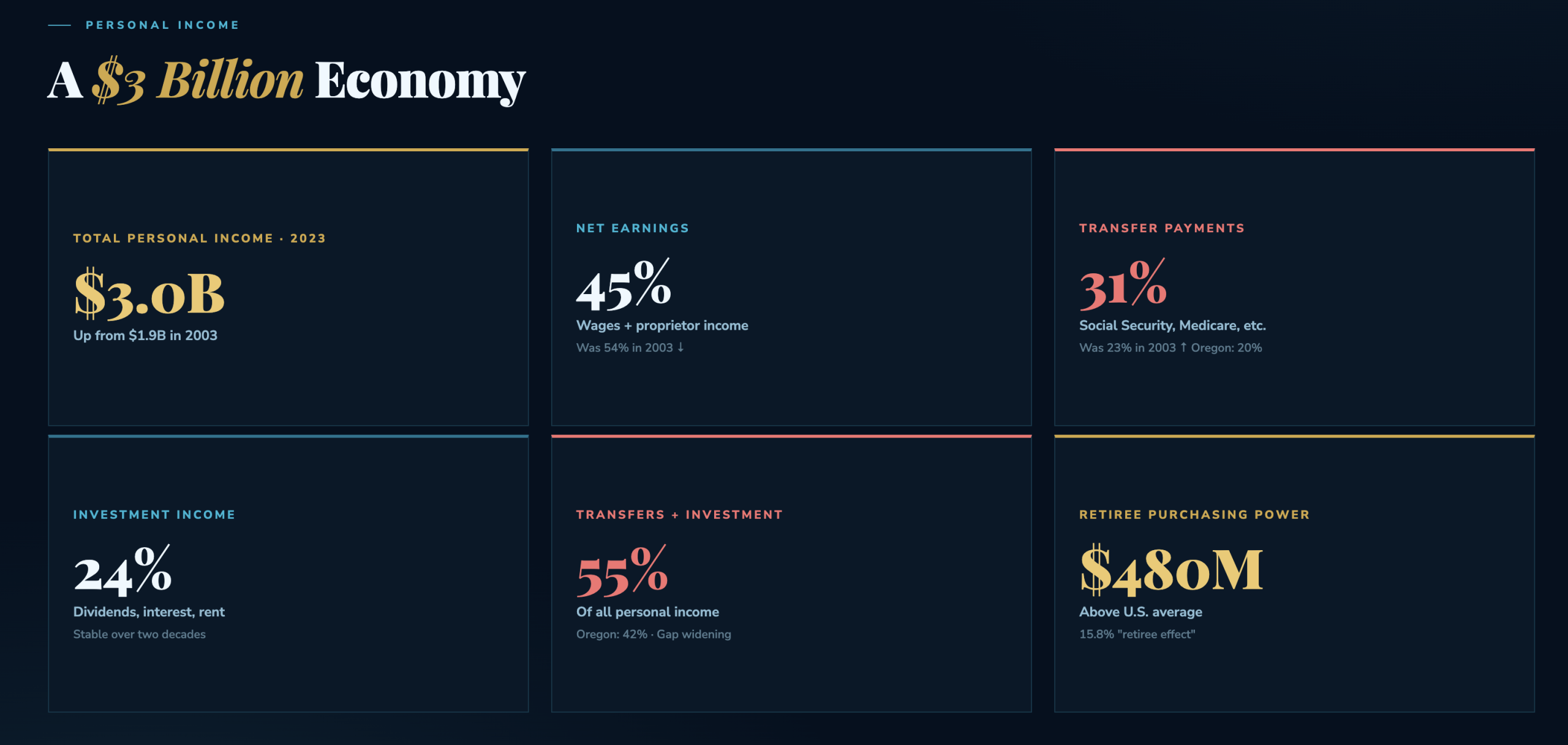 Transfer and investment income of retirees in Lincoln County now makes up 55 percent of personal income in the county — 13 percentage points more than the rest of Oregon. (Economic Development Alliance of Lincoln County)
Tackle the challenges
The result is many challenges for the county especially for low-income workers and housing supplies, according to Corvallis-based The Research Group, which dove into state and federal data. The findings also include:
- Business decisions to locate in Lincoln County will also look to factors such as quality-of-life for owners and workers along with labor force mobility, broadband presence, education and training, and commercial and industrial land availability. Potential workers will also be concerned with housing costs and childcare. Unless costs are reasonable, attracting employees may be difficult;
- More than 46 percent of working residents are actually employed outside the county, many of those work here remotely. “County lines are artificial,” said Schuytema.
- Lincoln County has far fewer households in the highest income brackets than the state. People with lower incomes face housing problems as rising demand for coastal property has priced homes and rentals out of reach. This lack of workforce housing in turn makes it more difficult for employers to attract and retain workers in occupations such as trade and service workers; and
- There has been a boom in the market for second homes in Lincoln and all coastal counties. In some coastal communities, 50 percent of the housing stock are second homes. The strong demand for second homes is pricing many coastal residents out of the housing market.
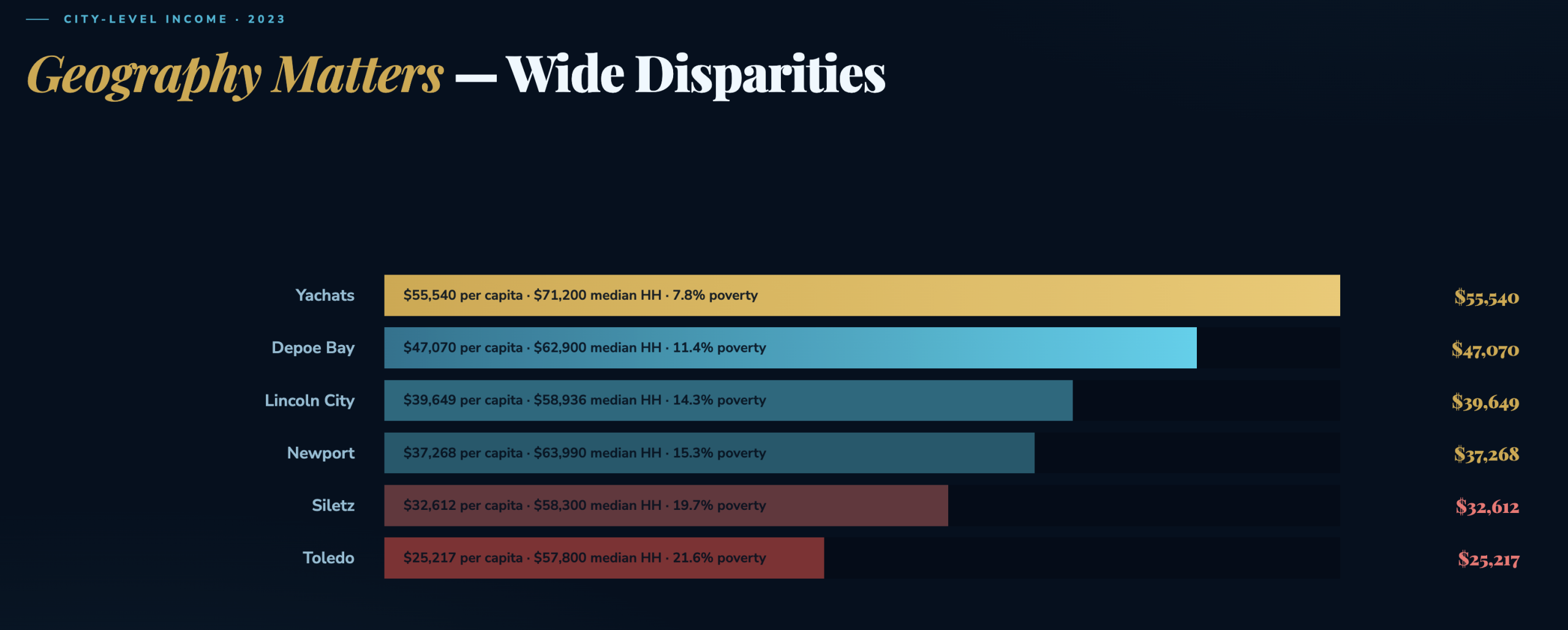 The small but retirement-dominated cities of Yachats and Depoe Bay have much higher per capita incomes than the rest of Lincoln County communities. (Economic Development Alliance of Lincoln County)
Some positives
The report and its analysis does point out some positive economic changes the past 10 years, including the dramatic expansion of health service jobs and two Samaritan Health Services hospitals built in 2019 and 2020. Other positives include the cluster of state and federal research and related jobs at the Hatfield Marine Science Center, low electrical rates via Central Lincoln People’s Utility District, Highway 20’s good connections to the Willamette Valley, and the double-edge sword of the attractiveness of the Pacific Ocean.
The challenge now, Schuytema, Buddingh and Radtke all say is to take a deeper dive into some issues that rose to the surface, including:
- The impact of stable, high-dollar jobs at big employers such as Georgia-Pacific;
- Examine the apparent consolidation in the commercial fishing industry;
- See if it is possible to develop “higher value” tourism programs; and
- Continue to press forward with workforce housing ideas and programs.
“It’s important for rural communities to have data to guide your own decision-making and business decision-making for the community,” Schuytema said. “Now we have the data. It helps make informed decisions.”
- Quinton Smith is the editor of Lincoln Chronicle and can be reached at [email protected]
To read the full report by The Research Group, go here
For a snapshot and charts of the study, go here

















This study full on indicates that hourly wage earners in Lincoln County are taking home a smaller and smaller share of income, and our population is aging. The tourism economy isn’t paying the bills for many working folks here, and many of our kids are leaving the area for better work opportunities elsewhere. There are good paying jobs here but not enough for everyone apparently. This will be a growing problem as we continue to search for people to fill needed positions. I think it’s time we think bigger on our coastal economy.
Our economy depends on us spending as many dollars as possible in local businesses, hiring local people, supporting local artists. Before you order from a big international company, make sure 1) you can’t find it locally (even if it’s more expensive), or 2) you really, really need it. Paying more locally means having our neighbors making decent wages and keeping local businesses open. Thank you for your attention to my message from the soapbox.
The shift to Medicare Advantage programs such as Devoted also undermines our local economy by focusing members to spend their quarterly over the counter allocation from CVS Pharmacies that no longer exist on the coast. Rather than spend those dollars locally, we have to buy online or drive 60 miles … which also expands our carbon footprint and undermines ‘buy local’.