

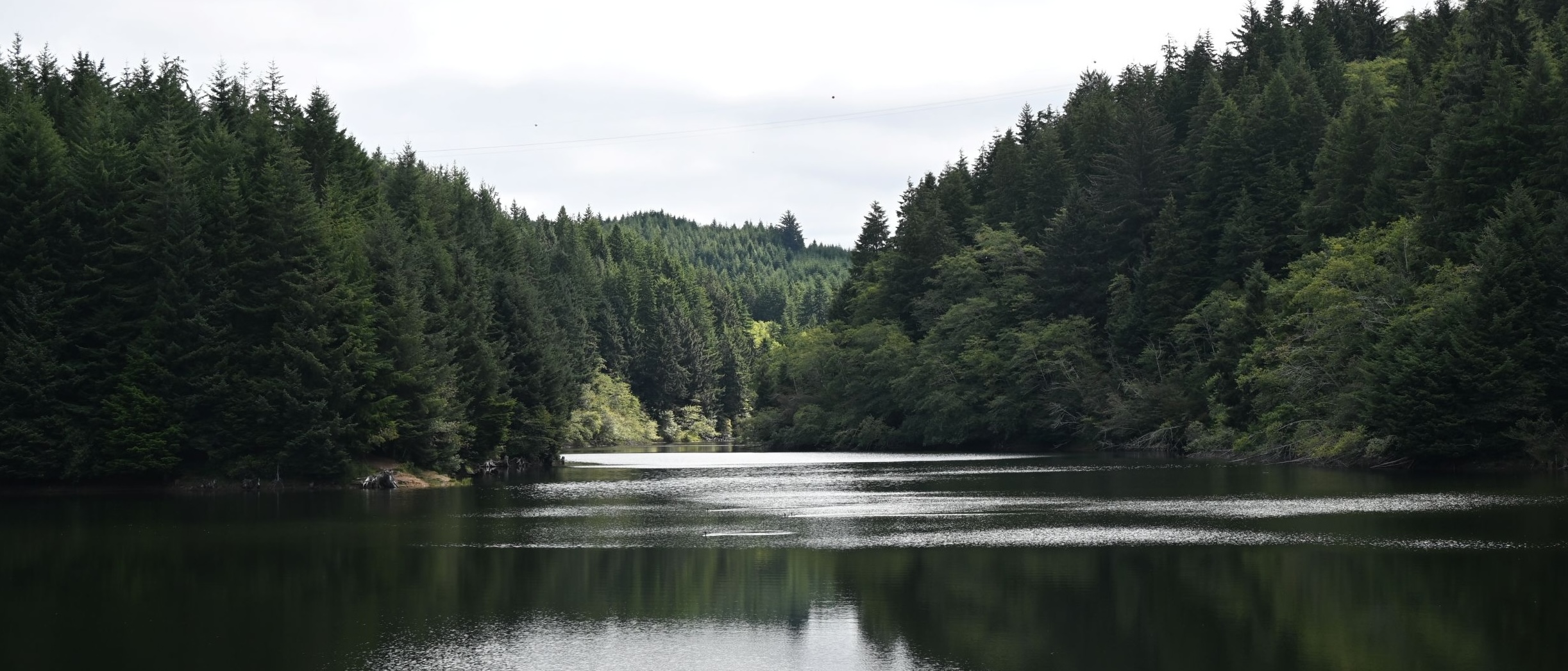
 Newport is facing financial challenges with attempts to replace its Big Creek dams and reservoir, the city’s sole source of drinking water. (Shayla Escudero/Lincoln Chronicle)
By SHAYLA ESCUDERO/Lincoln Chronicle
NEWPORT – The city of Newport is in a pickle – a large earthquake could destroy Big Creek Reservoir’s earthen dams, draining the city’s sole water supply, but building a new concrete dam would cost $250 million, money it doesn’t have and less likely to get.
An assessment commissioned by the city says the financial feasibility is slim to build a new dam, turning up the pressure to identify an alternative and solve the issue by the state’s imposed 2036 deadline.
The Newport city council heard last week just how costly building a dam would be – partially shouldered by steep water rate increases for all users. Now the city is re-evaluating if building a concrete dam is really its best option. They have until May to report their plan to the state.
 Water from several creeks collects at the city of Newport’s Big Creek reservoir, serving 10,000 residents and hundreds of businesses.
Sitting northeast of Newport, water flows from several creeks and collects at two Big Creek reservoirs, a stone throw away from Big Creek Park and the city’s Ocean to Bay Trail.
Behind two earthen dams built in the 1950s and 1960s sits about 50 million gallons of water – the city’s sole water supply serving 10,000 residents and hundreds of businesses.
Over a decade ago, when the city was constructing a new water treatment facility nearby, it discovered that the soil surrounding the two earthen dams was not stable and would easily collapse during a large earthquake. The city says the dams were built before current understanding of the seismic hazard of the Cascadia Subduction Zone.
The city has been drafting plans to construct a seismically sound concrete dam – a project that’s cost estimate keeps increasing and is currently estimated at $250 million.
As state and federal funding sources seem less likely to support the project, city leaders went back to the drawing board and in August hired a another consulting firm to perform an alternatives analysis.
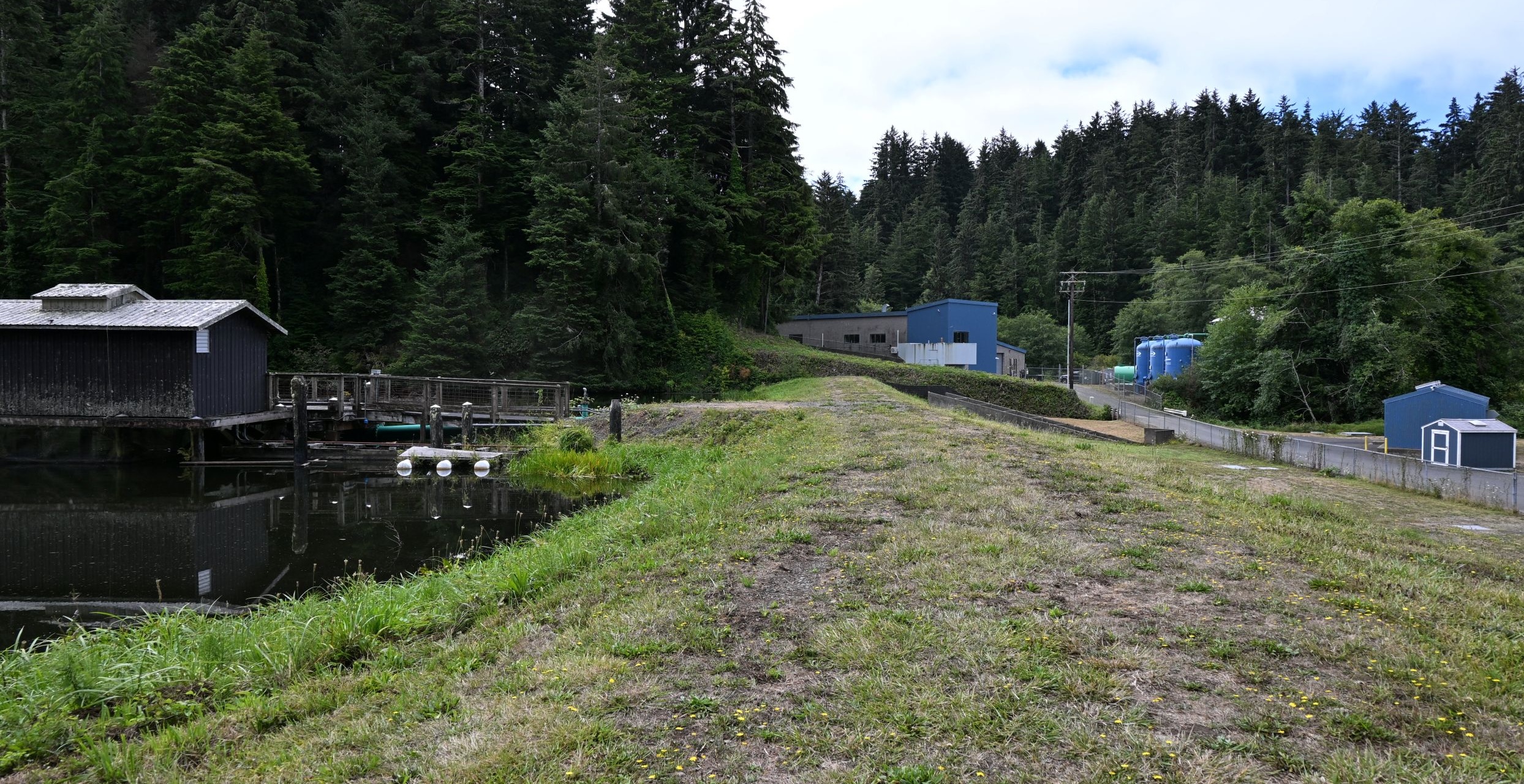 Big Creek dam No. 1 is a stone’s throw away from the city of Newport’s water treatment plant. Replacing the earthen dams with a seismically sound concrete dam is now estimated to cost $250 million. (Shayla Escudero/Lincoln Chronicle)
Dam money problems
During the Monday, Dec. 1 work session, council members received financial estimates that confirmed what they already suspected – building a concrete dam isn’t financially feasible.
Over the summer the estimated cost jumped to $185 million. But the newest evaluation climbed to $250 million when consultants looked at estimates for labor and materials with the city’s 2036 completion timeline, said Ben Stewart, an analyst with the consulting firm Stantec.
The company developed financial forecasts using rate increases and alternative funding sources to determine the financial feasibility of the project. There were some loans that could finance half the project’s cost, Stewart said, but it’s not certain that Newport would be eligible for those. Other options looked at using at least $50 million from the city’s general fund or a combination of loans. All scenarios required some portion of funding from increased water bills.
He computed three financial scenarios, including one that relied solely on water rate increases if no loans were available. That option would result in a $385 a month water bill for the average customer – which translates to about a 400 percent rate increase, Stewart said.
“Under all three scenarios, the project would result in water bills exceeding industry affordability thresholds, placing high burden on both median and low-income households,” he said.
The findings further emphasized the need for the city to find an alternative, and the city has a deadline to enact a plan.
The Oregon Water Resources Department is ordering the city to select an option for rehabilitation or replacement of the dam by May 1 after receiving the alternatives analysis, according to a July letter from the state to the city.
The letter also states that the city then has until Dec. 31, 2036 to complete the project or the state may seek “lawful remedy” against the city.
Some alternatives
The city hired another consultant, Jacob’s Engineering, to rank its alternatives by assessing the water needs of the city, cost, and other criteria.
Some of the alternatives the company is looking into include:
- Mitigating the existing dams;
- Building a new dam at the same location or outside of Big Creek;
- Using existing dams outside of the city such as Mill Creek Dam in Toledo;
- Removing the dams and drawing water year round from the Siletz River;
- Diverting water from the Yaquina River;
- Desalinating ocean water; and
- Recycling water from the wastewater treatment plant.
“We aren’t going to make a decision for the city, but we want to report and document so that the city can make an informed decision, Nason McCullough, a senior geotechnical engineer with Jacobs Engineering told city councilors Monday evening.
The consulting firm would expect to have the completed alternatives analysis completed at the end of March.
- Shayla Escudero covers Lincoln County government, education, Newport, housing and social services for Lincoln Chronicle and can be reached at [email protected]


















In these types of state or city funding crises for vital infrastructure, I rarely see any discussion on the high added cost of financing. Wall Street profits while towns and cities lose. There is a solution and it’s called a state or public bank. North Dakota has had one since the turn of the century and even during the Great Recession, it was the only state that functioned in the black. California could have saved almost half the 6 billion dollar cost of the Bay Bridge re-construction after the Loma Prieta Earth Quake, if that had been financed by a public bank. Find out more at this link, and urge your elected officials to start learning about this promising strategy.
https://ellenbrown.com/2014/06/01/infrastructure-sticker-shock-financing-costs-more-than-construction/
When I worked for the Bureau of Land Management Northwest Oregon District, we had a similar problem with an earthen dam that was constructed in the early 1950’s as a log pond. We performed a stabilization project that utilized a steel mesh across the face of the dam. It was anchored with hollow steel drill bits that were filled with a high strength mortar and bolted steel plates to keep the mesh in place during an earthquake.
This was evaluated by both Dam Divisions of US Forest Service and the Army Corps of Engineers. It was determined that it would withstand a significant earthquake and the cost was about $300k.
I copied the city manager and city engineer. They have a company doing an analysis and suggested at the very least it could be an interim solution as no real money is any where in site. Norm
Stop wasting time and effort on the “Uptown/101 project” and use the money for a down payment on the dam.
Yes, Dac Wilde … that’s exactly what I was going to say.