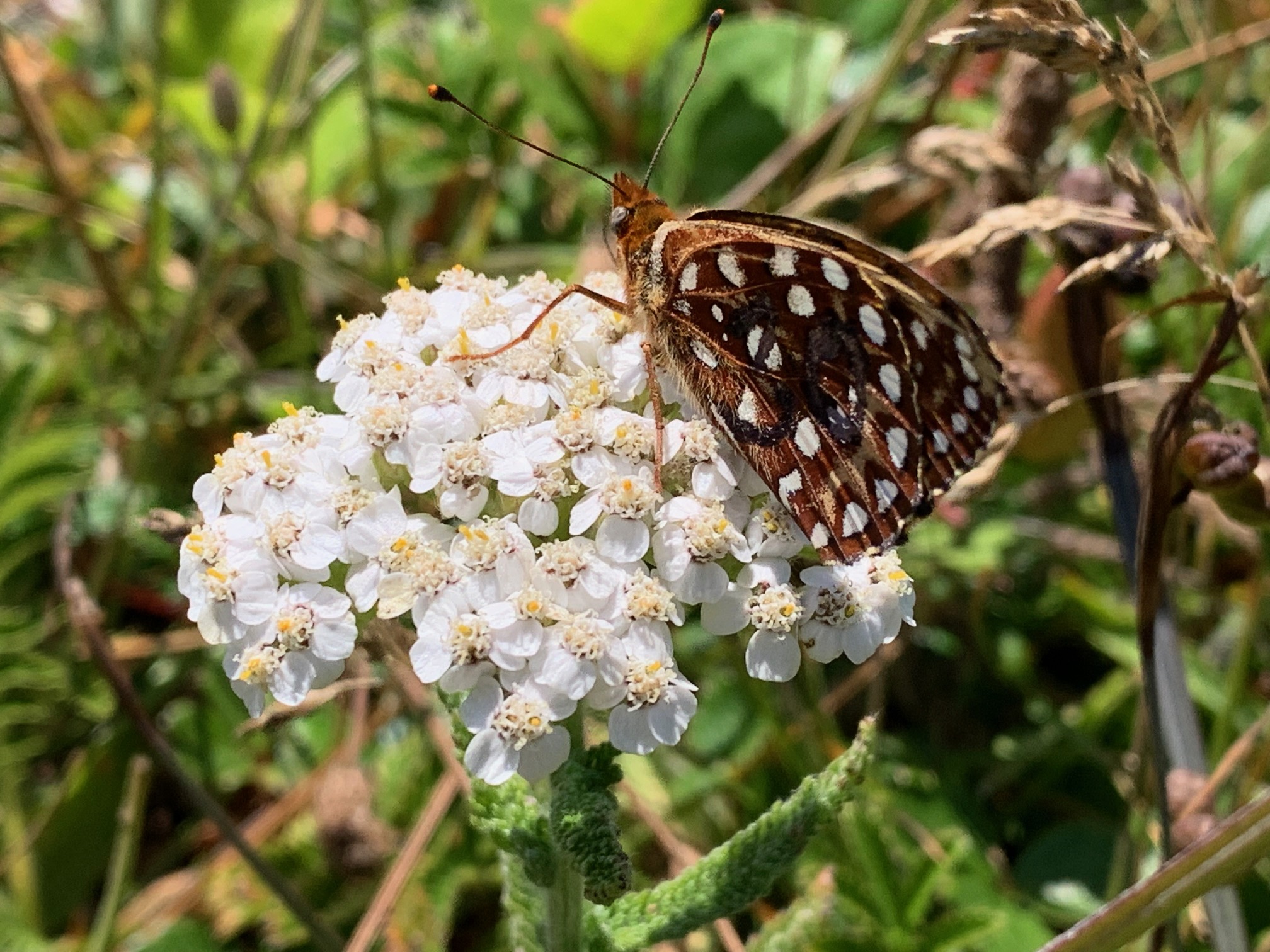
 A marked female silverspot — displaying its silver spots — lights upon a yarrow flower, one of its main nectar species. Females are slightly bigger than males and sometimes darker in color.
By KAREN RICHARDS/KLCC
The Lincoln Soil and Water Conservation District has spent five years working with federal agencies and private landowners trying to increase the habitat for the endangered Oregon silverspot butterfly in coastal meadows between Yachats and Florence.
The relatively large, orange and black insect with silvery patches on the undersides of its wings is threatened and protecting it isn’t easy.
 A few of the early blue violets, Viola adunca, bloom in early August. (Karen Richards/KLCC)
“During the larval stage, they only eat the early blue violet,” said Tyler Clouse, executive director of the Newport-based conservation district. “They can eat about 100 leaves, each larva. So, they need a lot of blue violets and good density. Unfortunately, to keep that habitat and to keep those violets, you need a lot of management.”
Indigenous burning practices maintained the meadows that support the early blue violet, but nearly all of those areas have disappeared, he said.
The butterfly was listed as threatened on the federal Endangered Species List in 1980. The Oregon Zoo has worked for more than 25 years to release either pupa or caterpillars into the slivers of remaining habitat, including Rock Creek, south of Yachats. As of 2025, the zoo had delivered more than 35,000 silverspots to public land on the coast.
 Tyler Clouse shows off his Oregon silverspot butterfly tattoo, with the early blue violet which caterpillars rely on and the dune tansy (yellow) that adults use for nectar. (Karen Richards/KLCC)
Clouse has a tattoo of the butterfly on his forearm, along with the plants associated with it. But he’d never seen a wild adult before this year.
“Timing hasn’t always worked out for us to come out to these meadows during the flight time,” he told KLCC during a recent tour of coastal habitat on public and private land. “I’m hoping today we’re going to actually see one flying about.”
He was joined by Katie Saaty, a water quality monitoring specialist with the soil and water district. She helped release larvae, or caterpillars, from the Oregon Zoo in May.
“They had them in these fancy little deli takeout container type of situations with a few early blue violet leaves in each one, to tide the caterpillars over,” Saaty said.
Saaty brought the caterpillars to salt spray meadows near Big Creek Road, between Yachats and Florence, looked for early blue violets and placed each one on its food plant.
Adult silverspots have a different diet, and that’s primarily where landowners have been able to help. Patrick Mahaffey was one of the first people to be involved in the Coastal Pollinators Program. It’s been five years since Clouse’s group first replanted his property near Bob Creek, and he said patience is key.
 Patrick Mahaffey’s coastal yard features hundreds of native flowering plants that attract pollinating insects. Mitzi’s Creek is named for his mother. (Photo by Karen Richards/KLCC)
“Building a house, you kind of design it, you build it, and there’s your house, right?” Mahaffey said. “And in building a meadow, it’s a living thing … you have to be committed to continually removing aggressive invasive plants and introducing and nurturing native plants.”
To encourage their cooperation, the district offers landowners a safe harbor agreement, or Conservation Benefit Agreement, which promises financial and technical assistance for helping to protect a threatened or endangered species and ensures they won’t face new property restrictions. A similar program was used to help the black-footed ferret in Colorado and Kansas.
 Mike Hoyt’s property is on the west side of U.S. Highway 101 in northwest Lane County. (Photo by Karen Richards/KLCC)
Either party can easily end the contract on short notice, according to Mike Hoyt, a landowner farther south on U.S. Highway 101.
“Our obligations are to maintain, do weed control on a yearly basis or twice a year basis, depending on what’s going to be required,” said Hoyt. “We said we’d be happy to do that, because we’d do that if we’d replanted the whole thing ourselves anyway.”
The district is ready to begin the site preparation process at Hoyt’s property this fall, in anticipation of spring planting, Clouse said. The plants used to cost $1.50 but they’ve gone up to $2.50 each, and the program needs $17,000 for spring.
“Now I have to make up $17,000,” Clouse said.
The agency receives funding from the U.S. Fish and Wildlife Service’s coastal program, a U.S. Forest Service program that sets aside forest thinning revenue for grants, and other sources.
The program doesn’t just help one species, Clouse said. The health of the butterfly is an indicator of how the whole habitat is doing.
“If we’re seeing the success of the (silverspot), we’re going to see the success of other species,” Clouse said. “We’re going to see biodiversity.”
Over the years, the population of silverspot and its habitat has grown, the scientists said.
 Katie Farmer, left, reaches into her net for an Oregon silverspot, as Katie Saaty and Tyler Clouse watch. (Photo by Karen Richards/KLCC)
In the meadow near Big Creek, field scientist Katie Farmer searched for butterflies, tracking where the adults go and when. Some silverspots have numbered wings, and some don’t.
“Last year we marked 116. We’re at 24. Which is a little low this year,” Farmer said. “But we’ve got different drought conditions, the meadows look different, the plant communities look different this year.”
Later, in an open area near a power line, Farmer netted a “naked” female — one without a number. Saaty and Clouse moved in — with Clouse enjoying his first close-up view of a silverspot — as Farmer tagged it number 25.
Delicately holding the butterfly, Farmer uncapped an ultra-fine black Sharpie and marked both wings.
After getting its tattoos, the butterfly flittered away into its environment.
- This story originally appeared on KLCC, a nonprofit public radio station in Eugene and a news partner of Lincoln Chronicle.