

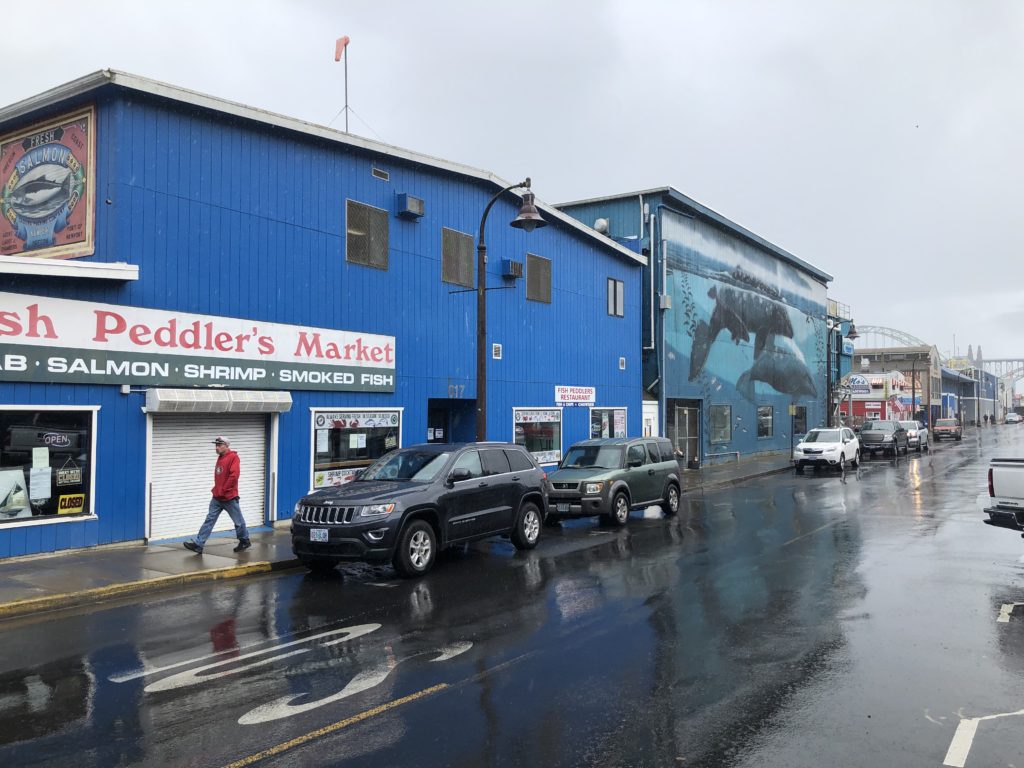
 Pacific Seafood’s processing plants dominate the west end of the Newport Bayfront but were not subject to $3.2 million in pollution fines announced last month. (Lincoln Chronicle file photo)
By ALEJANDRO FIGUEROA/Oregon Public Broadcasting
A bipartisan group of coastal Oregon lawmakers is asking state environmental regulators to pump the brakes on enforcing a set of civil fines against Pacific Seafood while the company appeals.
Last month, the state Department of Environmental Quality levied $3.2 million in combined civil penalties against Pacific Seafood processing facilities in Warrenton, Charleston and Brookings for allegedly discharging fish guts, chlorine, oil and grease into the water.
Pacific Seafood criticized DEQ’s permit requirements, calling them unreasonable and impossible with current technology. DEQ officials counter that other seafood processors have had no issues installing the necessary equipment to comply with regulations.
“The recently imposed wastewater treatment requirements by DEQ are significantly more stringent than those applied to seafood processors in any other state or country,” said Amy Wentworth, a spokeswoman for Pacific Seafood. “Regulations that are out of step with the broader industry landscape create real challenges for maintaining efficient and sustainable operations.”
Now, in a recent letter to DEQ, seven lawmakers with the Oregon Coastal Caucus are raising concerns over the agency’s “broader regulatory framework.” They said the environmental agency’s onerous rules for seafood processors could further hurt rural economies.
Two of the seven legislators signing the letter are Rep. David Gomberg, D-Otis, and Sen. Dick Anderson, R-Lincoln City.
The lawmakers are asking DEQ to put a pause on penalties and instead work with Pacific Seafood on a resolution with reasonable timelines.
“Our coastal communities, fishing families, and seafood workers depend on a regulatory system that supports, not undermines, their ability to thrive,” the lawmakers wrote in the letter. “The coast deserves a collaborative partner in DEQ, not a penalty collector.”
As part of the appeals process, DEQ has already scheduled a settlement meeting with Pacific Seafood in June. The company does not have to pay the penalties until an agreement is reached.
Clackamas-based Pacific Seafood employs more than 3,000 people and is one of the largest seafood processors in the country with more than 40 locations that harvest, process and distribute seafood — including plants along Yaquina Bay on the Newport bayfront.
Its dispute with DEQ revolves around permits required under the federal Clean Water Act. They are known as National Pollutant Discharge Elimination System permits. The permits start with a federal “floor” – the minimum conditions required to protect the environment and waterways – and state regulatory agencies can enforce or draft additional requirements.
Pacific Seafood and coastal lawmakers say DEQ has required seafood processors to discharge wastewater at much cleaner levels than the standards set for municipal drinking water.
But Harry Esteve, a spokesman for DEQ, disputed that comparison.
“Municipal drinking water has certain standards and discharge of industrial wastewater has certain standards,” Esteve said. “We disagree with that claim.”
Lawmakers also criticized DEQ’s actions at the Pacific Seafood Charleston facility near Coos Bay – which the agency says failed to install a wastewater treatment system by an April 2023 deadline.
In 2021, Pacific Seafood applied for a new wastewater permit at that Charleston site. But DEQ only started drafting conditions for that permit this March, even though it required the company to install a treatment system before those requirements were final, according to the lawmakers.
“Despite the absence of final permit conditions, the company has been encouraged to pursue significant capital investments in wastewater infrastructure, while being informed that future permit limits may not reflect achievable treatment capabilities and could ultimately render those investments obsolete,” the lawmakers wrote.
Back in April, Wentworth with Pacific Seafood told OPB the company had been working with the agency since 2017 to bring the Charleston site into compliance.
“DEQ’s regulatory pressures have already forced Pacific Seafood to shut down portions of its crab operations in Charleston to meet existing permits, resulting in the elimination of 35 jobs,” Wentworth wrote in an email. “Now DEQ is penalizing us with an outrageous fine and attempting to harm our reputation for not installing a treatment system for a permit they have not written.”
Esteve said Pacific Seafood had signed a memorandum of understanding with DEQ and agreed to install a water treatment system, but it failed to do so by the deadline that the company had agreed to.
“The large part of the penalty is the economic benefit that they received by not installing the appropriate technology and that creates a non-level playing field for other seafood processors who do invest in technology that allows them to meet their water quality permits,” Esteve said.
The lawmakers asked DEQ to pause public comments directed at Pacific Seafood until a constructive dialogue happens.
The lawmakers added they would like to convene a meeting with DEQ leadership, the governor’s office and Pacific Seafood executives to discuss “achievable, and science-based path forward with reasonable timelines.”
- This story originally appeared June 1, 2026 on Oregon Public Broadcasting.














Boo hoo, there’s a law and we don’t want to comply with it. Even though we agreed to. Years ago.
“The coast deserves a collaborative partner in DEQ, not a penalty collector.”
Ain’t no penalties to collect when rich company owners obey the law and do what they agreed to do. I hate the way they try to hold “jobs” hostage when it’s only their own pocketbooks they’re worried about. The whole reason they still have a fishery to exploit in the first place is precisely because the DEQ prevents all the other firms from spoiling it by discharging pollution. But Pacific Seafood is special apparently.
It’s astounding that Pacific Seafood, a family owned business, prospers off the exploitation of immigrant labor while simultaneously ignoring environmental regulations. And they get away with it, year after year, thanks to politicians and a commercial fishing industry that apparently puts profit before people. Here in Newport, migrant workers are housed in questionable hotels (that they pay for) and arrive so depleted, local non-profits have to step up to feed and clothe them because paychecks are slow in arriving. Remember in 2020, during Covid, Pacific Seafood posted the largest industrial outbreak in the state; 124 workers in Newport and 100 in Warrenton tested positive. And some died. But migrant workers don’t get health care (except worker’s comp which is required by law) so those folks were on their own. And again local non-profits stepped up to help. I look forward to the day a whistleblower exposes the greed and corruption and exploitation that define Pacific Seafood. I’ll wait.
I’m disappointed in the lawmakers representing the polluter in this case.
The “lower than drinking water line” is so disingenuous. They are referring to chlorine residuals. Every plant discharging into a bay has a zero chlorine residual. Drinking water has 1.0mg/l to prevent bacterial growth in the distribution system. Chlorine in the bay is toxic because it kills things that can’t move away from the plume like clams.
If they are referring to copper specifically, the NPDES limit is often driven by aquatic life criteria, not human health. Dissolved copper, zinc, and ammonia criteria for protection of fish and invertebrates are frequently far lower than human drinking water MCLs because aquatic organisms are far more sensitive than people. Copper is the classic example — the chronic aquatic life criterion can be in the single-digit µg/L range depending on hardness, while the drinking water action level is 1,300 µg/L. So yes, a metals limit can legitimately be “thousands of times” below the MCL, and that’s by design, not regulatory overreach.
If they don’t want to pay to build a plant to treat their wastewater than they should connect to the city system and pay the municipalities to expand their capacity.