

 Gulls jockey for position to try to snatch a Pacific herring from one lucky bird Monday near the south jetty of Yaquina Bay during the start of the annual spawn of Pacific herring, which could last into the week. (Photo by Roy W. Lowe)
By GARRET JAROS/YachatsNews
NEWPORT – Wildlife photographer and bird enthusiast Roy Lowe had been on the hunt for weeks, watching for telltale signs that would indicate the biggest feeding frenzy on the central Oregon coast was about to get underway.
He watched the waters of Yaquina Bay sporadically throughout February knowing that at any time millions of Pacific herring would make their annual stop to spawn along the jetties, creating a smorgasbord of fish and their billions of eggs for the birds, seals and sea lions who feast upon them relentlessly.
“And then in the last 10 days, a friend and I were coming daily because we knew,” Lowe said while standing on the south jetty Monday with fellow photographers and bird enthusiasts. “What we’ll see at the beginning is packs of sea lions chasing the fish. You can’t see the fish, but you see the sea lions diving as the herring go all the way up to the Oregon Oyster Farms way up the bay and then back out.”
Lowe of Waldport, a retired U.S. Fish & Wildlife regional manager, went on Oregon Birders Online to get out the word Friday.
 A California sea lion snacks on a spawning Pacific herring Monday in Yaquina Bay. (Photo by Roy W. Lowe)
“If you’re looking for a birding opportunity this weekend or next week you might want to consider including the Newport area,” he wrote. “For the past three days we have been observing the herring pre-spawning activity in Yaquina Bay where herds of sea lions chase herring around the bay with gulls, cormorants and other birds joining in to capture fish. Our best guess is that we will have a spawning event in the next three days but there are no guarantees.”
Lowe also noted that a significant herring spawn occurred Thursday at Otter Rock and that common murres came ashore on rocks at Yaquina Head for the first time in 2026 before flooding in on Friday.
He could not have been more accurate in his prediction.
“I was hoping the spawn would start now and go later but it started last night, although there was still some going on this morning when I arrived at 7 a.m.,” Lowe said Monday between snapping photos of sea lions munching herring and gulls playing tug-of-war over the fish.
An adult herring ranges in size from eight to 15 inches. Their average lifespan is seven to nine years during which time they spawn three to five times. They range the entire Pacific coastline from Baja to Alaska and across the north Pacific to Japan. A single female will lay about 20,000 eggs, of which only a couple will survive to adulthood.
 Dozens of sea lions prowl the Yaquina Bay south jetty Monday on the hunt for Pacific herring, whose spawn has turned the water light blue. Ducks will come next to pluck eggs from weeds and rocks. (Photo by Roy W. Lowe)
The waters along the length of Yaquina’s south jetty from the bridge past the main parking lot was a milky-blue in color from the milt in the water as groups of photographers and onlookers watched the melee of marauding wildlife throughout Monday morning.
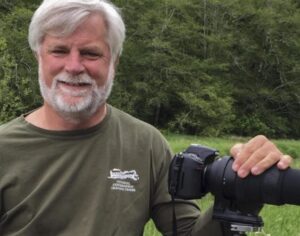 Lowe
“We think a lot of these birds are so stuffed with fish that when they catch one now it’s like ‘Do I really want to swallow this?’ ” Lowe said. “I think the spawn began during last night’s high tide.”
He added that he did manage to capture some video and photos of the schools of herring being herded by sea lions and the herring flipping onto the jetty’s rocks to escape.
“It’s pretty amazing to witness,” he said. “They had been chasing them for three days so we thought the spawn would happen soon. But what we didn’t know, they were actually spawning that day in a very small group.”
Flanking Lowe with cameras and binoculars were birders from the valley who had seen his online post and decided to make a try during Monday’s clear weather.
“We came over from Eugene,” said Erin Ely and her husband Doug Bielefeldt. “Birding is always just a good reason to get outside and enjoy. And it’s interesting.”
“I did a pelagic trip out of Newport a month ago and went out 15 miles or so and I swore to myself I was going to become a better birder on the coast,” Bielefeldt said. “That’s why I’m here, because I can’t identify a lot of birds that are on the coast.”
Lowe takes the cue to point out all three types of Oregon cormorants – Double-crested, Brandt’s and Pelagic – sitting on rocks just offshore.
Lowe is not the only one who has been watching the water for signs of the spawn. Just down the shoreline Monday was Carla Schubiger and her aquarium science students from Oregon Coast Community College.
“I always know that it’s coming up around this time of year,” Schubiger said. “And we have a nutrition-reproduction course this term and I always tell the students maybe we’ll get to see the herring spawning. It’s amazing to actually see it in person. So when I come over the bridge I always look and I saw it this morning. I also saw sea lion rafts out on Nye Beach where we never see them and I saw they were fat and happy and full.”
 Pacific herring thrash about and even throw themselves on the rocks of Yaquina Bay’s south jetty to escape sea lions on the hunt Monday. (Photo by Roy W. Lowe)
She said spawning will likely begin soon along the north jetty as well, which can happen as early as 24 hours or in a few days.
“This is my favorite time of year,” she said and laughed. “This is so great. It’s applied teaching in the outdoor classroom. It’s a spectacle. Very cool. And if we come back at low tide before it gets dark, the little seaweeds that grow on the rocks will be covered with eggs. It made for amazing photos last year. It looks like rock sugar, everything is rock sugar, particularly when the sun is shining. I love this.”
Lowe said it is not too late for people who want to witness the action.
“What’s going to happen starting Tuesday or the next day is there’ll be huge numbers of surf scoters – as many as 800 – coming in here to feed on the eggs,” he said. “And it’s pretty dramatic because they synchronize when they dive so the whole flock disappears and then they kind of explode up and it’s really fun to see.
“And there will probably be another spawn in the bay,” he added. “I can’t predict when but yeah, there will be plenty of birds around for the next five or six days feasting on the eggs.”
- Garret Jaros covers the communities of Yachats, Waldport, south Lincoln County and natural resources issues for Lincoln Chronicle and can be reached at [email protected]
To see more Yaquina Bay herring photos from Roy W. Lowe, go here














If you’re going to fish for them, remember to throw the salmon smolt back. It’s illegal to keep salmon smolt, which resemble herring. There is plenty of online info about how to dry herring to preserve them.
A fishing guide from ODWF ~
“9 reasons to fish for herring (and anchovies) And for more than just bait”
https://myodfw.com/articles/9-reasons-fish-herring-and-anchovies