
 Marci Baker, Eddie Townsend, Joe Steere and Cristen Don are hoping to win Lincoln County commission Position 2 outright in the May 19 primary election.
By the Lincoln Chronicle
Four candidates are seeking to fill the last two years of the late Claire Hall’s position on the Lincoln County Board of Commissioners.
If no one wins a majority in the May 19 primary, then the top two advance to the November ballot. A candidate winning a majority in May would appear alone in the November general election but not take office until January – when or if a person temporarily appointed would step down. Commissioners Walter Chuck and Casey Miller are trying to decide who to appoint but may not agree on which of two finalists – Cristen Don and Marcie Baker who are also on the May primary ballot – to appoint.
Here are the four candidates and their answers to five questions from the Lincoln Chronicle.
 Baker
Marci Baker is a Lincoln City councilor and worked for nearly two decades in restaurants, lodging and retail. She now owns her own restaurant, Kindred by Zest. She holds a bachelor’s degree in anthropology from the University of Oregon. She has served on the Lincoln City’s budget committee and planning commission, Lincoln County’s homeless advisory board and its regional solid waste committee. In her campaign, Baker said she wants to continue to champion the efforts left by Claire Hall, especially with regard to homelessness. She believes in working with people regardless of their political affiliations and sees the commissioner seat as an extension of the work she is already doing.
 Don
Cristen Don of South Beach has 20 years of experience managing public programs, budgets and natural resource programs for various agencies including the Oregon Department of Fish & Wildlife’s marine reserves program and the National Oceanic and Atmospheric Administration. She has a bachelor’s degree in marine biology from University of California Santa Cruz and a master’s degree in marine affairs from University of Washington. She is on the Lincoln County budget committee and serves as a board member and treasurer for the nonprofit, Samaritan House Family Shelter. Don is campaigning on promoting stable leadership that fosters trust. and some of the issues she cares about are affordable housing, access to health services, childcare and fiscal responsibility.
 Steere
Joe Steere lives on a cattle ranch on the Siletz River. He was a logger, commercial fisherman, and spent 34 years as a forester. He has a bachelor’s degree in agriculture engineering from Oregon State University and was elected to the Lincoln County Soil and Water Conservation District. He has served in leadership roles with the Lincoln County Farm Bureau, Oregon Cattleman’s Association and Midcoast Watersheds Council. In his campaign he has been critical of the delegation of duties between commissioners, concerned about a hiring freeze’s impact on the district attorney’s office and champions improved infrastructure including roads and utilities in the rural parts of the county.
 Townsend
Eddie Townsend of Newport is a lifelong resident of Lincoln County where he has taught and coached and worked as a real estate agent. He has a master’s degree in education from Southern Oregon University. In his campaign, Townsend has been critical of the decision to keep Commissioner Casey Miller from returning to his courthouse office and believes the dysfunction has distracted commissioners from other county issues. Townsend experienced homelessness as a youth and believes in improving the county’s coordination to address homelessness. He does not have prior government experience.
 For the first time in its history, all three seats on the Lincoln County Board of Commissioners are up for election at the same time, including four candiates for Position 2. (Shayla Escudero/Lincoln Chronicle)
Question: What do you see as the Board of Commissioners’ greatest challenge and how would you address it?
Joe Steere: The current board is in disarray as to what their responsibilities are. The commissioner’s office has for decades slowly unofficially let their responsibilities get taken over by the county counsel and other department leaders. In 2016, with Lincoln County Ordinance 517, the commissioners officially delegated most of their responsibility to an administrator which was fine until he left, and no clear path/instruction remained as to who or how to continue the administrative functions.
My plan to resolve this issue is to amend Ordinance 517 to address what has happened over the last 1 1/2 years, to prevent a reoccurrence. Commissioners need not to be left floundering when there is no administrator. Each commissioner’s oversight of one-third of the county departments will result in elected commissioners with the ability to assume control of county departments when the administrator is absent for long periods of time.
Eddie Townsend: I think the biggest challenge right now is making sure the county is actually working effectively for the people it serves especially when it comes to housing, economic pressure, and how people experience county systems day to day. We have real issues but we also have a responsibility to make sure our processes aren’t making those issues harder.
My approach would be to focus on clarity, accountability, and consistency. That means making sure departments have clear expectations, timelines are understood, and people aren’t getting stuck in unnecessary delays. I also think it’s important to listen closely to what people are actually experiencing and then follow through with practical solutions. That’s where I tend to operate — identify what’s not working, bring people together, and move toward something better with a common language.
Cristen Don: The greatest challenge facing commissioners is restoring stability and trust in our county government. Stability is the foundation for everything else – reliable services, sound budgeting, strong partnerships, and a community that feels heard and supported. To rebuild that foundation, we need steady, competent leadership that supports county staff, strengthens internal communication, and ensures essential services are delivered consistently and responsibly. Stability also means being transparent about our challenges and clear about how decisions are made.
My approach begins with listening. I am interested in hosting a series of listening and learning sessions across the county for all three commissioners to hear directly from residents about how we can improve communication, strengthen public participation, and make our decision‑making processes more accessible and meaningful. I would do the same internally – developing a process to hear and learn from departments and staff to understand what’s working, what’s not, and how we can rebuild a culture of collaboration and respect.
This won’t happen overnight. It requires patience, consistency, and a commitment to rebuilding trust step by step. And it’s especially urgent now. Lincoln County faces significant budget pressures in the coming years, including major shifts in state and federal funding. Navigating these challenges will require a cohesive community and a county government that is steady, transparent in decision-making, and focused on long‑term solutions.
Marci Baker: The greatest challenge in any organization is to eliminate the largest barriers to progress. I feel the largest barrier to creating solutions to our many present challenges is clarity and agreement around the county’s workflow. I would approach this as a challenge with two distinct parts.
First is restoring organizational clarity and alignment around governance roles including current administrative structure and delegation of authority. Ordinance 517, specifically the administrative delegation it implemented, is past due for review by the board. Additionally, the prolonged vacancy in the county administrator position, without a dedicated interim person adds a complex workload to existing staff and potentially collapses roles that under normal circumstances are intentionally separate. Second is ensuring the public feels welcomed and encouraged to engage with their government, and understands when and how they are able to engage on the decisions that impact them.
I support an immediate evaluation by the board of the rules that govern the board of commissioners, its members, meetings, and agenda procedures, along with review of the public comment rules, process and procedures; a public presentation on the current status of the administrator hiring process, the barriers that have delayed it, and how responsibilities are presently being delegated; and a discussion around whether Ordinance 517 should be reviewed before or after bringing on someone new. My approach would be to collaborate with all parties so we can reach shared agreements regarding workflow and move forward with clarity, stability, and public confidence.
Question: What experience do you have navigating conflict and how do you think that will prepare you for this role?
Townsend: A lot of my background has involved working with people in high-pressure situations whether that’s in the classroom, coaching, or running a business. Conflict comes with all of those roles. What I’ve learned is that most conflict comes down to people not feeling heard or understood. So my first step is always to listen carefully, make sure everyone feels respected, and then work toward a solution that people can move forward with even if it’s not perfect.
I don’t avoid difficult conversations, but I also don’t escalate them. I try to stay steady, focus on the issue instead of the emotion, and keep things moving in a productive direction. I think that approach translates well to this role, where you’re dealing with different perspectives and need to find common ground.
Don: I’ve spent my entire career working in environments where conflict is inevitable and where steady, practical leadership is essential. For 12 years, I led Oregon’s Marine Reserves Program at the Oregon Department of Fish & Wildlife – a statewide program created by the Legislature and closely watched by coastal communities, the fishing industry, conservation groups, and state leaders. It was a role where people cared deeply, disagreed passionately, and expected transparency and fairness.
My job was to navigate those tensions with clarity and respect. I met regularly with coastal city councils, county advisory groups, port authorities, and community members – listening, building trust, and helping people with very different viewpoints find common ground. That experience taught me how to lead in politically sensitive spaces, how to communicate openly, and how to keep people at the table even when conversations are hard. Earlier in my career, I worked on the statewide planning process for Oregon’s marine reserves, supported the Oregon legislative session, and helped develop early policy around alternative ocean energy. These were complex, emerging issues with no easy answers. My role was to synthesize information, bring people together, and help decision‑makers move forward thoughtfully and responsibly.
Across all of these roles, the through‑line is the same — I’m a practical, solutions‑oriented leader who knows how to work in complex systems, manage conflict constructively, and build trusted relationships. I’ve spent two decades coordinating with law enforcement, state agencies, coastal communities, and elected officials – often in situations where the stakes were high and the viewpoints were diverse.
Baker: Conflict is an inevitable part of leadership, particularly in public service where competing priorities, strong opinions, and high stakes are constant. My experience in business ownership, elected office, and community leadership has required me to navigate conflict regularly in many different contexts, oftentimes mediating tensions between others to proactively prevent conflict.
In my business I implemented proactive policies to build a culture with shared expectations that when conflict arises we address it directly, knowing it is an opportunity to strengthen our relationships and reach our shared goals. The best outcomes come when people feel heard and have space to cultivate shared understanding. When agreement is impossible and a parting of ways is the only option, it is okay. I do not see value in laying blame, holding grudges, or reliving past grievances. I view conflict as an opportunity for shared learning, and approach it with curiosity, not judgement. When handled well, disagreement can reveal gaps in communication, process, or understanding that ultimately make organizations stronger. Some of the most productive growth happens when difficult conversations are approached with honesty and professionalism.
Effective governance requires the ability to work through disagreement, maintain productive relationships, and make decisions in the public’s best interest even when consensus is difficult. I bring the emotional discipline, procedural mindset, and collaborative temperament needed to do that well.
Steere: I have many years of managing conflict from my managerial position with a timber company to working with fishing boat crews as skipper. I negotiated contracts, including multimillion-dollar contracts, and worked out conflicts until all parties were satisfied. And, as a side job, I owned and operated a small farm in the lower Siletz River valley.
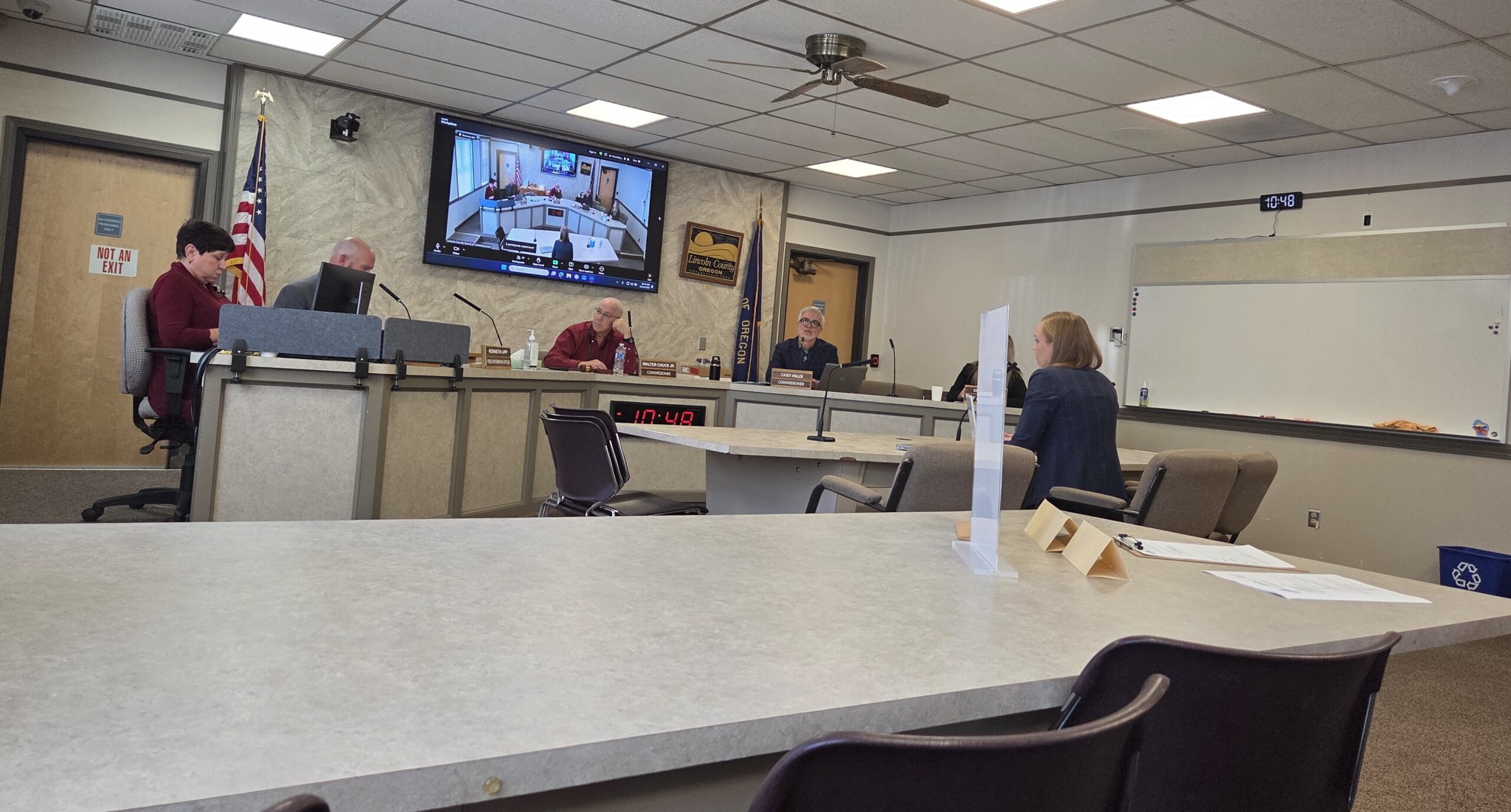 Lincoln County District Attorney Jenna Wallace has used the public comment period at commission meetings to argue for filling open positions in her department due to a hiring freeze. (Shayla Escudero/Lincoln Chronicle).
Question: In 2025-26 the county balanced a budget shortfall with a hiring freeze. What is your view of the county’s budget and hiring process and how involved should commissioners be with hiring freeze exceptions and budget priorities?
Don: During my 12 years leading ODFW’s marine reserves program I experienced multiple hiring freezes, furloughs, and significant one‑time budget cuts. I understand how these decisions affect staff morale, workloads, and the public services we’re able to deliver. Sometimes, in periods of real financial strain, a hiring freeze is the most responsible tool available. But it must be used carefully, transparently, and with a clear plan for how essential work will continue.
In general, I believe strongly in giving department heads and elected officials the autonomy they need to manage their teams and budgets. They are the subject‑matter experts, and they know what positions are essential to keeping their services functioning. At the same time, there must be clear expectations for fiscal responsibility, accountability, and communication, especially when resources are tight. As a commissioner, I would want to work closely with the finance department, the future county administrator, and department heads to evaluate whether our current budget allocation and hiring‑freeze exception processes are serving us well. I’m interested in exploring approaches that reduce the sense that departments are competing against each other for limited resources; provide more predictability, transparency, and flexibility; encourage departments to pursue new funding sources or revenue opportunities; ensure that essential services remain staffed and functional; and maintain strong fiscal oversight and accountability
Lincoln County is facing real financial challenges in the coming years. To navigate them, we need a budgeting and hiring process that is fair, transparent, and grounded in the realities of service delivery. My experience managing programs through difficult budget cycles has prepared me to help lead that work with steadiness and collaboration.
Baker: I presently have the same view as the rest of the general public on the county’s budget and hiring process and always withhold developing a personal opinion on a process until I am fully informed.
Commissioners should be responsible for setting the county’s strategic priorities, and the proposed budget prepared by administration should ultimately reflect those priorities. That budget then goes to the budget committee for approval and then to the board for adoption. Commissioners should not be involved in directing personnel matters individually or informally. Their role is to evaluate recommendations as a governing body, weigh policy and service trade-offs in public, and ensure decisions align with the county’s priorities and legal obligations. If hiring freezes or freeze exceptions are being considered the process should begin with consultation between administration and affected department leadership, including independently elected department heads where applicable. Those closest to the work are best positioned to identify operational impacts, potential reductions, and service-level tradeoffs. When proposed staffing changes materially affect public services, strategic priorities, or budget assumptions approved by the board, the administration should then evaluate that information, develop recommendations, and present those recommendations to the board for input or direction.
I support budgeting and staffing processes that are strategic, transparent, collaborative, and grounded in proper governance roles.
Steere: The commissioners, as representatives of the voters, need to be very involved with budget priorities, which can involve hiring freeze, layoffs, etc. One issue with budgets is that some departments are lightly funded from the general fund with most of the funding from grants, contracts, etc. Departments such as public works may have projects, or equipment purchases that can be put on hold relying on good leadership and crew to still get the job done.
Townsend: I understand why a hiring freeze would be used to manage a shortfall as it’s a way to create stability in the short term. At the same time, I think it’s important to be thoughtful about where flexibility is needed. Not all positions have the same impact, and some roles are critical to keeping services running effectively. I think commissioners should be involved at a strategic level such as setting priorities, understanding where the pressure points are, and making sure resources are aligned with the county’s most important responsibilities. But I also believe in trusting department leadership to provide good information and recommendations. The goal should be to balance fiscal responsibility with making sure the county can actually function well and serve people.
I think it’s very important that that role is filled. The board’s job is to set direction and policy, but you need strong day-to-day leadership to carry that out effectively. Without that, it puts more strain on both staff and commissioners, and it can slow things down. As a commissioner, I would want to support a clear, focused hiring process making sure expectations are well defined and that we’re bringing in someone who can lead, communicate well, and help align departments. It’s not just about filling the position it’s about finding the right person who can help the whole system work better.
 Lincoln County administrator Tim Johnson and Sheriff Adam Shanks brief commissioners in February 2025 on the construction of a new animal shelter in Waldport — just a few weeks before Johnson’s resignation. (Quinton Smith/Lincoln Chronicle)
Question: One of the main responsibilities of elected officials is to hire and oversee a chief executive officer, administrator, manager and/or superintendent to handle day-to-day operations. It’s been more than a year since the county had an administrator. How important do you think it is that that role be filled and what could you do as a commissioner to get it filled?
Baker: Filling the county administrator role is extremely important. Lincoln County’s size and complexity needs clear executive leadership to coordinate operations, implement board policy, manage department directors, and ensure continuity across the organization. Prolonged vacancies in that role create operational strain, blur lines of authority, and can lead to inconsistent administration. At the same time, hiring the wrong administrator can create even greater problems than waiting to hire the right one. The goal should be urgency with discipline — not rushing, but moving forward through a clear and accountable process.
As a commissioner, my first step would be to ensure the board and public have a shared understanding of the current status of the hiring process, the barriers that have delayed it, and whether the board remains aligned on the structure and expectations of the role itself. It is difficult to successfully hire for a position if there is not internal clarity about what is being hired for. From there, I would work to establish a defined process, timeline, and decision framework so the recruitment can move forward transparently and intentionally. Last year, in my role on Lincoln City’s city council, I participated in three different recruitment and hiring processes, twice for a pro-tem city manager and another for the permanent position. Through all these processes I gained practical understanding of how important structure, clarity, and alignment are when hiring leadership at this level.
The county needs stable administrative leadership, and I would treat filling that role as a top governance priority.
Steere: A good administrator, or administrative office, with the support of the commissioners will be a benefit to the operation of all county departments. The responsibility of the commissioners to oversee and assist where possible the administrative duties should be a priority for the commissioners. Support and backup are essential when needed, and the commissioners should not be fearful of ending an administrator’s contract if they do not perform.
If the commissioners are involved in oversight of county departments, they should be able to hear and evaluate any issues good or bad reported by the public or staff, and work with the administrator to implement what the constituent’s would benefit from. One issue when hiring is finding someone who can run the county as the commissioners, representing the constituents, would want it run when budgets are the driving force.
Townsend: I understand why the county has traditionally had an administrator, and I think that role can be valuable in certain systems. That said, I also believe there’s a strong case that the responsibility for leadership and coordination should ultimately sit with the commissioners themselves. That’s who the public elects, and that’s where accountability should be most direct.
For me, it comes down to making sure there is clear ownership of decisions and direction. Whether that’s through an administrator or through a more hands-on board, what matters most is that the county is operating efficiently and that people know who is responsible. I tend to lean toward a model where commissioners are actively engaged, accessible, and directly involved in making sure departments are aligned and moving in the right direction. The goal isn’t structure for the sake of structure, it’s making sure the system works well for the people of Lincoln County.
Don: I believe filling the administrator position is extremely important. This role provides continuity, coordination, and the 30,000‑foot perspective that keeps county government running smoothly. A strong administrator brings deep expertise in governance, budgeting, and long‑term planning, and ensures that day‑to‑day operations across departments are aligned, efficient, and well‑supported.
Without an administrator, responsibilities that should be centralized fall heavily on county counsel, human resources, and commissioners. Restoring this position would strengthen internal systems, improve communication, and help the county navigate the lean financial years ahead with more stability and foresight. A fully staffed administrative leadership team also allows commissioners to focus on the roles the public most needs from them — being out in the community, listening, sharing information, and strengthening trust; working with legislators, our representatives in the U.S. Congress, and agencies to secure stable, predictable funding for essential services; and bringing people together, locally and regionally, to tackle shared challenges such as childcare, wildfire preparedness, housing, and infrastructure.
Across my career, I’ve built partnerships, strengthened systems, and helped organizations function more effectively. I would bring that same approach to filling this role. As a commissioner, I would work closely with human resources to run a strong recruitment process. That includes reaching out to county administrators and city managers elsewhere in Oregon to understand where they look for job postings, what qualifications matter most, and what questions help identify candidates with the right leadership style and experience. Re-establishing the county administrator position is a critical step toward restoring stability and strengthening county government for the long term.
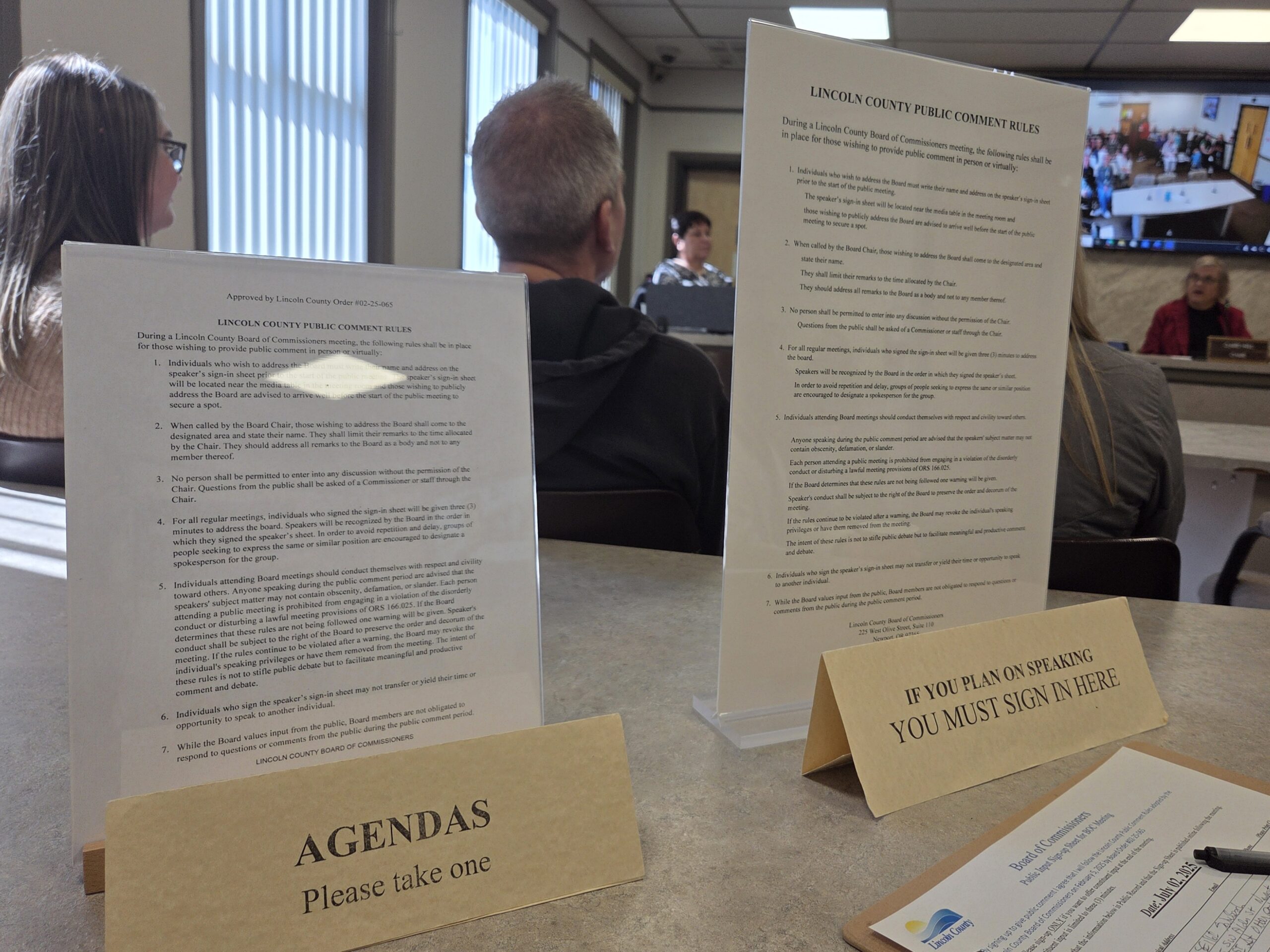 Before Lincoln County commission meetings were moved online this winter, public comment rules were displayed by the sign-up sheet. (Shayla Escudero/Lincoln Chronicle)
Question: How do you think the Board of Commissioners handles communicating and listening to constituents? What is your approach to handling instances of heated public comment or conflict?
Steere: I was comfortable with both current commissioners and thought that they were not afraid to hear any of the public. The commissioners giving in to (reportedly) staff’s request to close public comment and/or attendance at the meetings was a weak move. With the rules now imposed on elected officials, the bi-monthly commissioner’s meeting is about the only way a single individual or group can speak to all commissioners, staff, the public, and the press at the same time.
Heated public comment should be an expected part of the job. Conflict is usually solved when both parties work to resolve an issue with a philosophy of not hurting the other party when thinking of solutions. Having law enforcement present at the board’s public meetings is an option if staff are afraid.
Townsend: I think communication is one of the most important parts of this role, and it’s something that can always be improved. People want to feel like they’re being heard and that their concerns matter. My approach is to be accessible, to listen first, and to communicate clearly about what can and can’t be done. When it comes to heated public comment, I think it’s important to stay calm, respectful, and focused but allow people to communicate even through their frustrations and hurt. At the end of the day we are all human and we need to share in the human experience even if its messy at times. People are often speaking from frustration or concern, and it’s important not to take that personally. You can acknowledge where people are coming from while still keeping the conversation productive and grounded. At the end of the day, you don’t have to agree with everyone but you do have to treat people with respect and make sure they feel heard.
Don: County government works best when people feel heard, when processes are predictable, and when commissioners show up with steadiness and respect. I believe the board can strengthen its communication with the public by making our processes clearer, more consistent, and more accessible.
A key part of that is ensuring that public comment is offered at every board meeting, at a predictable time, with clear expectations for how the process works. When people know what to expect — how to sign up, how much time they’ll have, and what the ground rules are — it reduces tension and helps everyone participate more constructively. Consistent, fairly enforced rules also help maintain a respectful environment for both the public and county staff. I also believe in being transparent about the legal boundaries we operate within. Oregon’s public meeting laws and other legal constraints sometimes limit what commissioners can say or discuss. Even when we can’t share details, we can explain why — and that kind of clarity helps rebuild trust.
Stability also comes from meeting people where they are. I support holding some meetings or work sessions in communities across the county and creating more informal opportunities for dialogue, such as listening sessions. When commissioners show up in people’s own communities, it strengthens relationships and reduces conflict before it escalates.
When public comment becomes heated, my approach is calm, steady, and grounded in respect. I listen fully, acknowledge concerns, and maintain clear boundaries so meetings remain safe and productive. Conflict doesn’t intimidate me; I’ve spent my career navigating it with transparency, fairness, and a focus on solutions. My approach is straight forward: strengthen the systems, improve the processes, and create more opportunities for real dialogue. That’s how we rebuild trust and bring stability back to county government.
Baker: It is less important what I personally think about how the board is listening than what I have heard clearly from many constituents — a significant number of people do not feel heard, represented, or meaningfully included in the process. Whether leaders agree with that perception or not, public trust erodes when that sentiment becomes widespread.
At its foundation, democracy requires continued dialogue. We must keep listening, stay at the table through disagreement, and work toward solutions rather than disengagement. That also requires civility and structure. Public bodies must maintain clear, adopted rules for meetings and public participation and uphold those rules consistently. When civility breaks down, or when rules and procedures are applied inconsistently, confidence in the integrity of the process begins to erode.
My approach is to lead with professionalism, maintain high expectations for civility from everyone involved, and ensure public processes remain both orderly and meaningfully accessible. Strong democratic institutions depend on both public trust and procedural integrity, and preserving both must be a priority.
To see or read the Lincoln County voter’s pamphlet statements of the candidates, go here
To watch or see a Lincoln County League of Women Voters forum with the candidates, go here